Benjamin Goodluck, Pandharikar Gaurav, Frendo Pierre
Université Côte d'Azur, INRAE, CNRS, ISA, 06000 Nice, France.
Université de Lorraine, INRAE, UMR IAM, 54280 Champenoux, France.
Biology (Basel). 2022 Jun 3;11(6):861. doi: 10.3390/biology11060861.
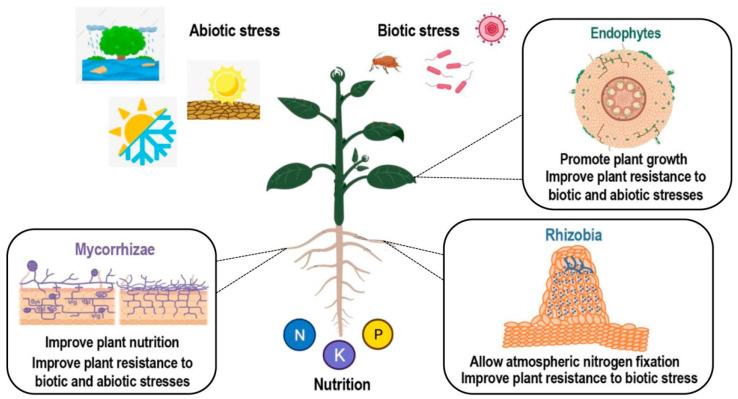
Plants form beneficial symbioses with a wide variety of microorganisms. Among these, endophytes, arbuscular mycorrhizal fungi (AMF), and nitrogen-fixing rhizobia are some of the most studied and well understood symbiotic interactions. These symbiotic microorganisms promote plant nutrition and growth. In exchange, they receive the carbon and metabolites necessary for their development and multiplication. In addition to their role in plant growth and development, these microorganisms enhance host plant tolerance to a wide range of environmental stress. Multiple studies have shown that these microorganisms modulate the phytohormone metabolism in the host plant. Among the phytohormones involved in the plant defense response against biotic environment, salicylic acid (SA) plays an important role in activating plant defense. However, in addition to being a major actor in plant defense signaling against pathogens, SA has also been shown to be involved in plant-microbe symbiotic interactions. In this review, we summarize the impact of SA on the symbiotic interactions. In addition, we give an overview of the impact of the endophytes, AMF, and rhizobacteria on SA-mediated defense response against pathogens.
植物与多种微生物形成有益的共生关系。其中,内生菌、丛枝菌根真菌(AMF)和固氮根瘤菌是一些研究最多且理解最透彻的共生相互作用。这些共生微生物促进植物营养和生长。作为交换,它们获得自身发育和繁殖所需的碳和代谢产物。除了在植物生长发育中的作用外,这些微生物还增强宿主植物对多种环境胁迫的耐受性。多项研究表明,这些微生物调节宿主植物中的植物激素代谢。在参与植物对生物环境防御反应的植物激素中,水杨酸(SA)在激活植物防御方面发挥着重要作用。然而,除了是植物针对病原体防御信号传导的主要参与者外,SA还被证明参与植物 - 微生物共生相互作用。在本综述中,我们总结了SA对共生相互作用的影响。此外,我们概述了内生菌、AMF和根际细菌对SA介导的针对病原体防御反应的影响。