Graduate School of Medicine, Dentistry and Pharmaceutical Sciences, Okayama University, Okayama 700-8530, Japan.
Collaborative Research Center of Okayama University for Infectious Diseases in India, Kolkata 700010, India.
Int J Environ Res Public Health. 2022 Jun 10;19(12):7141. doi: 10.3390/ijerph19127141.
Approximately 2.9 million people worldwide suffer from cholera each year, many of whom are destitute. However, understanding of immunity against cholera is still limited. Several studies have reported the duration of antibodies following cholera; however, systematic reviews including a quantitative synthesis are lacking.
To meta-analyze cohort studies that have evaluated vibriocidal, cholera toxin B subunit (CTB), and lipopolysaccharide (LPS) antibody levels following a clinical cholera case.
Design: Systematic review and meta-analysis. We searched PubMed and Web of science for studies assessing antibodies against in cohorts of patients with clinical cholera. Two authors independently extracted data and assessed the quality of included studies. Random effects models were used to pool antibody titers in adults and older children (aged ≥ 6 years). In sensitivity analysis, studies reporting data on young children (2-5 years) were included.
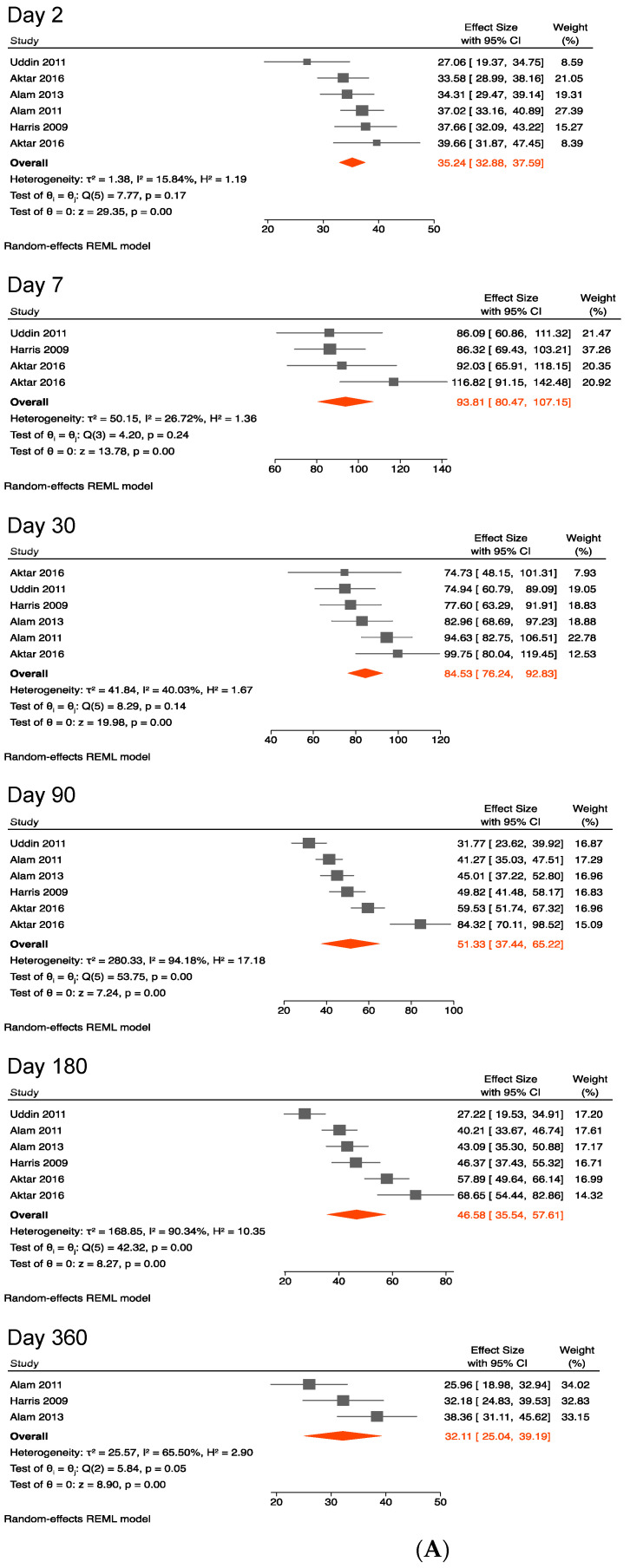
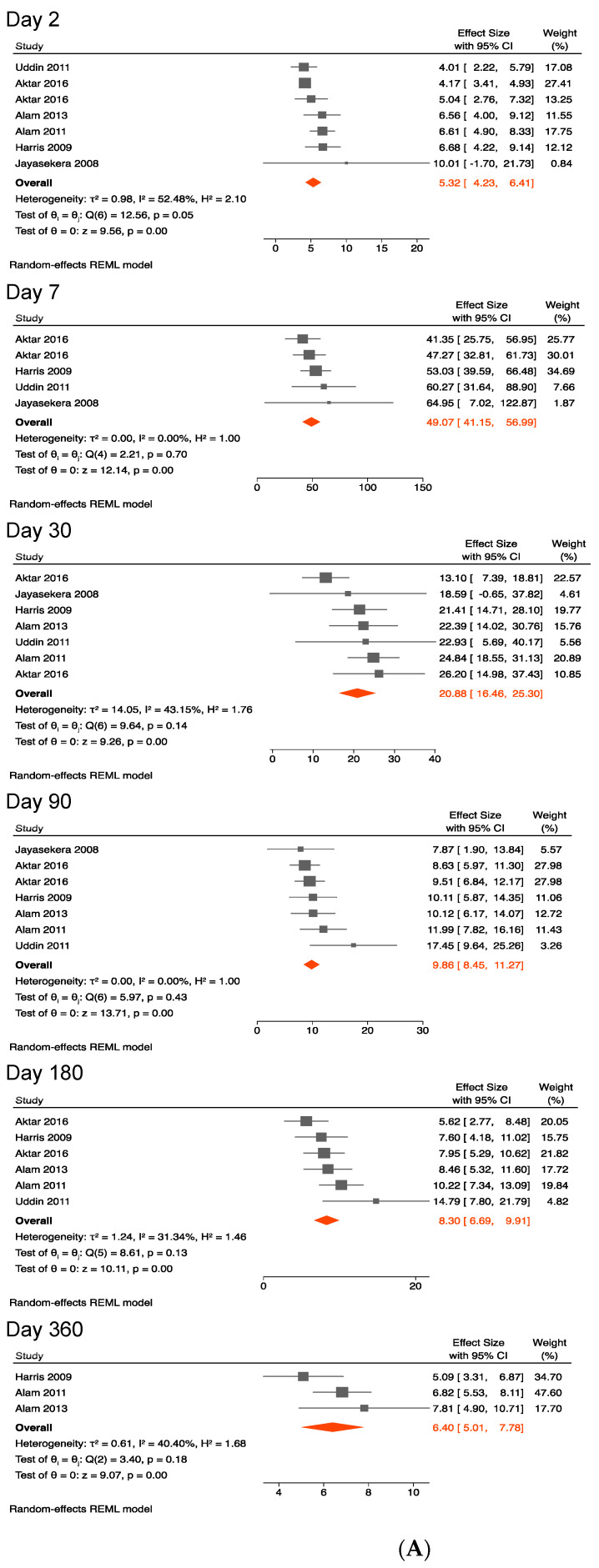
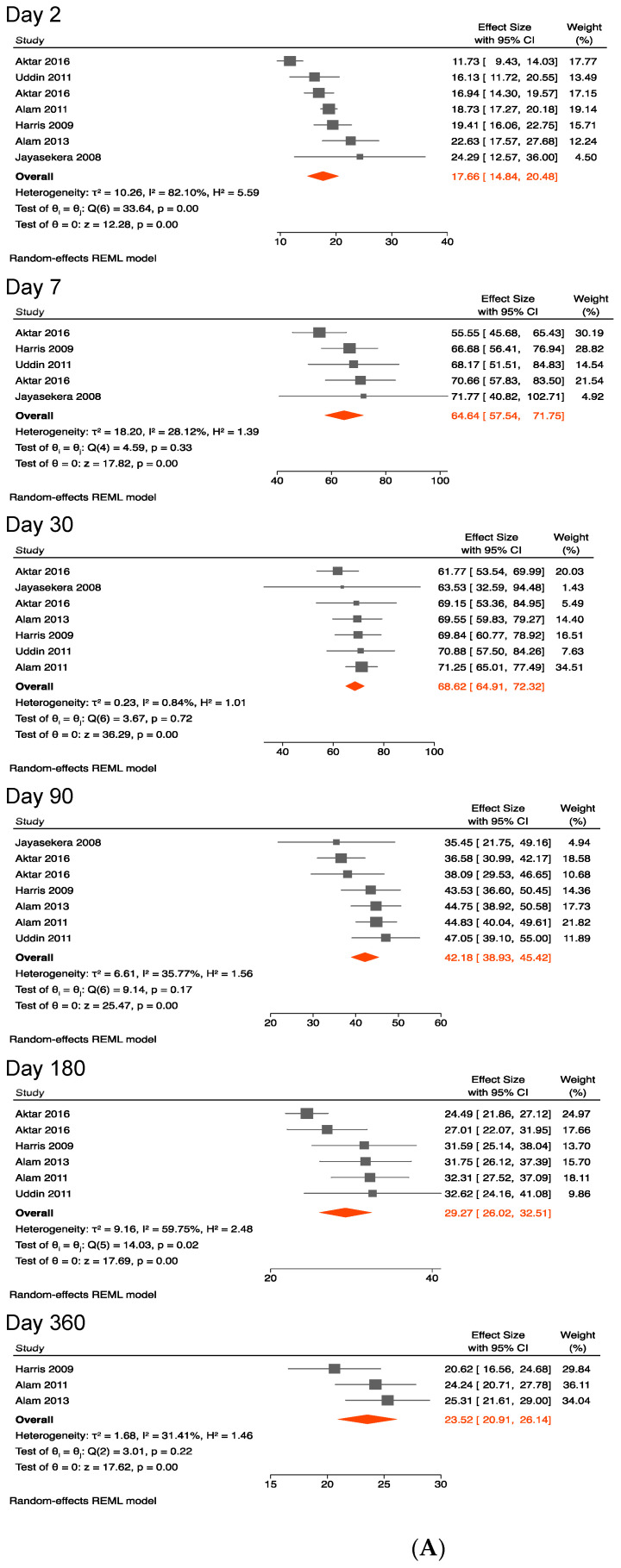
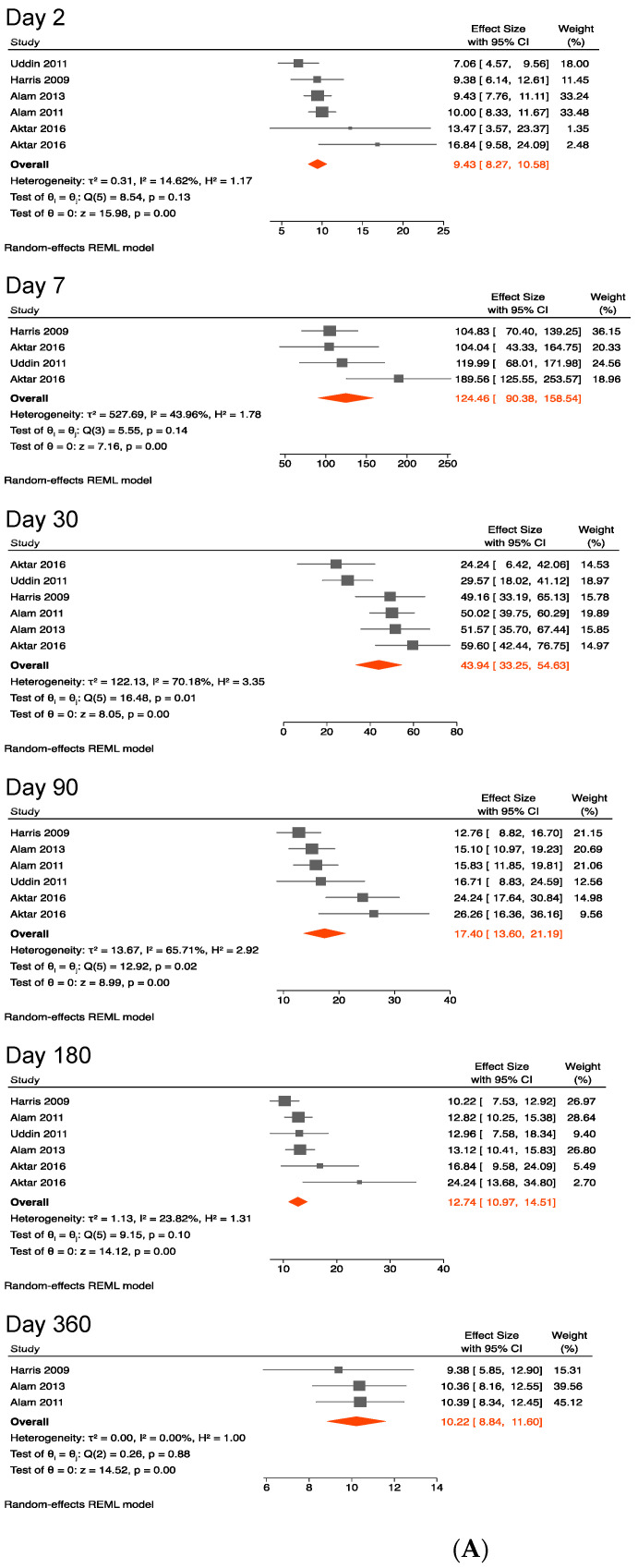
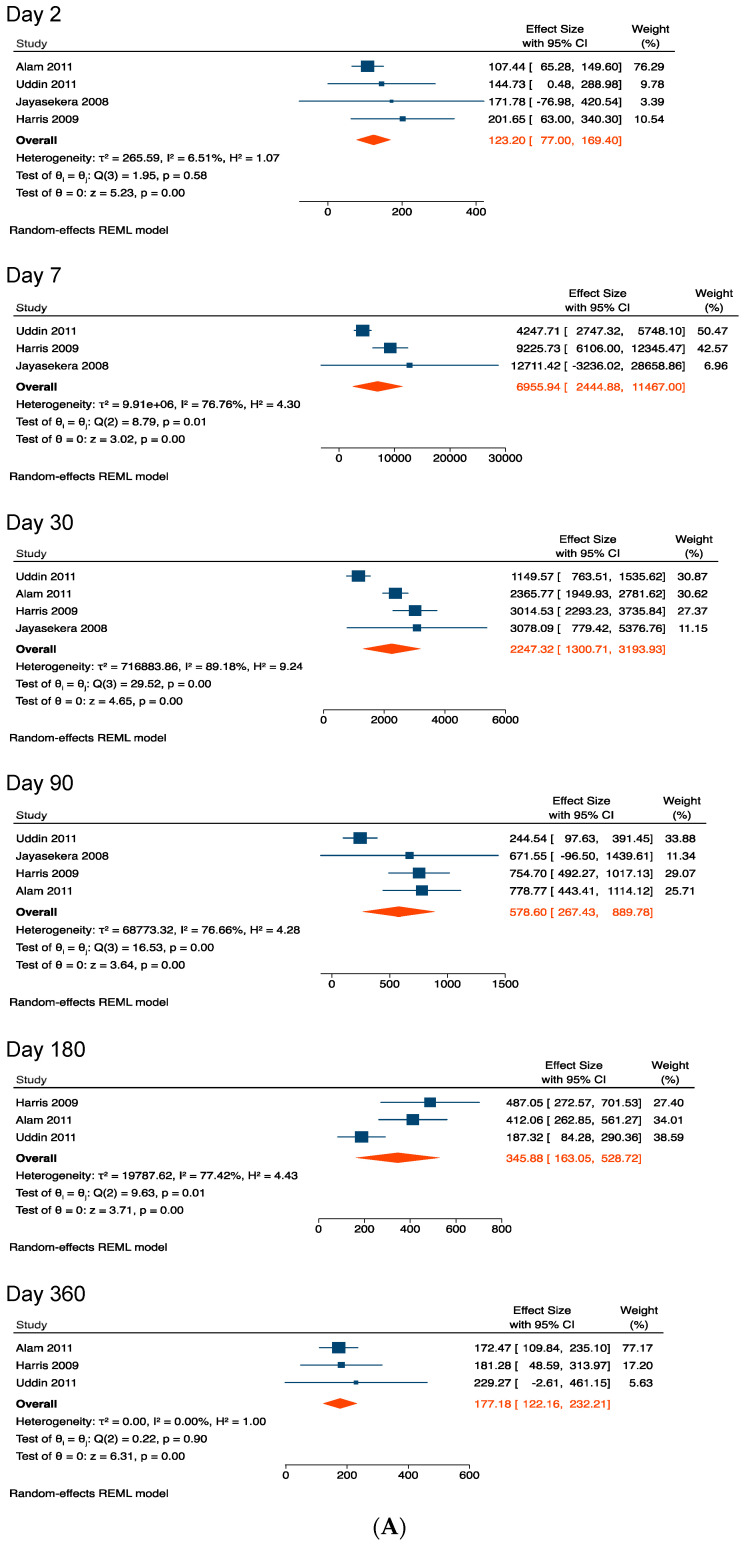
Nine studies met our inclusion criteria for systematic review and seven for meta-analysis. The pooled mean of vibriocidal antibody titers in adults and older children (aged ≥ 6 years) was 123 on day 2 post-symptom onset, which sharply increased on day 7 (pooled mean = 6956) and gradually waned to 2247 on day 30, 578 on day 90, and 177 on day 360. Anti-CTB IgA antibodies also peaked on day 7 (pooled mean = 49), followed by a rapid decrease on day 30 (pooled mean = 21), and further declined on day 90 (pooled mean = 10), after which it plateaued from day 180 (pooled mean = 8) to 360 (pooled mean = 6). Similarly, anti-CTB IgG antibodies peaked in early convalescence between days 7 (pooled mean = 65) and 30 (pooled mean = 69), then gradually waned on days 90 (pooled mean = 42) and 180 (pooled mean = 30) and returned to baseline on day 360 (pooled mean = 24). Anti-LPS IgA antibodies peaked on day 7 (pooled mean = 124), gradually declined on day 30 (pooled mean = 44), which persisted until day 360 (pooled mean = 10). Anti LPS IgG antibodies peaked on day 7 (pooled mean = 94). Thereafter, they decreased on day 30 (pooled mean = 85), and dropped further on days 90 (pooled mean = 51) and 180 (pooled mean = 47), and returned to baseline on day 360 (pooled mean = 32). Sensitivity analysis including data from young children (aged 2-5 years) showed very similar findings as in the primary analysis.
This study confirms that serological antibody (vibriocidal, CTB, and LPS) titers return to baseline levels within 1 year following clinical cholera, i.e., before the protective immunity against subsequent cholera wanes. However, this decay should not be interpreted as waning immunity because immunity conferred by cholera against subsequent disease lasts 3-10 years. Our study provides evidence for surveillance strategies and future research on vaccines and also demonstrates the need for further studies to improve our understanding of immunity against cholera.
每年全球约有 290 万人患霍乱,其中许多人赤贫。然而,人们对霍乱免疫力的理解仍然有限。有几项研究报告了霍乱后抗体的持续时间;但是,缺乏系统的综述和定量综合。
分析评估临床霍乱病例后,弧菌杀菌、霍乱毒素 B 亚单位(CTB)和脂多糖(LPS)抗体水平的队列研究。
设计:系统评价和荟萃分析。我们在 PubMed 和 Web of Science 中搜索了评估临床霍乱患者中针对弧菌的抗体的队列研究。两位作者独立提取数据并评估了纳入研究的质量。随机效应模型用于汇总成人和大龄儿童(年龄≥6 岁)的抗体滴度。在敏感性分析中,纳入了报告 2-5 岁幼儿数据的研究。
9 项研究符合系统评价的纳入标准,7 项研究符合荟萃分析的纳入标准。成人和大龄儿童(年龄≥6 岁)弧菌杀菌抗体滴度的汇总平均值在症状出现后第 2 天为 123,第 7 天急剧增加(汇总平均值为 6956),第 30 天逐渐降至 2247,第 90 天降至 578,第 180 天降至 177,第 360 天降至 177。抗 CTB IgA 抗体也在第 7 天达到峰值(汇总平均值为 49),第 30 天迅速下降(汇总平均值为 21),第 90 天进一步下降(汇总平均值为 10),之后从第 180 天(汇总平均值为 8)到第 360 天(汇总平均值为 6)保持稳定。同样,抗 CTB IgG 抗体在第 7 天(汇总平均值为 65)和第 30 天(汇总平均值为 69)之间的早期恢复期达到峰值,然后在第 90 天(汇总平均值为 42)和第 180 天(汇总平均值为 30)逐渐下降,并在第 360 天恢复到基线(汇总平均值为 24)。抗 LPS IgA 抗体在第 7 天达到峰值(汇总平均值为 124),第 30 天逐渐下降(汇总平均值为 44),一直持续到第 360 天(汇总平均值为 10)。抗 LPS IgG 抗体在第 7 天达到峰值(汇总平均值为 94)。此后,它们在第 30 天下降(汇总平均值为 85),在第 90 天和第 180 天进一步下降(汇总平均值为 51 和 47),并在第 360 天恢复到基线(汇总平均值为 32)。敏感性分析包括 2-5 岁幼儿的数据,结果与主要分析非常相似。
本研究证实,临床霍乱后血清抗体(弧菌杀菌、CTB 和 LPS)滴度在 1 年内恢复到基线水平,即保护性免疫对随后的霍乱减弱之前。然而,这种衰减不应被解释为免疫减弱,因为霍乱提供的对随后疾病的免疫力持续 3-10 年。我们的研究为监测策略和霍乱疫苗的未来研究提供了证据,也表明需要进一步研究以提高我们对霍乱免疫力的理解。