Department of Epidemiology, New York University School of Global Public Health, New York, NY 10003, USA.
Department of Health, Behavior and Society, Johns Hopkins Bloomberg School of Public Health, Baltimore, MD 21205, USA.
Int J Environ Res Public Health. 2022 Jun 17;19(12):7452. doi: 10.3390/ijerph19127452.
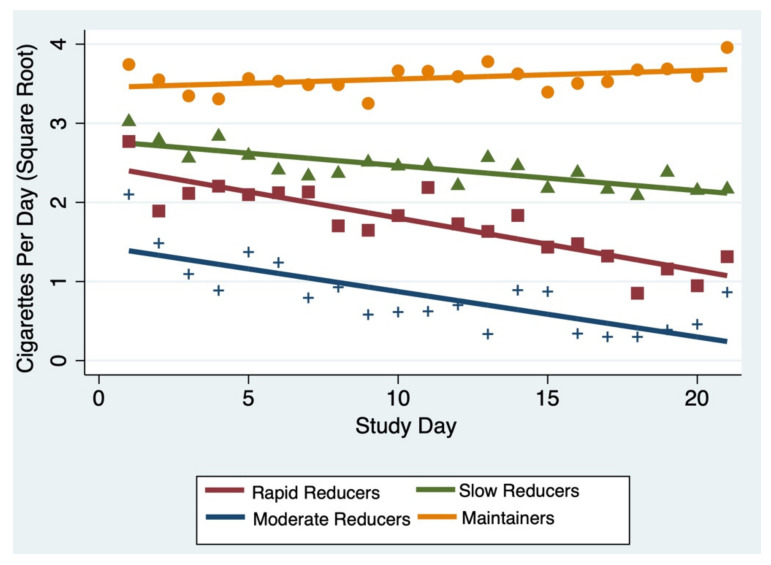
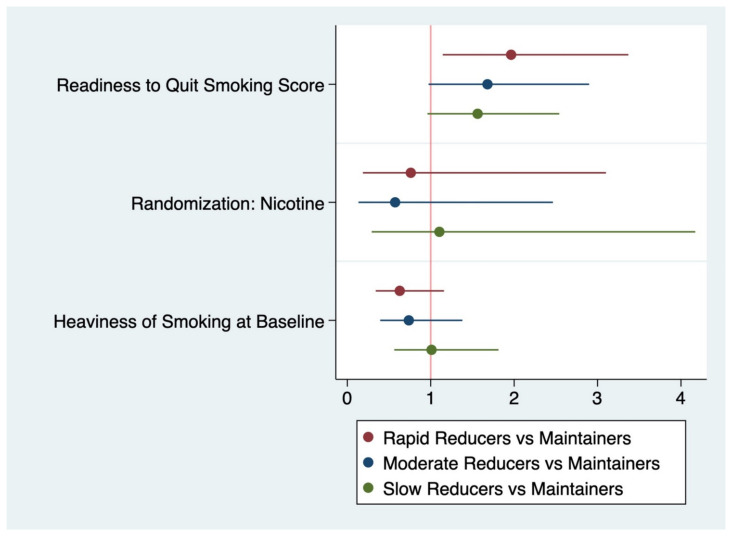
Electronic cigarettes (ECs) may hold great potential for helping smokers transition off combustible cigarettes (CCs); however, little is known about the patterns that smokers follow when using an EC as a CC-substitute in order to ultimately reduce and quit smoking. Our primary aim in this study was to evaluate whether common patterns of CC use exist amongst individuals asked to substitute an EC for at least half of the CCs they would normally smoke. These patterns may elucidate the immediate switching and reduction behaviors of individuals using ECs as a reduction/cessation tool. This analysis uses data from a randomized controlled trial of 84 adult smokers assigned to receive either 4.5% nicotine or placebo (0% nicotine) EC. Participants were advised to use the EC to help them reach a 50% reduction in cigarettes-per-day (CPD) within 3 weeks. Longitudinal trajectory analysis was used to identify CPD reduction classes amongst the sample; participants clustered into four distinct, linear trajectories based on daily CC use during the 3-week intervention. Higher readiness to quit smoking, prior successful quit attempts, and lower baseline CC consumption were associated with assignment into "more successful" CC reduction classes. ECs may be a useful mechanism to promote CC reduction. This study demonstrates that a fine-grained trajectory approach can be applied to examine switching patterns in the critical first weeks of an attempt.
电子烟(ECs)在帮助吸烟者从可燃香烟(CCs)过渡方面可能具有巨大潜力;然而,对于吸烟者在将 EC 用作 CC 替代品以最终减少和戒烟时遵循的模式知之甚少。我们在这项研究中的主要目的是评估在被要求用 EC 替代至少一半通常吸烟的 CC 的人群中,是否存在 CC 使用的常见模式。这些模式可能阐明了将 EC 用作减少/戒烟工具的个体的即时切换和减少行为。本分析使用了一项随机对照试验的数据,该试验招募了 84 名成年吸烟者,他们被分配接受 4.5%尼古丁或安慰剂(0%尼古丁)EC。参与者被建议使用 EC 帮助他们在 3 周内将香烟日消耗量(CPD)减少 50%。纵向轨迹分析用于确定样本中的 CPD 减少类别;参与者根据 3 周干预期间的每日 CC 使用情况聚类为四个不同的线性轨迹。更高的戒烟准备程度、以前成功的戒烟尝试以及更低的基线 CC 消费与被分配到“更成功”的 CC 减少类别相关。ECs 可能是促进 CC 减少的有用机制。本研究表明,精细轨迹方法可用于检查尝试戒烟的最初几周内的切换模式。