Dipartimento di Oncologia Medica, Centro di Riferimento Oncologico di Aviano (CRO) IRCCS, 33081 Aviano, Italy.
Department of Medicine (DAME), University of Udine, 33100 Udine, Italy.
Int J Mol Sci. 2022 Jun 9;23(12):6477. doi: 10.3390/ijms23126477.
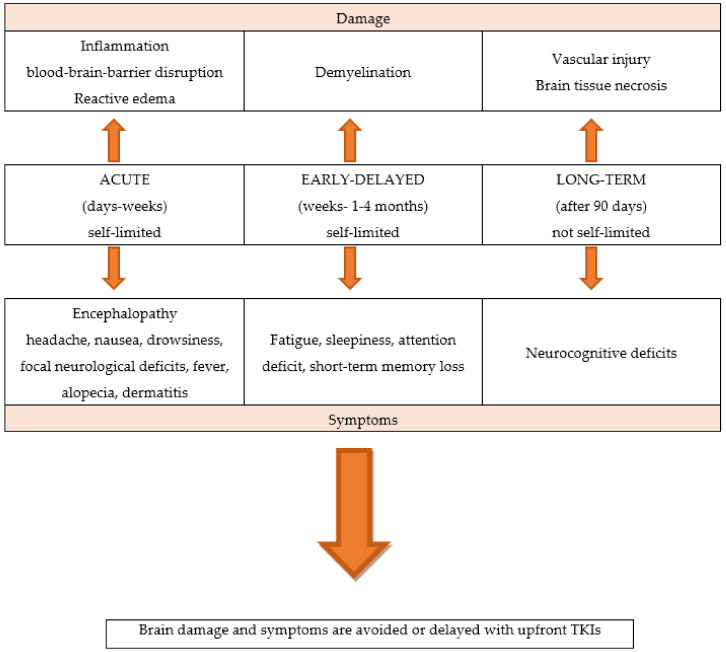
The therapeutic landscape in patients with advanced non-small-cell lung cancer harboring oncogenic biomarkers has radically changed with the development of targeted therapies. Although lung cancers are known to frequently metastasize to the brain, oncogene-driven non-small-cell lung cancer patients show a higher incidence of both brain metastases at baseline and a further risk of central nervous system progression/relapse. Recently, a new generation of targeted agents, highly active in the central nervous system, has improved the control of intracranial disease. The intracranial activity of these drugs poses a crucial issue in determining the optimal management sequence in oncogene-addicted non-small-cell lung cancer patients with brain metastases, with a potential change of paradigm from primary brain irradiation to central nervous system penetrating targeted inhibitors.
随着靶向治疗的发展,携带致癌生物标志物的晚期非小细胞肺癌患者的治疗选择发生了巨大变化。尽管肺癌经常转移到大脑,但驱动癌基因的非小细胞肺癌患者在基线时既有更高的脑转移发生率,也有进一步发生中枢神经系统进展/复发的风险。最近,新一代在中枢神经系统中高度活跃的靶向药物改善了颅内疾病的控制。这些药物的颅内活性在确定伴有脑转移的致癌基因依赖性非小细胞肺癌患者的最佳管理顺序方面是一个关键问题,这可能会使治疗模式从脑照射转变为中枢神经系统穿透性靶向抑制剂。