Department of Pathology, School of Basic Medical Sciences, Peking University Health Science Center, 38 Xueyuan Road, Haidian District, Beijing 100191, China.
Int J Mol Sci. 2022 Jun 12;23(12):6573. doi: 10.3390/ijms23126573.
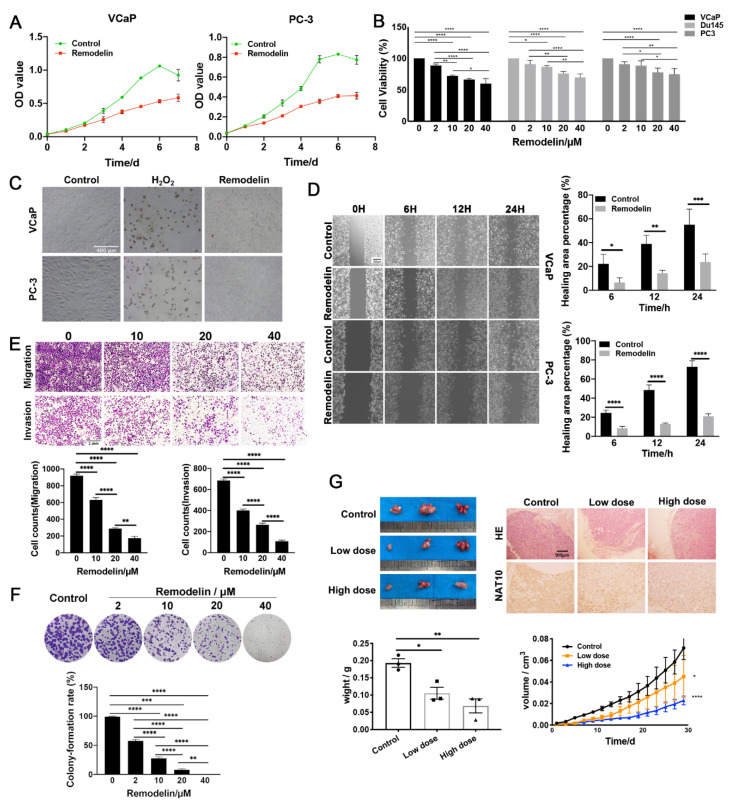
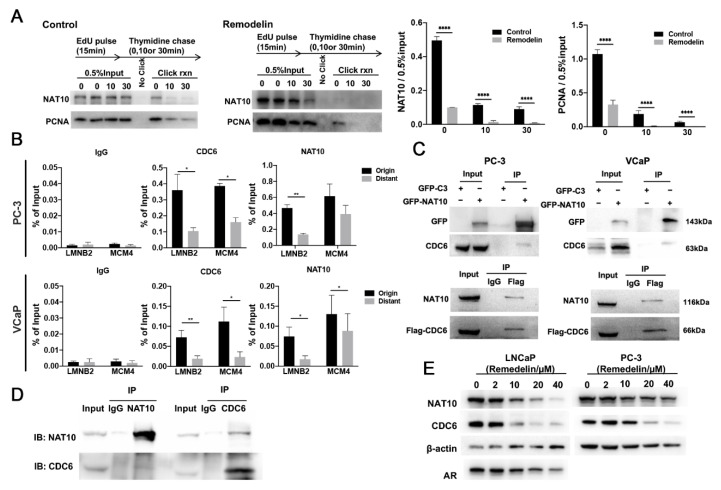
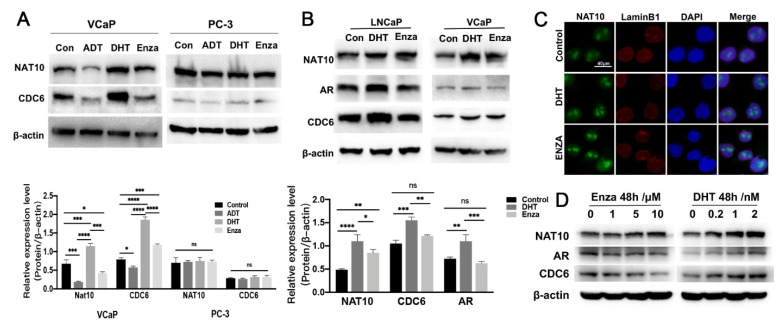
Cancer suppression through the inhibition of -acetyltransferase 10 (NAT10) by its specific inhibitor Remodelin has been demonstrated in a variety of human cancers. Here, we report the inhibitory effects of Remodelin on prostate cancer (PCa) cells and the possible associated mechanisms. The prostate cancer cell lines VCaP, LNCaP, PC3, and DU145 were used. The in vitro proliferation, migration, and invasion of cells were measured by a cell proliferation assay, colony formation, wound healing, and Transwell assays, respectively. In vivo tumor growth was analyzed by transplantation into nude mice. The inhibition of NAT10 by Remodelin not only suppressed growth, migration, and invasion in vitro, but also the in vivo cancer growth of prostate cancer cells. The involvement of NAT10 in DNA replication was assessed by EdU labeling, DNA spreading, iPOND, and ChIP-PCR assays. The inhibition of NAT10 by Remodelin slowed DNA replication. NAT10 was detected in the prereplication complex, and it could also bind to DNA replication origins. Furthermore, the interaction between NAT10 and CDC6 was analyzed by Co-IP. The altered expression of NAT10 was measured by immunofluorescence staining and Western blotting. Remodelin markedly reduced the levels of CDC6 and AR. The expression of NAT10 could be altered under either castration or noncastration conditions, and Remodelin still suppressed the growth of in vitro-induced castration-resistant prostate cancers. The analysis of a TCGA database revealed that the overexpression of NAT10, CDC6, and MCM7 in prostate cancers were correlated with the Gleason score and node metastasis. Our data demonstrated that Remodelin, an inhibitor of NAT10, effectively inhibits the growth of prostate cancer cells under either no castration or castration conditions, likely by impairing DNA replication.
通过其特异性抑制剂重塑素抑制乙酰转移酶 10(NAT10)已在多种人类癌症中得到证实。在这里,我们报告了重塑素对前列腺癌(PCa)细胞的抑制作用及其可能的相关机制。使用了前列腺癌细胞系 VCaP、LNCaP、PC3 和 DU145。通过细胞增殖测定、集落形成、划痕愈合和 Transwell 测定分别测量细胞的体外增殖、迁移和侵袭。通过移植到裸鼠中来分析体内肿瘤生长。重塑素对 NAT10 的抑制不仅抑制了前列腺癌细胞的体外生长、迁移和侵袭,还抑制了体内癌症生长。通过 EdU 标记、DNA 展开、iPOND 和 ChIP-PCR 测定评估 NAT10 在 DNA 复制中的作用。重塑素对 NAT10 的抑制减缓了 DNA 复制。NAT10 被检测到在复制前复合物中,它还可以与 DNA 复制起始点结合。此外,通过 Co-IP 分析了 NAT10 与 CDC6 之间的相互作用。通过免疫荧光染色和 Western blot 测定了 NAT10 的改变表达。重塑素显著降低了 CDC6 和 AR 的水平。在去势或非去势条件下都可以改变 NAT10 的表达,并且重塑素仍然抑制体外诱导的去势抵抗性前列腺癌的生长。对 TCGA 数据库的分析表明,前列腺癌中 NAT10、CDC6 和 MCM7 的过表达与 Gleason 评分和淋巴结转移有关。我们的数据表明,NAT10 的抑制剂重塑素在去势或非去势条件下都能有效地抑制前列腺癌细胞的生长,可能是通过损害 DNA 复制来实现的。