Cuesta-Gómez Alicia, Martín-Díaz Paloma, Sánchez-Herrera Baeza Patricia, Martínez-Medina Alicia, Ortiz-Comino Carmen, Cano-de-la-Cuerda Roberto
Department of Physical Therapy, Occupational Therapy, Physical Medicine and Rehabilitation, Faculty of Health Sciences, Rey Juan Carlos University, 28008 Madrid, Spain.
International PhD School, Rey Juan Carlos University, 28008 Madrid, Spain.
J Clin Med. 2022 Jun 7;11(12):3261. doi: 10.3390/jcm11123261.
The Nintendo Switch (NS) is the ninth video game console developed by Nintendo. Joy-Cons are the primary game controllers for the NS video game console, and they have an infrared motion camera sensor that allows capturing the patient's hands without the need to place sensors or devices on the body. The primary aim of the present study was to evaluate the effects of the NS, combined with a conventional intervention, for improving upper limb (UL) grip muscle strength, coordination, speed of movements, fine and gross dexterity, functionality, quality of life, and executive function in multiple sclerosis (MS) patients. Furthermore, we sought to assess satisfaction and compliance levels.
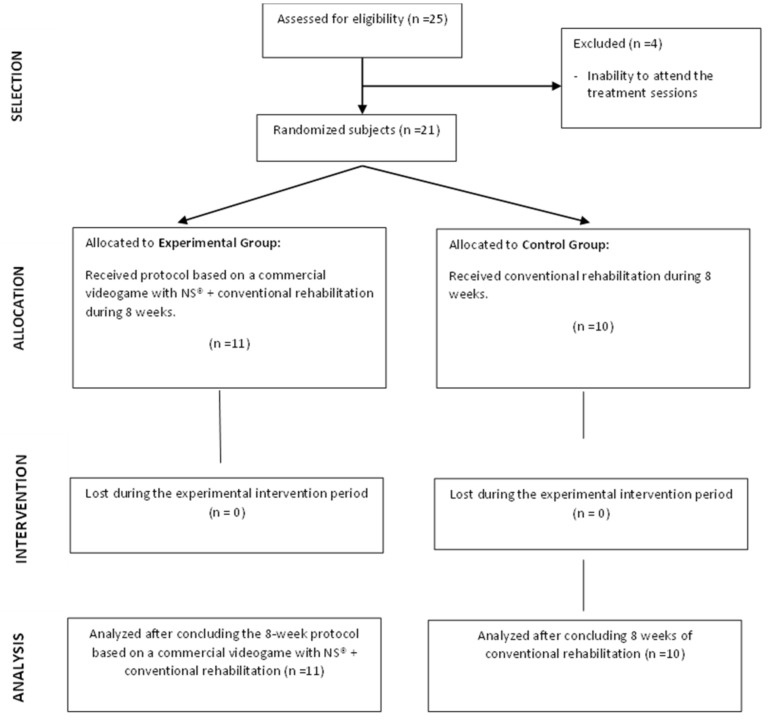
A single-blinded, randomized clinical trial was conducted. The sample was randomized into two groups: an experimental group who received treatment based on Dr Kawashima's Brain Training for the NS (20 min) plus conventional rehabilitation (40 min), and a control group who received the same conventional rehabilitation (60 min) for the ULs. Both groups received two 60 min sessions per week over an eight-week period. Grip strength, the Box and Blocks Test (BBT), the Nine Hole Peg Test (NHPT), the QuickDASH, the Multiple Sclerosis Impact Scale (MSIS-29), the Trail Making Test (TMT), and the Stroop Color and Word Test (SCWT) were used pre- and post-treatment. Side effects and attendance rates were also recorded.
Intragroup analysis showed significant improvements for the experimental group in the post-treatment assessments for grip strength in the more affected side ( = 0.033), the BBT for the more ( = 0.030) and the less affected side ( = 0.022), the TMT (A section) ( = 0.012), and the QuickDASH ( = 0.017). No differences were observed for the control group in intragroup analysis, but they were observed in the NHPT for the more affected side ( = 0.012). The intergroup analysis did not show differences between both groups.
Our results show that an eight-week experimental protocol, after using Dr Kawashima's Brain Training and the right-side Joy-Con controller for the NS, combined with a conventional intervention, showed improvements in grip strength, coordination, fine and gross motor function, executive functions, and upper limb functionality in the experimental group. However, no differences were observed when both groups were compared in the intergroup analysis. The addition of Brain Training for the NS for the upper limb rehabilitation did not show side effects and was rated with a high satisfaction and excellent compliance in people with MS.
This randomized controlled trial has been registered at ClinicalTrials Identifier: NCT04171908, November 2019.
任天堂Switch(NS)是任天堂开发的第九款视频游戏机。Joy-Con是NS视频游戏机的主要游戏控制器,它有一个红外运动摄像头传感器,无需在身体上放置传感器或设备就能捕捉患者的手部动作。本研究的主要目的是评估NS结合传统干预措施,对改善多发性硬化症(MS)患者上肢(UL)握力、协调性、运动速度、精细和粗大动作灵活性、功能、生活质量及执行功能的效果。此外,我们还试图评估满意度和依从性水平。
进行了一项单盲随机临床试验。样本被随机分为两组:实验组接受基于川岛博士大脑训练的NS游戏(20分钟)加传统康复治疗(40分钟),对照组接受相同的上肢传统康复治疗(60分钟)。两组在八周内每周接受两次60分钟的治疗。在治疗前后使用握力、箱块测试(BBT)、九孔插板测试(NHPT)、快速残疾评定量表(QuickDASH)、多发性硬化症影响量表(MSIS-29)、连线测验(TMT)和斯特鲁普颜色和文字测验(SCWT)进行评估。还记录了副作用和出勤率。
组内分析显示,实验组在治疗后评估中,患侧握力(P = 0.033)、患侧和非患侧的BBT(分别为P = 0.030和P = 0.022)、TMT(A部分)(P = 汗牛充栋 012)和QuickDASH(P = 0.017)有显著改善。对照组在组内分析中未观察到差异,但在患侧的NHPT中观察到差异(P = 0.012)。组间分析未显示两组之间存在差异。
我们的结果表明,在使用川岛博士大脑训练和NS的右侧Joy-Con控制器并结合传统干预措施进行为期八周的实验方案后,实验组在上肢握力、协调性、精细和粗大运动功能、执行功能及上肢功能方面有改善。然而,在组间分析中比较两组时未观察到差异。在MS患者中,将NS大脑训练添加到上肢康复中未显示出副作用,且满意度高、依从性好。
这项随机对照试验已在ClinicalTrials标识符:NCT04171908注册,注册时间为2019年11月。