Caruntu Ana, Moraru Liliana, Ciubotaru Diana Alina, Tanase Cristiana, Scheau Cristian, Caruntu Constantin
Department of Oral and Maxillofacial Surgery, "Carol Davila" Central Military Emergency Hospital, 010825 Bucharest, Romania.
Department of Oral and Maxillofacial Surgery, Faculty of Dental Medicine, "Titu Maiorescu" University, 031593 Bucharest, Romania.
J Clin Med. 2022 Jun 16;11(12):3459. doi: 10.3390/jcm11123459.
Oral squamous cell carcinoma (OSCC) is a common malignancy worldwide, leading to significant disease-associated social and financial burdens. The investigation of underlying mechanisms involved in carcinogenesis and tumor progression in OSCC might provide new therapeutic perspectives with an impact on disease control and patient survival. Our study aims to investigate the interrelation between metabolic processes, expressed through final catabolism products and clinicopathological characteristics in OSCC.
This is a single cancer comparative retrospective study investigating metabolic byproducts, namely serum urea, creatinine and uric acid, detected at the moment of diagnosis in patients with OSCC, in comparison to healthy controls. Clinical and paraclinical data regarding exposure to risk factors, disease staging and pathological characteristics were collected for all patients. Subjects with co-existing systemic or metabolic diseases, or with a history of malignancy, were excluded from the study. Subsequently, the metabolic byproducts revealing significant changes in OSCC patients were considered for a correlation analysis with the disease clinico-pathological characteristics.
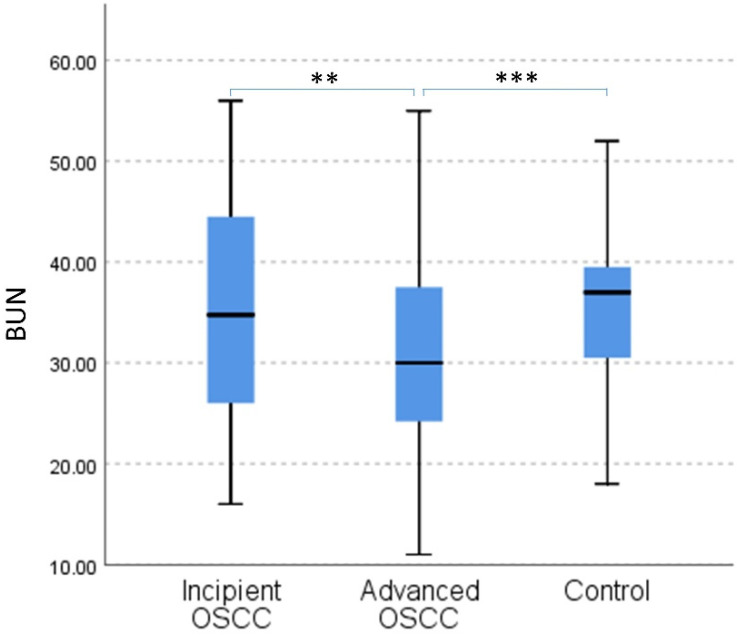
Blood levels for urea, creatinine and uric acid were determined in a total of 225 subjects: 145 patients diagnosed with OSCC and 80 healthy control subjects admitted to our hospital between 2016 and 2021. The comparative analysis between groups revealed that the serum urea level was significantly lower in OSCC patients ( = 0.0344). Serum creatinine and uric acid did not reveal significant differences between groups. Furthermore, in advanced stages of the disease (stages III and IV), the blood level of urea was significantly lower compared to incipient OSCC (stages I and II) ( = 0.003). We found a negative correlation of serum urea levels with smoking ( = 0.0004) and cervical lymph node metastasis ( = 0.0070), and a positive correlation with aging ( = 0.0000). We found no significant correlation of serum urea with primary tumor size ( = 0.5061) and patient survival ( = 0.2932).
Decreased serum urea levels are detected in patients with advanced OSCC, in correlation with lymph node metastasis. The invasive features of tumor cells in OSCC might be promoted in association with dysregulation of protein catabolism processes, facilitating aggressive behavior in OSCC.
口腔鳞状细胞癌(OSCC)是全球常见的恶性肿瘤,会导致严重的疾病相关社会和经济负担。对OSCC致癌和肿瘤进展相关潜在机制的研究可能会提供新的治疗视角,对疾病控制和患者生存产生影响。我们的研究旨在探讨通过最终分解代谢产物表达的代谢过程与OSCC临床病理特征之间的相互关系。
这是一项单癌种对照回顾性研究,调查OSCC患者诊断时检测到的代谢副产物,即血清尿素、肌酐和尿酸,并与健康对照进行比较。收集了所有患者关于危险因素暴露、疾病分期和病理特征的临床及辅助临床数据。患有并存的全身性或代谢性疾病或有恶性肿瘤病史的受试者被排除在研究之外。随后,考虑在OSCC患者中显示出显著变化的代谢副产物与疾病临床病理特征进行相关性分析。
共对225名受试者测定了尿素、肌酐和尿酸的血药浓度:145名被诊断为OSCC的患者和80名2016年至2021年间入住我院的健康对照受试者。组间比较分析显示,OSCC患者的血清尿素水平显著较低(P = 0.0344)。血清肌酐和尿酸在组间未显示出显著差异。此外,在疾病晚期(III期和IV期),尿素的血药浓度与早期OSCC(I期和II期)相比显著较低(P = 0.003)。我们发现血清尿素水平与吸烟(P = 0.0004)和颈部淋巴结转移(P = 0.0070)呈负相关,与衰老呈正相关(P = 0.0000)。我们发现血清尿素与原发肿瘤大小(P = 0.5061)和患者生存率(P = 0.2932)无显著相关性。
晚期OSCC患者血清尿素水平降低,与淋巴结转移相关。OSCC中肿瘤细胞的侵袭特征可能与蛋白质分解代谢过程失调有关,促进了OSCC的侵袭性行为。