Burrello Jacopo, Gallone Guglielmo, Burrello Alessio, Jahier Pagliari Daniele, Ploumen Eline H, Iannaccone Mario, De Luca Leonardo, Zocca Paolo, Patti Giuseppe, Cerrato Enrico, Wojakowski Wojciech, Venuti Giuseppe, De Filippo Ovidio, Mattesini Alessio, Ryan Nicola, Helft Gérard, Muscoli Saverio, Kan Jing, Sheiban Imad, Parma Radoslaw, Trabattoni Daniela, Giammaria Massimo, Truffa Alessandra, Piroli Francesco, Imori Yoichi, Cortese Bernardo, Omedè Pierluigi, Conrotto Federico, Chen Shao-Liang, Escaned Javier, Buiten Rosaly A, Von Birgelen Clemens, Mulatero Paolo, De Ferrari Gaetano Maria, Monticone Silvia, D'Ascenzo Fabrizio
Division of Internal Medicine and Hypertension, Department of Medical Sciences, University of Turin, 10126 Turin, Italy.
Division of Cardiology, Department of Medical Sciences, University of Turin, 10126 Turin, Italy.
J Pers Med. 2022 Jun 17;12(6):990. doi: 10.3390/jpm12060990.
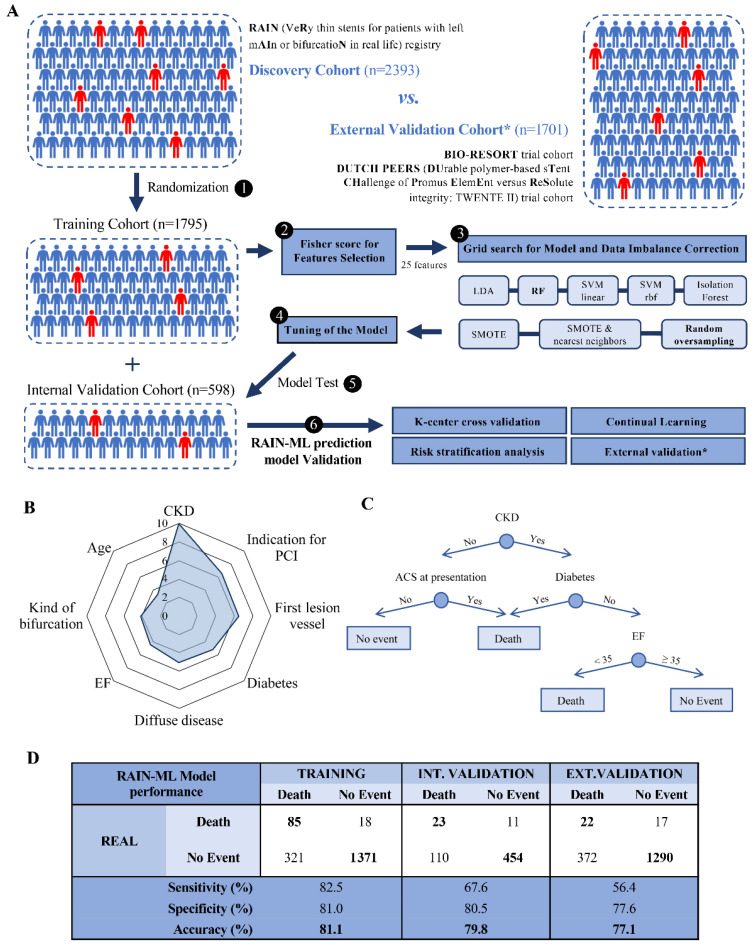
Stratifying prognosis following coronary bifurcation percutaneous coronary intervention (PCI) is an unmet clinical need that may be fulfilled through the adoption of machine learning (ML) algorithms to refine outcome predictions. We sought to develop an ML-based risk stratification model built on clinical, anatomical, and procedural features to predict all-cause mortality following contemporary bifurcation PCI. Multiple ML models to predict all-cause mortality were tested on a cohort of 2393 patients (training, n = 1795; internal validation, n = 598) undergoing bifurcation PCI with contemporary stents from the real-world RAIN registry. Twenty-five commonly available patient-/lesion-related features were selected to train ML models. The best model was validated in an external cohort of 1701 patients undergoing bifurcation PCI from the DUTCH PEERS and BIO-RESORT trial cohorts. At ROC curves, the AUC for the prediction of 2-year mortality was 0.79 (0.74-0.83) in the overall population, 0.74 (0.62-0.85) at internal validation and 0.71 (0.62-0.79) at external validation. Performance at risk ranking analysis, k-center cross-validation, and continual learning confirmed the generalizability of the models, also available as an online interface. The RAIN-ML prediction model represents the first tool combining clinical, anatomical, and procedural features to predict all-cause mortality among patients undergoing contemporary bifurcation PCI with reliable performance.
对冠状动脉分叉处经皮冠状动脉介入治疗(PCI)后的预后进行分层是一项尚未满足的临床需求,可通过采用机器学习(ML)算法来优化结局预测来实现。我们试图开发一种基于ML的风险分层模型,该模型基于临床、解剖和手术特征构建,以预测当代分叉PCI后的全因死亡率。在来自真实世界RAIN注册研究的2393例接受当代支架分叉PCI的患者队列(训练组,n = 1795;内部验证组,n = 598)中测试了多个预测全因死亡率的ML模型。选择了25个常见的患者/病变相关特征来训练ML模型。最佳模型在来自DUTCH PEERS和BIO-RESORT试验队列的1701例接受分叉PCI的患者外部队列中进行了验证。在ROC曲线分析中,总体人群中预测2年死亡率的AUC为0.79(0.74 - 0.83),内部验证时为0.74(0.62 - 0.85),外部验证时为0.71(0.62 - 0.79)。风险排序分析、k中心交叉验证和持续学习的性能证实了模型的可推广性,该模型也可作为在线界面使用。RAIN-ML预测模型是首个结合临床、解剖和手术特征来预测当代分叉PCI患者全因死亡率且性能可靠的工具。