Division of Gastroenterology, Fondazione IRCCS "Casa Sollievo della Sofferenza", 71013 San Giovanni Rotondo, Italy.
Bioinformatics Unit, Fondazione IRCCS "Casa Sollievo della Sofferenza", 71013 San Giovanni Rotondo, Italy.
Nutrients. 2022 Jun 14;14(12):2452. doi: 10.3390/nu14122452.
Celiac disease (CD) is an autoimmune disease with the destruction of small intestinal villi, which occurs in genetically predisposed individuals. At the present moment, a gluten-free diet (GFD) is the only way to restore the functionality of gut mucosa. However, there is an open debate on the effects of long-term supplementation through a GFD, because some authors report an unbalance in microbial taxa composition.
For microbiome analysis, fecal specimens were collected from 46 CD individuals in GFD for at least 2 years and 30 specimens from the healthy controls (HC). Data were analyzed using an ensemble of software packages: QIIME2, Coda-lasso, Clr-lasso, Selbal, PICRUSt2, ALDEx2, dissimilarity-overlap analysis, and dysbiosis detection tests.
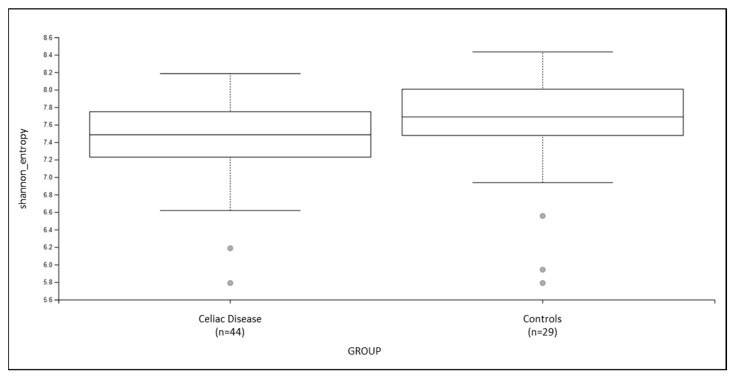
The adherence to GFD restored the alpha biodiversity of the gut microbiota in celiac people but microbial composition at beta diversity resulted as different to HC. The microbial composition of the CD subjects was decreased in a number of taxa, namely Bifidobacterium longum and several belonging to Lachnospiraceae family, whereas Bacteroides genus was found to be more abundant. Predicted metabolic pathways among the CD bacterial communities revealed an important role in tetrapyrrole biosynthesis.
CD patients in GFD had a non-dysbiotic microbial composition for the crude alpha diversity metrics. We found significant differences in beta diversity, in certain taxon, and pathways between subjects with inactive CD in GFD and controls. Collectively, our data may suggest the development of new GFD products by modulating the gut microbiota through diet, supplements of vitamins, and the addition of specific prebiotics.
本研究旨在分析和比较乳糜泻(CD)患者在接受无麸质饮食(GFD)治疗至少 2 年后的粪便微生物组,与健康对照组(HC)之间的差异。
收集 46 名 CD 患者和 30 名 HC 的粪便样本,使用 QIIME2、Coda-lasso、Clr-lasso、Selbal、PICRUSt2、ALDEx2、差异重叠分析和失调检测等软件包进行分析。
GFD 治疗恢复了 CD 患者肠道微生物群的 alpha 多样性,但 beta 多样性的微生物组成与 HC 不同。与 HC 相比,CD 患者的肠道微生物组成中某些双歧杆菌属和厚壁菌门的数量减少,而拟杆菌属的数量增加。预测 CD 患者的细菌群落的代谢途径表明,在四吡咯生物合成中具有重要作用。
对于粗 alpha 多样性指标,GFD 治疗的 CD 患者具有非失调的微生物组成。我们发现,在接受 GFD 治疗的无活动期 CD 患者与对照组之间,beta 多样性、某些分类群和途径存在显著差异。总的来说,我们的数据可能提示通过饮食、维生素补充剂和添加特定的益生元来调节肠道微生物群,从而开发新的 GFD 产品。