Department of Genetics, Physical Anthropology and Animal Physiology, University of the Basque Country (UPV/EHU) and Biocruces Bizkaia Health Research Institute, Leioa, Spain.
Spanish Biomedical Research Center in Diabetes and Associated Metabolic Disorders (CIBERDEM), Madrid, Spain.
Front Immunol. 2023 Jun 30;14:1082862. doi: 10.3389/fimmu.2023.1082862. eCollection 2023.
Celiac Disease (CeD) is an autoimmune disorder triggered by gluten intake in genetically susceptible individuals. Highest risk individuals are homozygous for the Human Leucocyte Antigen (HLA) DQ2.5 haplotype or DQ2.5/DQ2.2 heterozygous. Both the HLA-DQ2-positive high genetic risk individuals and those that have developed the disease have altered intestinal microbiota, but it remains unclear whether these alterations are a cause or a consequence of CeD.
To investigate a potential bidirectional causality between gut microbiota (GM) and CeD in HLA-DQ2 high genetic risk individuals.
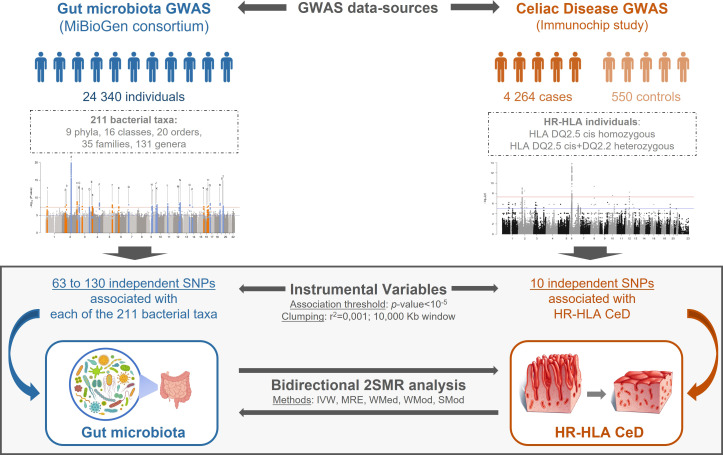
We performed a bidirectional Two-Sample Mendelian Randomization (2SMR) test using summary statistics from the largest publicly available Genome-Wide Association Study (GWAS) of GM and the summary statistics of the Immunochip CeD study of those individuals with the HLA-DQ2 high-risk haplotype. To test whether changes in GM composition were causally linked to CeD, GM data were used as exposure and CeD data as outcome; to test for reverse causation, the exposure and outcome datasets were inverted.
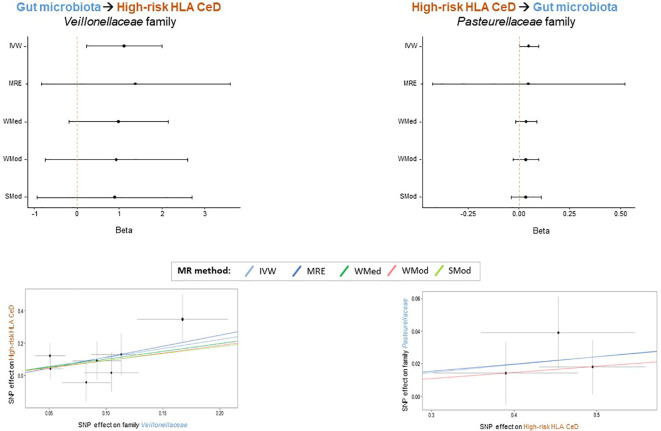
We identified several bacteria from and families of the Firmicutes phylum as potentially causal in both directions. In addition, our results suggest that changes in the abundance of family might be causal in the development of CeD, while alterations in family might be a consequence of the disease itself.
Our results suggest that the relationship between GM and HLA-DQ2 high risk individuals is highly complex and bidirectional.
乳糜泻(CeD)是一种由遗传易感个体摄入麸质引起的自身免疫性疾病。最高危个体为人类白细胞抗原(HLA)DQ2.5 单倍型纯合子或 DQ2.5/DQ2.2 杂合子。HLA-DQ2 阳性高遗传风险个体和已发病个体的肠道微生物群均发生改变,但这些改变是 CeD 的原因还是结果尚不清楚。
探讨 HLA-DQ2 高遗传风险个体的肠道微生物群(GM)与 CeD 之间的潜在双向因果关系。
我们使用来自最大的公开 GM 全基因组关联研究(GWAS)的汇总统计数据和 HLA-DQ2 高风险单倍型个体的免疫芯片 CeD 研究的汇总统计数据,进行了双向两样本 Mendelian 随机化(2SMR)检验。为了检验 GM 组成的变化是否与 CeD 存在因果关系,我们将 GM 数据作为暴露因素,CeD 数据作为结局因素;为了检验反向因果关系,我们将暴露组和结局组的数据进行了反转。
我们从厚壁菌门的和 科中鉴定出几种细菌,它们在两个方向上都可能具有因果关系。此外,我们的结果表明, 科的丰度变化可能是 CeD 发病的原因,而 科的改变可能是疾病本身的结果。
我们的结果表明,GM 与 HLA-DQ2 高风险个体之间的关系非常复杂且具有双向性。