Department of Pediatrics, "Grigore T. Popa" University of Medicine and Pharmacy, 700115 Iasi, Romania.
Pediatrics, Ovidius University, 900470 Constanta, Romania.
Nutrients. 2023 May 27;15(11):2499. doi: 10.3390/nu15112499.
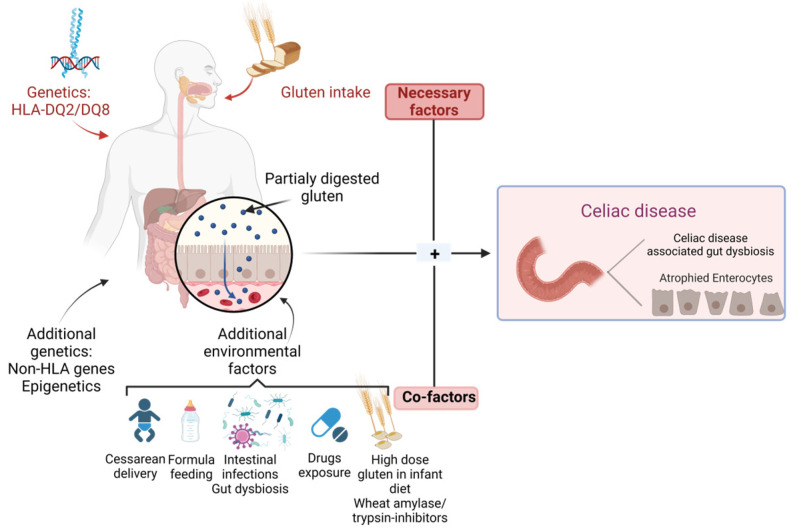
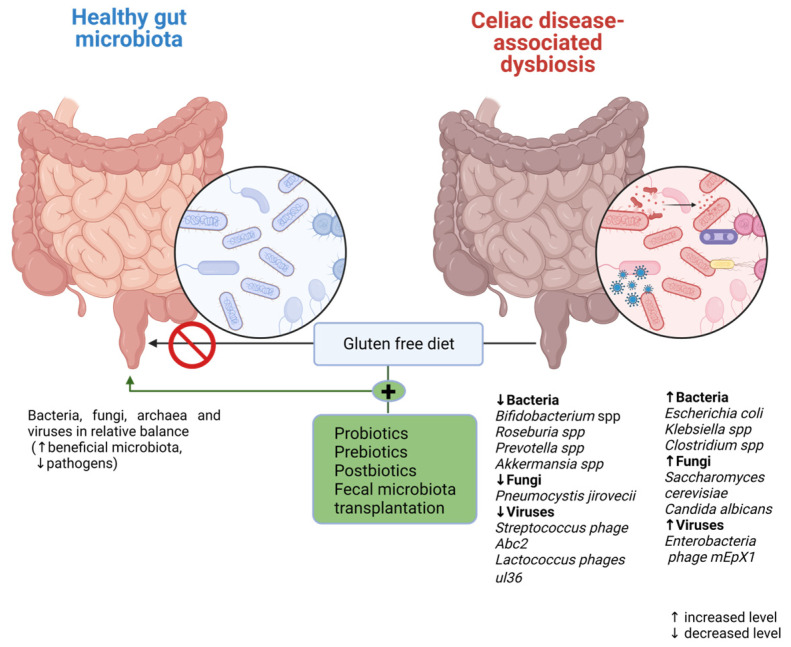
Celiac disease (CD) is a multifactorial disorder, defined by a complex interplay of genetic and environmental factors. Both genetic predisposition and dietary exposure to gluten are essential factors in triggering CD. However, there is proof that their presence is necessary, but not sufficient, for disease development. Through gut microbiota modulation, several additional environmental factors have shown their potential role as co-factors in CD pathogenesis. The aim of this review is to illustrate the possible mechanisms that stand behind the gut microbiota's involvement in CD pathogenesis. Furthermore, we discuss microbiota manipulation's potential role as both a preventative and therapeutic option. The available literature provides evidence that even before CD onset, factors including cesarean birth and formula feeding, as well as intestinal infection exposure, amplify the risk of CD in genetically predisposed individuals, due to their influence on the intestinal microbiome composition. Active CD was associated with elevated levels of several Gram-negative bacterial genera, including , , and , while beneficial bacteria such as lactobacilli and bifidobacteria were less abundant. Viral and fungal dysbiosis has also been described in CD, evidencing specific taxa alteration. A gluten-free diet (GFD) may improve the clinical symptoms and duodenal histopathology, but the persistence of intestinal dysbiosis in CD children under a GFD urges the need for additional therapy. Probiotics, prebiotics, and fecal microbial transplant have demonstrated their efficacy in restoring gut microbiota eubiosis in adult CD patients; however, their efficacy and safety as adjunctive therapies to a GFD in pediatric patients needs further investigation.
乳糜泻(CD)是一种多因素疾病,由遗传和环境因素的复杂相互作用定义。遗传易感性和膳食中接触麸质是引发 CD 的必要因素。然而,有证据表明,它们的存在是疾病发展的必要条件,但不是充分条件。通过肠道微生物群调节,一些额外的环境因素已显示出它们在 CD 发病机制中作为共同因素的潜在作用。本综述的目的是说明肠道微生物群参与 CD 发病机制的可能机制。此外,我们还讨论了微生物群操纵作为预防和治疗选择的潜在作用。现有文献提供的证据表明,即使在 CD 发病之前,包括剖宫产和配方奶喂养以及肠道感染暴露在内的因素,由于它们对肠道微生物群组成的影响,会增加遗传易感性个体患 CD 的风险。活动性 CD 与几种革兰氏阴性细菌属的水平升高有关,包括 、 、 和 ,而有益细菌如乳杆菌和双歧杆菌则较少。CD 中也描述了病毒和真菌失调,表明特定分类群发生改变。无麸质饮食(GFD)可能改善临床症状和十二指肠组织病理学,但 CD 儿童在 GFD 下持续存在肠道失调促使需要额外的治疗。益生菌、益生元和粪便微生物移植已证明它们在恢复成人 CD 患者肠道微生物群生态平衡方面的疗效;然而,作为 GFD 辅助治疗在儿科患者中的疗效和安全性需要进一步研究。