
在合成过程中,缓冲液成分融入聚血清素纳米颗粒和薄膜的框架结构中。
Buffer Components Incorporate into the Framework of Polyserotonin Nanoparticles and Films during Synthesis.
作者信息
Jeon Keuna, Asuncion Justin Andrei, Corbett Alexander Lucien, Yuan Tiange, Patel Meera, Andoy Nesha May Octavio, Kreis Christian Titus, Voznyy Oleksandr, Sullan Ruby May Arana
机构信息
Department of Physical and Environmental Sciences, University of Toronto Scarborough, 1065 Military Trail, Toronto, ON M1C 1A4, Canada.
Department of Chemistry, University of Toronto, 80 St. George St., Toronto, ON M5S 3H6, Canada.
出版信息
Nanomaterials (Basel). 2022 Jun 13;12(12):2027. doi: 10.3390/nano12122027.
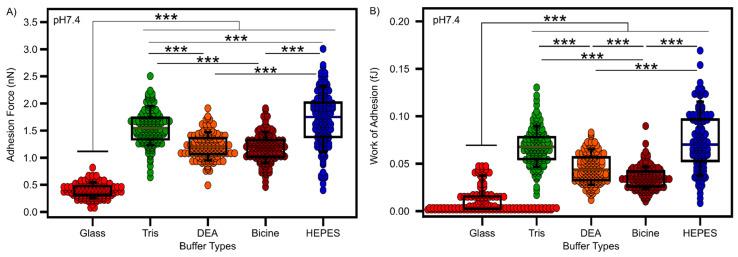
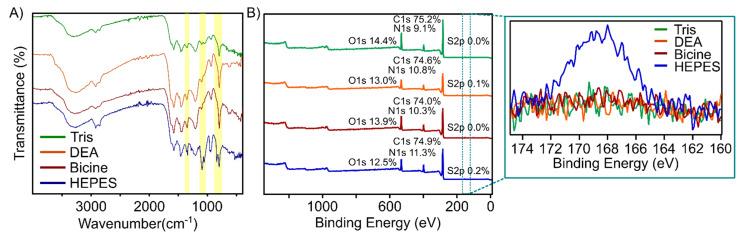
Polyserotonin nanoparticles (PSeNP) and films are bioinspired nanomaterials that have potential in biomedical applications and surface coatings. As studies on polyserotonin (PSe) nanoparticles and films are still in their infancy, synthetic pathways and material development for this new class of nanomaterial await investigation. Here, we sought to determine how different buffers used during the polymerization of serotonin to form nanoparticles and films impact the physicochemical properties of PSe materials. We show that buffer components are incorporated into the polymer matrix, which is also supported by density functional theory calculations. While we observed no significant differences between the elasticity of nanoparticles synthesized in the different buffers, the nanoscale surface properties of PSe films revealed dissimilarities in surface functional groups influenced by solvent molecules. Overall, the results obtained in this work can be used towards the rational design of PSe nanomaterials with tailored properties and for specific applications.
聚血清素纳米颗粒(PSeNP)和薄膜是受生物启发的纳米材料,在生物医学应用和表面涂层方面具有潜力。由于对聚血清素(PSe)纳米颗粒和薄膜的研究仍处于起步阶段,这类新型纳米材料的合成途径和材料开发有待研究。在此,我们试图确定在血清素聚合形成纳米颗粒和薄膜过程中使用的不同缓冲液如何影响PSe材料的物理化学性质。我们表明缓冲液成分被纳入聚合物基质中,这也得到了密度泛函理论计算的支持。虽然我们观察到在不同缓冲液中合成的纳米颗粒的弹性没有显著差异,但PSe薄膜的纳米级表面性质显示出受溶剂分子影响的表面官能团存在差异。总体而言,这项工作获得的结果可用于合理设计具有定制性质的PSe纳米材料并用于特定应用。



 Zotero 插件