Schulz Katja, Oļševskis Edvīns, Viltrop Arvo, Masiulis Marius, Staubach Christoph, Nurmoja Imbi, Lamberga Kristīne, Seržants Mārtiņš, Malakauskas Alvydas, Conraths Franz Josef, Sauter-Louis Carola
Friedrich-Loeffler-Institut, Federal Research Institute for Animal Health, Institute of Epidemiology, 17493 Greifswald-Insel Riems, Germany.
Food and Veterinary Service, 1050 Riga, Latvia.
Pathogens. 2022 Jun 20;11(6):711. doi: 10.3390/pathogens11060711.
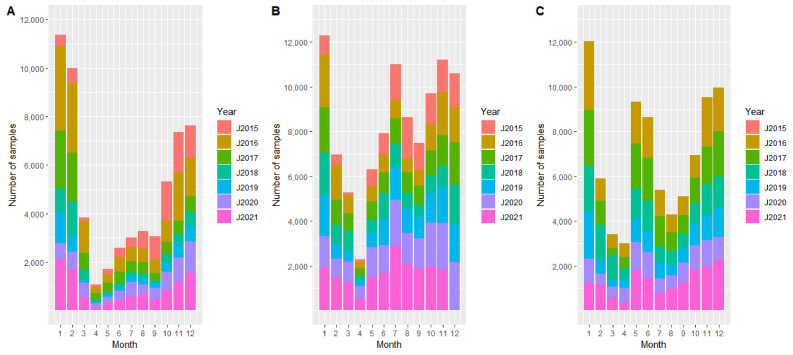
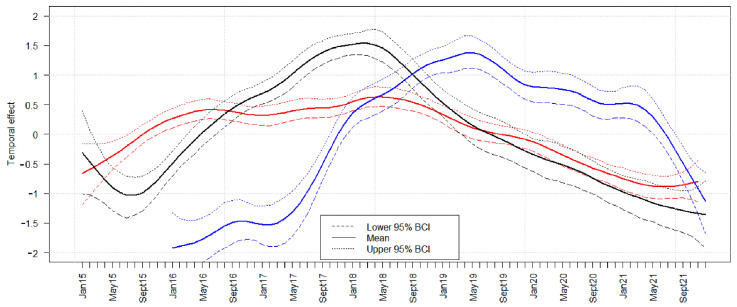
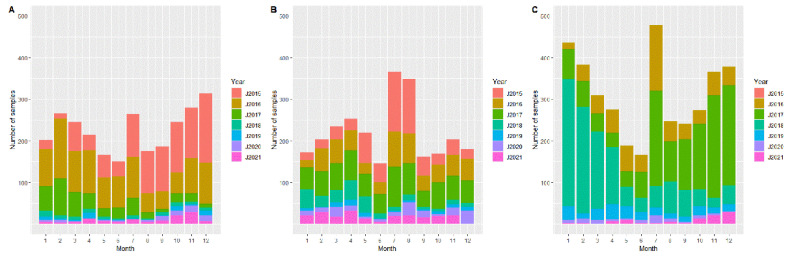
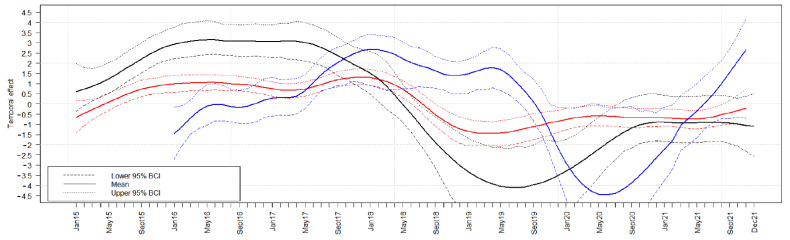
African swine fever (ASF) was first detected in Lithuania, Latvia, and Estonia in 2014 and has since been circulating in the Baltic States with a similar epidemiological course characterized by persistence of the disease in the wild boar population and occasional spill-over infections in domestic pigs. The aim of the present study was to evaluate surveillance data on ASF in wild boar from the three countries to improve our understanding of the course of the disease. ASF surveillance and wild boar population data of the countries were analyzed. In all three countries, a decrease in the prevalence of ASF virus-positive wild boar was observed over time. Although somewhat delayed, an increase in the seroprevalence was seen. At the same time, the wild boar population density decreased significantly. Towards the end of the study period, the wild boar population recovered, and the prevalence of ASF virus-positive wild boar increased again, whereas the seroprevalence decreased. The decreasing virus prevalence has obviously led to virus circulation at a very low level. Together with the decreasing wild boar population density, the detection of ASF-infected wild boar and thus ASF control has become increasingly difficult. The course of ASF and its continuous spread clearly demonstrate the necessity to scrutinize current ASF surveillance and control strategies fundamentally and to consider new transdisciplinary approaches.
非洲猪瘟(ASF)于2014年首次在立陶宛、拉脱维亚和爱沙尼亚被发现,此后一直在波罗的海国家传播,其流行病学过程相似,特点是野猪群体中疾病持续存在,家猪偶尔会出现溢出性感染。本研究的目的是评估这三个国家野猪ASF的监测数据,以增进我们对该疾病发展过程的了解。对这些国家的ASF监测和野猪种群数据进行了分析。在所有三个国家,随着时间的推移,ASF病毒阳性野猪的患病率均有所下降。虽然出现得有些延迟,但血清阳性率有所上升。与此同时,野猪种群密度显著下降。在研究期快结束时,野猪种群数量恢复,ASF病毒阳性野猪的患病率再次上升,而血清阳性率下降。病毒患病率的下降显然导致病毒在极低水平上传播。随着野猪种群密度的下降,检测感染ASF的野猪以及控制ASF变得越来越困难。ASF的发展过程及其持续传播清楚地表明,有必要从根本上审视当前的ASF监测和控制策略,并考虑新的跨学科方法。