Salawi Ahmad, Khan Arooj, Zaman Muhammad, Riaz Tehseen, Ihsan Hafsa, Butt Muhammad Hammad, Aman Waqar, Khan Rahima, Majeed Imtiaz, Almoshari Yosif, Alshamrani Meshal
Department of Pharmaceutics, College of Pharmacy, Jazan University, Jazan 45142, Saudi Arabia.
Faculty of Pharmacy, University of Central Punjab, Lahore 54000, Pakistan.
Polymers (Basel). 2022 Jun 11;14(12):2369. doi: 10.3390/polym14122369.
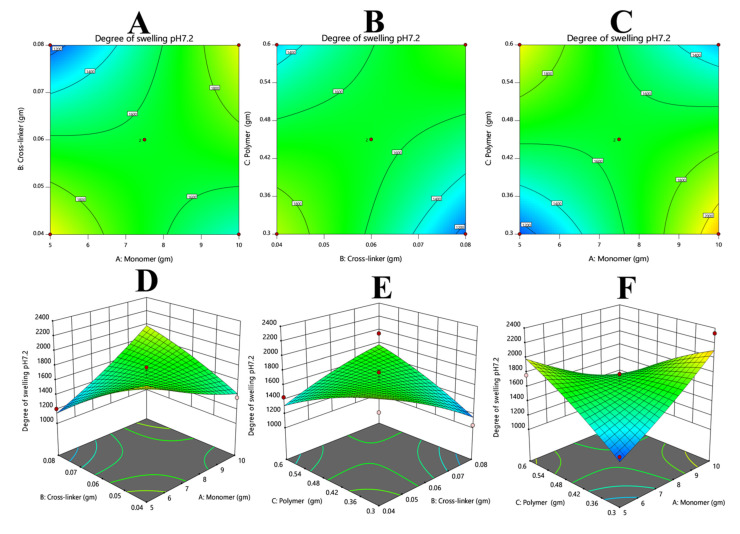
Nowadays, the use of statistical approaches, i.e., Box-Bhenken designs, are becoming very effective for developing and optimizing pharmaceutical drug formulations. In the current work, a Box-Bhenken design was employed using Design Expert version 11 to develop, evaluate, and optimize a hydrogel-based formulation for sustained release of an antiviral drug, i.e., favipiravir. The hydrogels were prepared using the free radical polymerization technique. β-Cyclodextrin (β-CD), ,'-methylenebisacrylamide (MBA), acrylic acid (AA), and potassium per sulfate (KPS) were used as oligomer, crosslinker, monomer, and initiator, respectively. Three variables, including β-CD (X), MBA (X), and AA (X) were used at various concentrations for the preparation of hydrogels, followed by evaluation of a sol-gel fraction, swelling, porosity, chemical compatibilities, in vitro drug release, and entrapment efficiency. The results of the studies revealed that the degree of swelling was pH dependent, the best swelling being at pH 7.2 (1976%). On the other hand, for the low sol fraction of 0.2%, the reasonable porosity made the hydrogel capable of loading 99% favipiravir, despite its hydrophobic nature. The maximum entrapment efficiency (99%) was observed in optimized hydrogel formulation (F15). Similarly, in vitro drug release studies showed that the prepared hydrogels exhibited a good, sustained release effect till the 24th hour. The kinetic modelling of drug release data revealed that the Korsmeyer-Peppas model was best fit model, describing a diffusion type of drug release from the prepared hydrogels. Conclusively, the outcomes predict that the hydrogel-based system could be a good choice for developing a sustained-release, once-daily dosage form of favipiravir for improved patient compliance.
如今,统计方法(即Box-Bhenken设计)在开发和优化药物制剂方面正变得非常有效。在当前的工作中,使用Design Expert 11版本采用Box-Bhenken设计来开发、评估和优化一种用于抗病毒药物法匹拉韦缓释的水凝胶制剂。水凝胶采用自由基聚合技术制备。β-环糊精(β-CD)、N,N'-亚甲基双丙烯酰胺(MBA)、丙烯酸(AA)和过硫酸钾(KPS)分别用作低聚物、交联剂、单体和引发剂。使用β-CD(X1)、MBA(X2)和AA(X3)三个变量的不同浓度来制备水凝胶,随后评估溶胶-凝胶分数、溶胀度、孔隙率、化学相容性、体外药物释放和包封率。研究结果表明,溶胀度取决于pH值,在pH 7.2时溶胀效果最佳(1976%)。另一方面,对于0.2%的低溶胶分数,合理的孔隙率使水凝胶尽管具有疏水性,但仍能够负载99%的法匹拉韦。在优化的水凝胶制剂(F15)中观察到最大包封率(99%)。同样,体外药物释放研究表明,制备的水凝胶在第24小时前表现出良好的缓释效果。药物释放数据的动力学建模表明,Korsmeyer-Peppas模型是最佳拟合模型,描述了药物从制备的水凝胶中的扩散型释放。总之,结果预测基于水凝胶的系统可能是开发法匹拉韦每日一次缓释剂型以提高患者依从性的良好选择。