Limbu Yam B, Gautam Rajesh K, Pham Long
Feliciano School of Business, Montclair State University, 1 Normal Ave, Montclair, NJ 07043, USA.
Department of Anthropology, Dr. Harisingh Gour Central University, Sagar 470003, India.
Vaccines (Basel). 2022 Jun 18;10(6):973. doi: 10.3390/vaccines10060973.
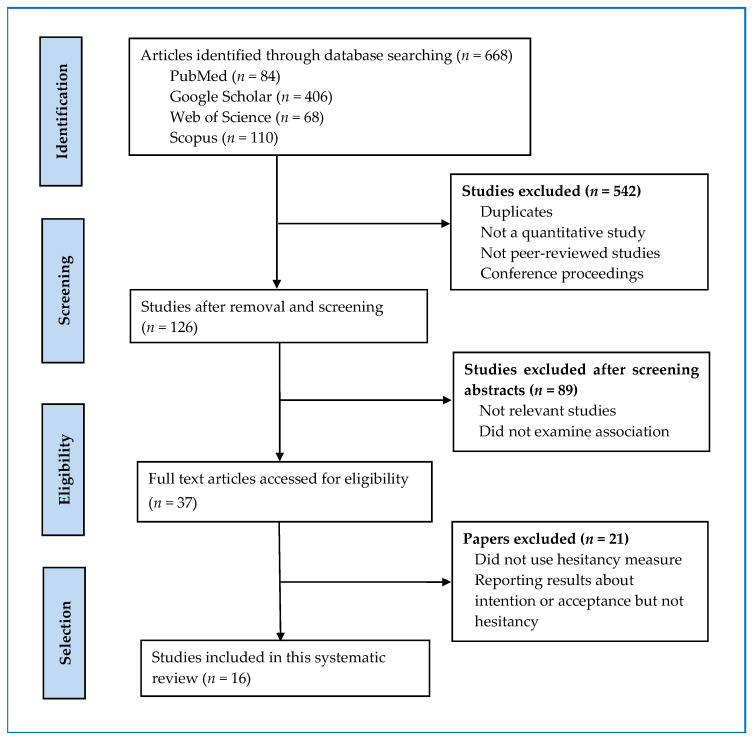
This study systematically analyzes the research that used the Health Belief Model (HBM) as a theoretical basis to examine the influence of HBM constructs on COVID-19 vaccine hesitancy. Following PRISMA guidelines, PubMed, Web of Science, Google Scholar, and Scopus were searched for quantitative studies. Sixteen studies with 30,242 participants met inclusion criteria. The prevalence of COVID-19 vaccine hesitancy was 33.23% (95% CI 24.71-41.39%). Perceived barriers and perceived benefits were the most common HBM constructs that were significantly associated with vaccine hesitancy. While perceived benefits was inversely associated, a positive association was found between perceived barriers and vaccine hesitancy. Other HBM constructs that were frequently examined and inversely associated were perceived susceptibility, cues to action, perceived severity, and self-efficacy. The most common HBM modifying factor that was directly associated with COVID-19 vaccine hesitancy was gender, followed by education, age, geographical locations, occupation, income, employment, marital status, race, and ethnicity; however, a few studies report inconsistent results. Other modifying variables that influenced vaccine hesitancy were knowledge of COVID-19, prior diagnosis of COVID-19, history of flu vaccination, religion, nationality, and political affiliation. The results show that HBM is useful in predicting COVID-19 vaccine hesitancy.
本研究系统分析了以健康信念模型(HBM)为理论基础,探讨HBM各构成要素对新冠疫苗犹豫影响的相关研究。按照PRISMA指南,在PubMed、科学网、谷歌学术和Scopus数据库中检索定量研究。16项研究共纳入30242名参与者,符合纳入标准。新冠疫苗犹豫的患病率为33.23%(95%置信区间24.71 - 41.39%)。感知障碍和感知益处是与疫苗犹豫显著相关的最常见HBM构成要素。感知益处呈负相关,而感知障碍与疫苗犹豫呈正相关。其他经常被研究且呈负相关的HBM构成要素包括感知易感性、行动线索、感知严重性和自我效能感。与新冠疫苗犹豫直接相关的最常见HBM调节因素是性别,其次是教育程度、年龄、地理位置、职业、收入、就业状况、婚姻状况、种族和民族;然而,少数研究报告的结果不一致。其他影响疫苗犹豫的调节变量包括对新冠的了解、既往新冠诊断、流感疫苗接种史、宗教、国籍和政治归属。结果表明,HBM有助于预测新冠疫苗犹豫情况。