Dar Fayaz Ahmad, Mushtaq Naveed Ul, Saleem Seerat, Rehman Reiaz Ul, Dar Tanvir Ul Hassan, Hakeem Khalid Rehman
Department of Bioresources, Amar Singh College Campus, Cluster University, Srinagar, 190008 Jammu and Kashmir, India.
Department of Bioresources, University of Kashmir, Srinagar, 190006 Jammu and Kashmir, India.
Int J Genomics. 2022 Jun 14;2022:1092894. doi: 10.1155/2022/1092894. eCollection 2022.
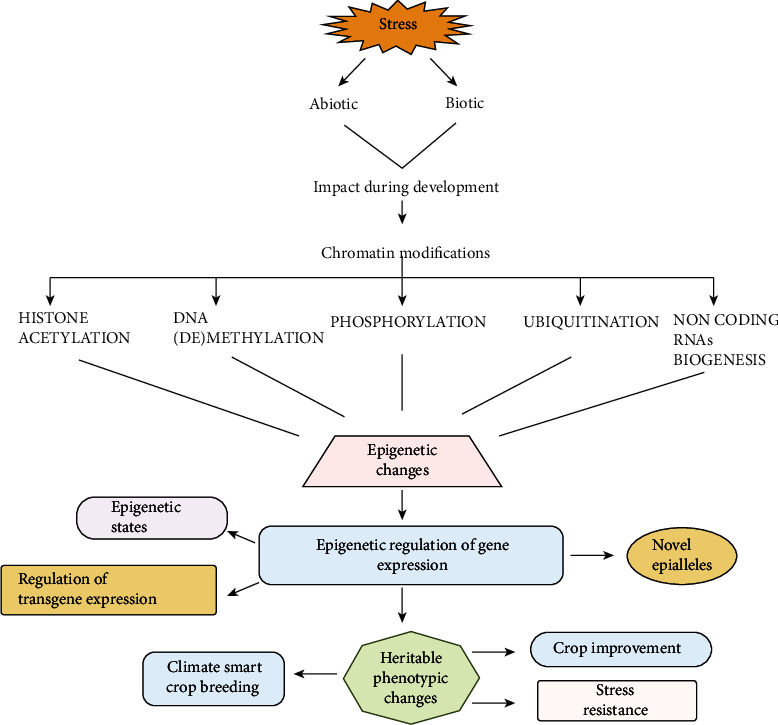
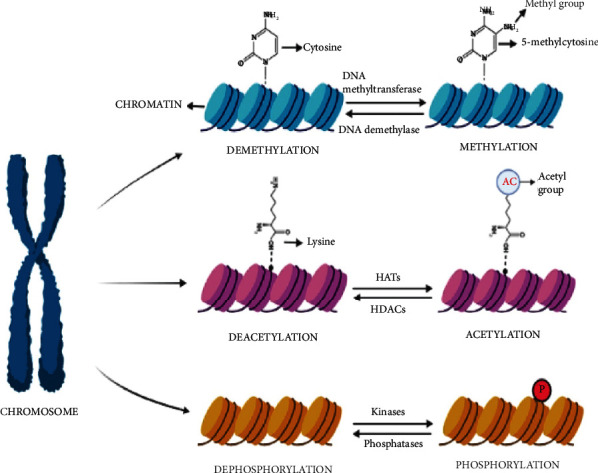
Plants being sessile are always exposed to various environmental stresses, and to overcome these stresses, modifications at the epigenetic level can prove vital for their long-term survival. Epigenomics refers to the large-scale study of epigenetic marks on the genome, which include covalent modifications of histone tails (acetylation, methylation, phosphorylation, ubiquitination, and the small RNA machinery). Studies based on epigenetics have evolved over the years especially in understanding the mechanisms at transcriptional and posttranscriptional levels in plants against various environmental stimuli. Epigenomic changes in plants through induced methylation of specific genes that lead to changes in their expression can help to overcome various stress conditions. Recent studies suggested that epigenomics has a significant potential for crop improvement in plants. By the induction and modulation of various cellular processes like DNA methylation, histone modification, and biogenesis of noncoding RNAs, the plant genome can be activated which can help in achieving a quicker response against various plant stresses. Epigenetic modifications in plants allow them to adjust under varied environmental stresses by modulating their phenotypic plasticity and at the same time ensure the quality and yield of crops. The plasticity of the epigenome helps to adapt the plants during pre- and postdevelopmental processes. The variation in DNA methylation in different organisms exhibits variable phenotypic responses. The epigenetic changes also occur sequentially in the genome. Various studies indicated that environmentally stimulated epimutations produce variable responses especially in differentially methylated regions (DMR) that play a major role in the management of stress conditions in plants. Besides, it has been observed that environmental stresses cause specific changes in the epigenome that are closely associated with phenotypic modifications. However, the relationship between epigenetic modifications and phenotypic plasticity is still debatable. In this review, we will be discussing the role of various factors that allow epigenetic changes to modulate phenotypic plasticity against various abiotic stress in plants.
植物固着生长,总是面临各种环境胁迫,为了克服这些胁迫,表观遗传水平的修饰对它们的长期生存至关重要。表观基因组学是指对基因组上表观遗传标记的大规模研究,这些标记包括组蛋白尾巴的共价修饰(乙酰化、甲基化、磷酸化、泛素化以及小RNA机制)。多年来,基于表观遗传学的研究不断发展,特别是在理解植物针对各种环境刺激的转录和转录后水平的机制方面。植物通过特定基因的诱导甲基化导致其表达变化从而引起的表观基因组变化,有助于克服各种胁迫条件。最近的研究表明,表观基因组学在植物作物改良方面具有巨大潜力。通过诱导和调节各种细胞过程,如DNA甲基化、组蛋白修饰和非编码RNA的生物合成,可以激活植物基因组,这有助于对各种植物胁迫做出更快的反应。植物中的表观遗传修饰使它们能够通过调节表型可塑性在各种环境胁迫下进行调整,同时确保作物的质量和产量。表观基因组的可塑性有助于植物在发育前和发育后的过程中适应环境。不同生物体中DNA甲基化的变化表现出可变的表型反应。表观遗传变化也在基因组中依次发生。各种研究表明,环境刺激引起的表观突变会产生可变的反应,特别是在差异甲基化区域(DMR),这些区域在植物胁迫条件的管理中起主要作用。此外,已经观察到环境胁迫会导致表观基因组发生特定变化,这些变化与表型修饰密切相关。然而,表观遗传修饰与表型可塑性之间的关系仍存在争议。在这篇综述中,我们将讨论各种因素的作用,这些因素使表观遗传变化能够调节植物对各种非生物胁迫的表型可塑性。