Department of Statistics, Umeå School of Business, Economics and Statistics, Umeå University, Umeå, Sweden.
Department of Public Health and Clinical Medicine, Sunderby Research Unit, Umeå University, Sweden.
PLoS One. 2022 Jun 24;17(6):e0270533. doi: 10.1371/journal.pone.0270533. eCollection 2022.
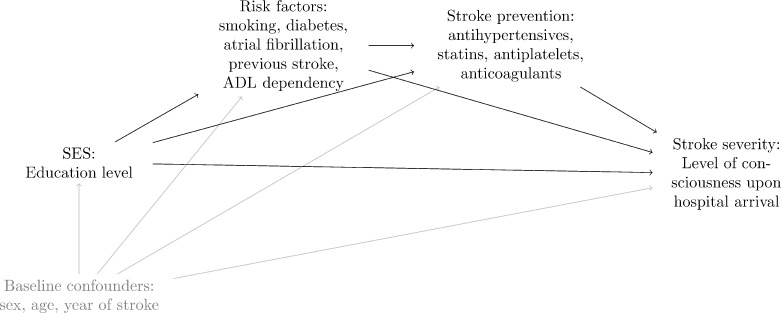
Those with low socioeconomic status have an increased risk of stroke, more severe strokes, reduced access to treatment, and more adverse outcomes after stroke. The question is why these differences are present. In this study we investigate to which extent the association between low socioeconomic status and stroke severity can be explained by differences in risk factors and stroke prevention drugs.
The study included 86 316 patients registered with an ischemic stroke in the Swedish Stroke Register (Riksstroke) 2012-2016. Data on socioeconomic status was retrieved from the Longitudinal integrated database for health insurance and labour market studies (LISA) by individual linkage. We used education level as proxy for socioeconomic status, with primary school education classified as low education. Stroke severity was measured using the Reaction Level Scale, with values above 1 classified as severe strokes. To investigate the pathways via risk factors and stroke prevention drugs we performed a mediation analysis estimating indirect and direct effects.
Low education was associated with an excess risk of a severe stroke compared to mid/high education (absolute risk difference 1.4%, 95% CI: 1.0%-1.8%), adjusting for confounders. Of this association 28.5% was an indirect effect via risk factors (absolute risk difference 0.4%, 95% CI: 0.3%-0.5%), while the indirect effect via stroke prevention drugs was negligible.
Almost one third of the association between low education and severe stroke was explained by risk factors, and clinical effort should be taken to reduce these risk factors to decrease stroke severity among those with low socioeconomic status.
社会经济地位较低的人患中风的风险增加,中风更严重,治疗机会减少,中风后结果更差。问题是为什么会存在这些差异。在这项研究中,我们调查了社会经济地位与中风严重程度之间的关联在多大程度上可以用危险因素和中风预防药物的差异来解释。
该研究纳入了 2012-2016 年在瑞典中风登记处(Riksstroke)登记的 86316 例缺血性中风患者。社会经济地位数据通过个体链接从长期综合医疗保险和劳动力市场研究数据库(LISA)中检索。我们使用教育水平作为社会经济地位的替代指标,将小学教育归类为低教育水平。中风严重程度使用反应水平量表进行测量,评分高于 1 分被归类为严重中风。为了研究通过危险因素和中风预防药物的途径,我们进行了中介分析,估计间接和直接效应。
与中/高等教育相比,低教育与严重中风的风险增加相关(绝对风险差异为 1.4%,95%可信区间:1.0%-1.8%),校正混杂因素后。该关联中有 28.5%是通过危险因素的间接效应(绝对风险差异为 0.4%,95%可信区间:0.3%-0.5%),而通过中风预防药物的间接效应可忽略不计。
低教育与严重中风之间的关联有近三分之一可以用危险因素来解释,临床工作应努力减少这些危险因素,以降低社会经济地位较低的人群中风的严重程度。