Early Start, University of Wollongong, Wollongong, NSW, Australia.
School of Education, Faculty of the Arts, Social Sciences and Humanities, University of Wollongong, Wollongong, NSW, Australia.
Int J Behav Nutr Phys Act. 2022 Jun 25;19(1):73. doi: 10.1186/s12966-022-01311-2.
Physical activity (PA) participation among youth tends to be insufficient and is prone to decline with age. In Australia, this decline has been shown to particularly occur in the domain of non-organized PA (e.g. active play and informal sport) between childhood and adolescence. However, information about changes in more specific groupings of activities within non-organized PA (i.e. subdomains) is needed, as this could support more targeted intervention strategies. This study aimed to investigate changes in the duration of specific subdomains of non-organized PA between late childhood (10-11 years) and early adolescence (12-13 years) in Australia, as well as whether these changes are moderated by sex.
Data were sourced from Waves 6 and 7 of the Longitudinal Study of Australian Children (n = 3614). Youth time-use diaries (24-h) were used to measure the duration of eight subdomains of non-organized PA at both waves (athletics/gymnastics, ball sports, cycling/motor/roller sports, fitness/gym/exercise, martial arts/dancing, water/ice/snow sports, active play and other outdoor/nature PA). Multilevel mixed modelling was used to explore longitudinal changes between waves and the potential moderation effect of sex.
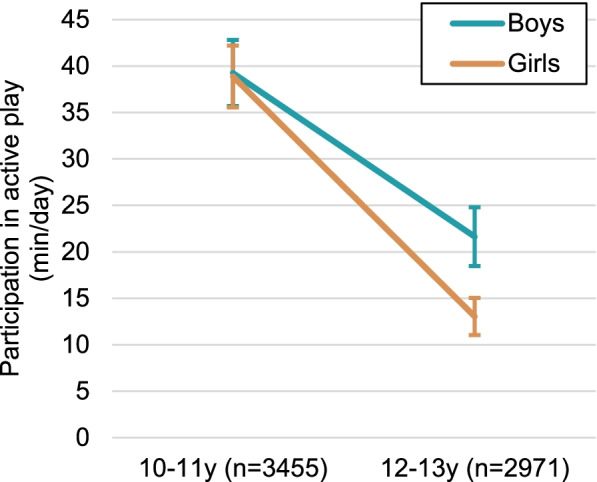
Active play declined the most of all subdomains (β = -20.5 min/day; 95% CI = -23.4, -17.6, p < 0.001). A smaller decline was observed in the subdomain of non-organized ball sports (β = -4.1 min/day; 95% CI = -5.9, -2.3, p < 0.001). Other subdomains remained stable or had only very small changes in participation. The decline in active play was moderated by sex, with a steeper decline among girls. No other notable moderation effects were observed.
Future studies may seek to explore and test the acceptability of PA promotion strategies to encourage active play participation, such as 'reframing' childhood play activities to be appropriate for adolescents. Such studies might particularly seek the perspectives of girls in the transition to adolescence.
年轻人的身体活动(PA)参与度往往不足,并且随着年龄的增长而容易下降。在澳大利亚,这种下降尤其发生在儿童期和青春期之间非组织性 PA 的领域(例如积极玩耍和非正式运动)。然而,需要了解非组织性 PA 中更具体活动分组(即子领域)的变化情况,因为这可以支持更有针对性的干预策略。本研究旨在调查澳大利亚青少年晚期(10-11 岁)和早期(12-13 岁)非组织性 PA 的特定子领域的持续时间变化,以及这些变化是否受到性别的调节。
数据来自澳大利亚儿童纵向研究的第 6 波和第 7 波(n=3614)。青年时间使用日记(24 小时)用于测量两波的非组织性 PA 的八个子领域的持续时间(田径/体操、球类运动、骑自行车/机动/滚轮运动、健身/健身房/锻炼、武术/舞蹈、水上/冰/雪地运动、积极玩耍和其他户外/自然 PA)。使用多级混合模型来探索波之间的纵向变化以及性别的潜在调节作用。
在所有子领域中,积极玩耍的下降幅度最大(β=-20.5 分钟/天;95%CI=-23.4,-17.6,p<0.001)。非组织性球类运动子领域的下降幅度较小(β=-4.1 分钟/天;95%CI=-5.9,-2.3,p<0.001)。其他子领域保持稳定或仅略有变化。积极玩耍的下降受到性别的调节,女孩的下降更为陡峭。没有观察到其他明显的调节作用。
未来的研究可能会探索和测试 PA 促进策略的可接受性,以鼓励积极玩耍的参与,例如“重新定义”儿童玩耍活动以适合青少年。此类研究可能特别寻求青少年过渡期间女孩的观点。