Département de Médecine de Famille et Médecine d'urgence, Université de Sherbrooke, Sherbrooke, QC, J1K 2R1, Canada.
Centre de Formation Médicale du Nouveau-Brunswick, Moncton, NB, E1A 7R1, Canada.
Sci Rep. 2023 Aug 23;13(1):13740. doi: 10.1038/s41598-023-40882-3.
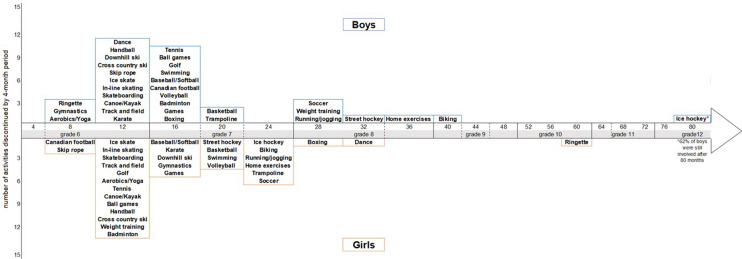
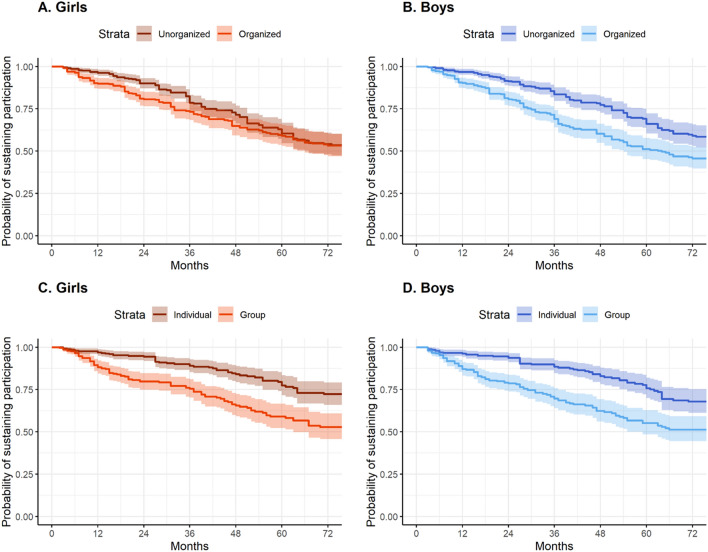
Among same-age adolescents, those who enter puberty relatively later and those who are relatively younger (e.g., born later in the year) might be at greater risk of physical activity discontinuation. This study aimed to (1) describe gender-specific discontinuation, re-engagement, and uptake rates in various types of physical activities from the age of 11 to 17 years, and (2) assess puberty timing and relative age as predictors of discontinuation from organized, unorganized, individual, and group-based physical activities. Longitudinal data from 781 (56% girls, age 10-13 years at study baseline) Canadian participants who self-reported puberty status, birthdate, and involvement in 36 physical activities every four months from 2011 to 2018 was analyzed. The incidence of discontinuation, re-engagement, and uptake in organized/unorganized and individual/group activities from grade 6 until grade 12 was described and Cox proportional hazard models were used to estimate associations of puberty timing and relative age with organized/unorganized and individual/group activity discontinuation. Results demonstrate that individual and unorganized activities are maintained longer than group-based and organized activities. Girls who started puberty earlier were more likely to discontinue organized activities than girls with average-puberty timing [Hazard ratio (HR) (95% confidence interval (CI)) 1.68 (1.05-2.69)]. Compared to boys born in the 4th quarter of the year, boys born in the 2nd quarter of the year were less likely to discontinue organized [HR (95% CI) 0.41 (0.23-0.74)], unorganized [HR (95% CI) 0.33 (0.16-0.70)], group [HR (95% CI) 0.58 (0.34-0.98)], and individual activities[HR (95% CI) 0.46 (0.23-0.91)], and boys born in the 3rd quarter were less likely to discontinue unorganized activities[HR (95% CI) 0.41 (0.19-0.88)]. This study illustrates the patterns of physical activity participation throughout adolescence. However, the generalizability of findings may be limited due to participant representation.
在同年龄段的青少年中,那些进入青春期较晚和相对年龄较小的人(例如,出生较晚)可能更容易停止体育活动。本研究旨在:(1)描述从 11 岁到 17 岁期间各种类型的体育活动的性别特异性停止、重新参与和参与率;(2)评估青春期时间和相对年龄作为组织、非组织、个体和基于小组的体育活动停止的预测因素。对 2011 年至 2018 年期间,781 名(56%为女孩,研究基线时年龄为 10-13 岁)加拿大参与者的纵向数据进行了分析,这些参与者自我报告了青春期状态、出生日期,并每四个月报告一次参与 36 项体育活动的情况。描述了从 6 年级到 12 年级期间组织/非组织和个体/小组活动的停止、重新参与和参与率,并使用 Cox 比例风险模型估计了青春期时间和相对年龄与组织/非组织和个体/小组活动停止的关联。结果表明,个体和非组织活动的持续时间长于基于小组和组织的活动。较早进入青春期的女孩比青春期正常的女孩更有可能停止参加组织活动[危险比(HR)(95%置信区间(CI))1.68(1.05-2.69)]。与 4 季度出生的男孩相比,2 季度出生的男孩不太可能停止参加组织活动[HR(95%CI)0.41(0.23-0.74)]、非组织活动[HR(95%CI)0.33(0.16-0.70)]、小组活动[HR(95%CI)0.58(0.34-0.98)]和个体活动[HR(95%CI)0.46(0.23-0.91)],而 3 季度出生的男孩不太可能停止非组织活动[HR(95%CI)0.41(0.19-0.88)]。本研究说明了整个青春期体育活动参与的模式。然而,由于参与者的代表性,研究结果的普遍性可能受到限制。