Department of Medicine and Surgery, University of Milan Bicocca, Milan, Italy; Division of Psychiatry, University College London, London, UK.
Department of Medicine and Surgery, University of Milan Bicocca, Milan, Italy.
J Psychiatr Res. 2022 Aug;152:242-249. doi: 10.1016/j.jpsychires.2022.06.018. Epub 2022 Jun 16.
The mental health of the Italian population declined at the onset of the COVID-19 pandemic. However, nationwide population prevalence estimates may not effectively reproduce the heterogeneity in distress responses to the pandemic. In particular, contextual determinants specific to COVID-19 pandemic need to be considered. We thus aimed to explore the association between local COVID-19 mortality rates and mental health response among the general population.
We capitalised on data (N = 17,628) from a large, cross-sectional, national survey, the COMET study, run between March and May 2020. While psychological distress was measured by General Health Questionnaire-12 (GHQ-12), the Depression, Anxiety and Stress Scale-21 Items (DASS-21) was used to assess relevant domains. In addition, a Covid-19 mortality ratio was built to compare single regional mortality rates to the national estimate and official statistics were used to control for other area-level determinants.
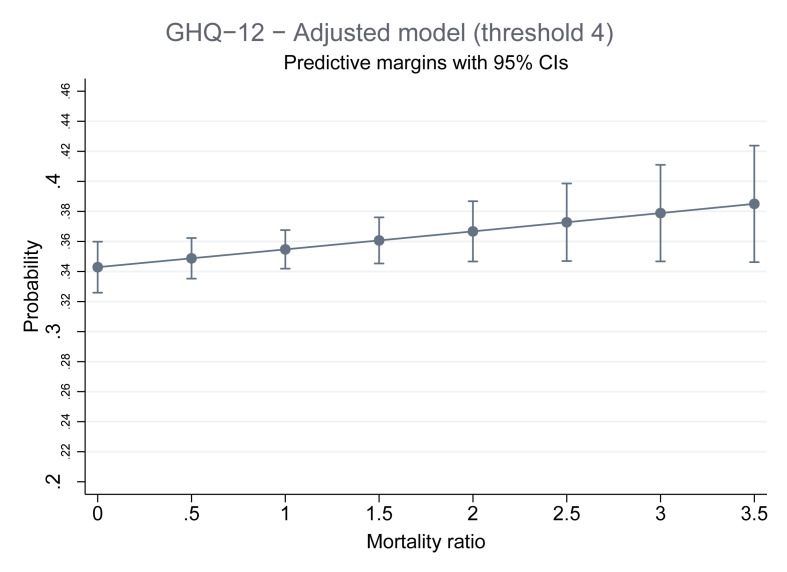
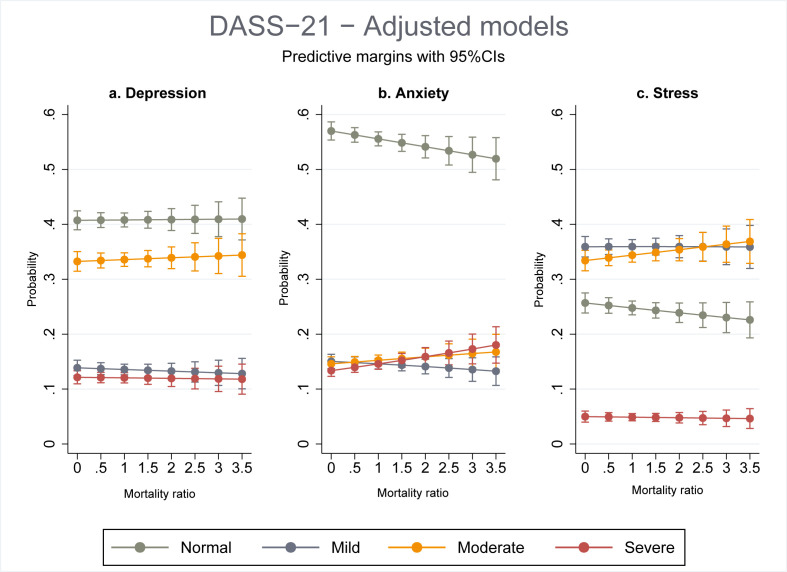
Adjusted ordered regression analyses showed an association between mortality ratio and moderate (OR = 1.10, 95%CI 1.03-1.18) and severe (OR = 1.11, 95%CI 1.03-1.21) DASS-21 anxiety levels. No effects of mortality ratio on GHQ-12 scores and DASS-21 depression and stress levels, uniformly high across the country, were estimated.
Although we could not find any association between regional COVID-19 mortality ratio and depression or psychological distress, anxiety levels were significantly increased among subjects from areas with the highest mortality rates. Local mortality rate seems a meaningful driver for anxiety among the general population. Considering the potentially long-lasting scenario, local public health authorities should provide neighbouring communities with preventive interventions reducing psychological isolation and anxiety levels.
意大利民众的心理健康在 COVID-19 大流行开始时下降。然而,全国范围内的流行患病率估计可能无法有效地再现大流行期间对困扰的反应的异质性。特别是,需要考虑 COVID-19 大流行特有的情境决定因素。因此,我们旨在探讨一般人群中当地 COVID-19 死亡率与心理健康反应之间的关联。
我们利用了 2020 年 3 月至 5 月期间进行的一项大型、横断面、全国性调查 COMET 研究的数据(N=17628)。虽然心理困扰通过一般健康问卷-12(GHQ-12)进行测量,但使用抑郁、焦虑和压力量表-21 项(DASS-21)评估相关领域。此外,构建了 COVID-19 死亡率比,以比较单个地区的死亡率与全国估计值,并使用官方统计数据控制其他地区水平决定因素。
调整后的有序回归分析显示,死亡率比与中度(OR=1.10,95%CI 1.03-1.18)和重度(OR=1.11,95%CI 1.03-1.21)DASS-21 焦虑水平之间存在关联。未估计死亡率比对 GHQ-12 评分以及 DASS-21 抑郁和压力水平的影响,这些水平在全国范围内普遍较高。
尽管我们没有发现地区 COVID-19 死亡率比与抑郁或心理困扰之间的任何关联,但在死亡率最高的地区,焦虑水平显著升高。当地死亡率似乎是一般人群焦虑的一个重要驱动因素。考虑到潜在的长期情况,当地公共卫生当局应向邻近社区提供预防干预措施,以减少心理隔离和焦虑水平。