Røsstad Tove, Salvesen Øyvind, Steinsbekk Aslak, Grimsmo Anders, Sletvold Olav, Garåsen Helge
Department of Public Health and Nursing, Norwegian University of Science and Technology (NTNU), Trondheim, Norway.
Department of Health and Welfare Services, Trondheim, Norway.
BMC Health Serv Res. 2017 Apr 17;17(1):275. doi: 10.1186/s12913-017-2206-3.
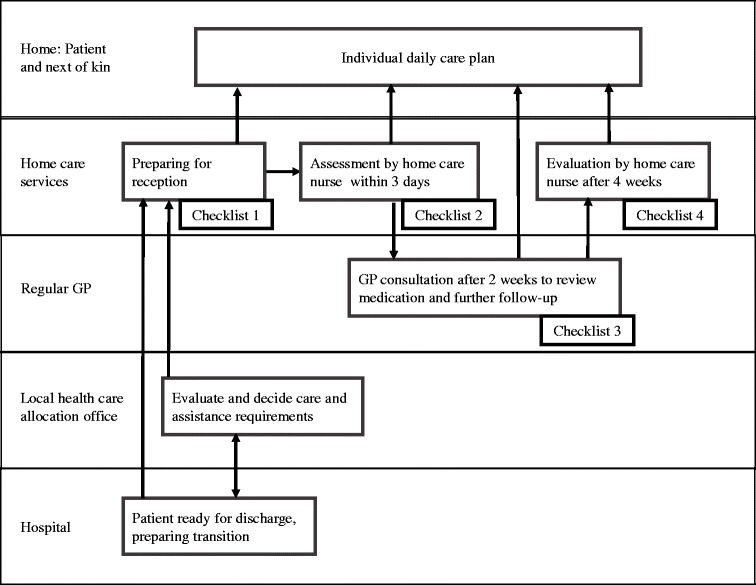
Improved discharge arrangements and targeted post-discharge follow-up can reduce the risk of adverse events after hospital discharge for elderly patients. Although more care is to shift from specialist to primary care, there are few studies on post-discharge interventions run by primary care. A generic care pathway, Patient Trajectory for Home-dwelling elders (PaTH) including discharge arrangements and follow-up by primary care, was developed and introduced in Central Norway Region in 2009, applying checklists at defined stages in the patient trajectory. In a previous paper, we found that PaTH had potential of improving follow-up in primary care. The aim of this study was to establish the effect of PaTH-compared to usual care-for elderly in need of home care services after discharge from hospital.
We did an unblinded, cluster randomised controlled trial with 12 home care clusters. Outcomes were measured at the patient level during a 12-month follow-up period for the individual patient and analysed applying linear and logistic mixed models. Primary outcomes were readmissions within 30 days and functional level assessed by Nottingham extended ADL scale. Secondary outcomes were number and length of inpatient hospital care and nursing home care, days at home, consultations with the general practitioners (GPs), mortality and health related quality of life (SF-36).
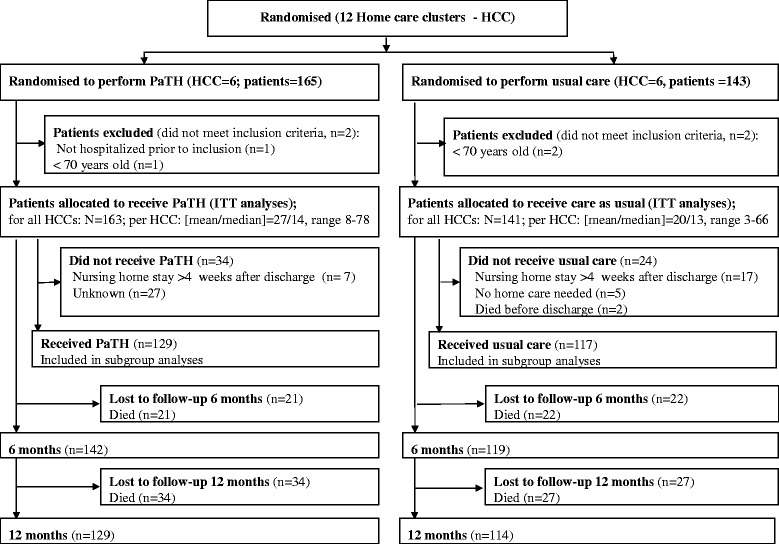
One-hundred and sixty-three patients were included in the PaTH group (six clusters), and 141 patients received care as usual (six clusters). We found no statistically significant differences between the groups for primary and secondary outcomes except for more consultations with the GPs in PaTH group (p = 0.04). Adherence to the intervention was insufficient as only 36% of the patients in the intervention group were assessed by at least three of the four main checklists in PaTH, but this improved over time.
Lack of adherence to PaTH rendered the study inconclusive regarding the elderly's functional level, number of readmissions after hospital discharge, and health care utilisation except for more consultations with the GPs. A targeted exploration of prerequisites for implementation is recommended in the pre-trial phase of complex intervention studies.
Clinical Trials.gov NCT01107119 , retrospectively registered 2010.04.18.
改进出院安排和有针对性的出院后随访可降低老年患者出院后不良事件的风险。尽管更多的护理工作正从专科护理转向初级护理,但关于初级护理机构开展的出院后干预措施的研究却很少。2009年,挪威中部地区开发并引入了一种通用护理路径——居家老年人患者轨迹(PaTH),包括出院安排和初级护理机构的随访,并在患者轨迹的特定阶段应用了检查表。在之前的一篇论文中,我们发现PaTH有改善初级护理随访的潜力。本研究的目的是确定与常规护理相比,PaTH对出院后需要居家护理服务的老年人的影响。
我们进行了一项非盲、整群随机对照试验,涉及12个居家护理群组。在个体患者12个月的随访期内,在患者层面测量结局,并应用线性和逻辑混合模型进行分析。主要结局是30天内的再入院情况以及通过诺丁汉扩展日常生活活动量表评估的功能水平。次要结局包括住院护理和养老院护理的次数及时长、在家天数、与全科医生(GP)的会诊次数、死亡率以及健康相关生活质量(SF-36)。
PaTH组(6个群组)纳入了163例患者,141例患者接受常规护理(6个群组)。除了PaTH组与全科医生的会诊次数更多(p = 0.04)外,我们发现两组在主要和次要结局方面没有统计学上的显著差异。对干预措施的依从性不足,因为干预组中只有36%的患者通过PaTH的四个主要检查表中的至少三个进行了评估,但这一情况随着时间推移有所改善。
除了与全科医生的会诊次数更多外,由于对PaTH的依从性不足,该研究在老年人的功能水平、出院后再入院次数以及医疗保健利用方面尚无定论。建议在复杂干预研究的试验前阶段,有针对性地探索实施的先决条件。
ClinicalTrials.gov NCT01107119,于2010年4月18日进行回顾性注册。