Medical Research Council Epidemiology Unit, Institute of Metabolic Science, University of Cambridge School of Clinical Medicine, Cambridge, United Kingdom.
Nutrition and Metabolism Branch, International Agency for Research on Cancer, World Health Organization, Lyon, France.
Am J Clin Nutr. 2022 Aug 4;116(2):511-522. doi: 10.1093/ajcn/nqac094.
Self-reported meat consumption is associated with disease risk but objective assessment of different dimensions of this heterogeneous dietary exposure in observational and interventional studies remains challenging.
We aimed to derive and validate scores based on plasma metabolites for types of meat consumption. For the most predictive score, we aimed to test whether the included metabolites varied with change in meat consumption, and whether the score was associated with incidence of type 2 diabetes (T2D) and other noncommunicable diseases.
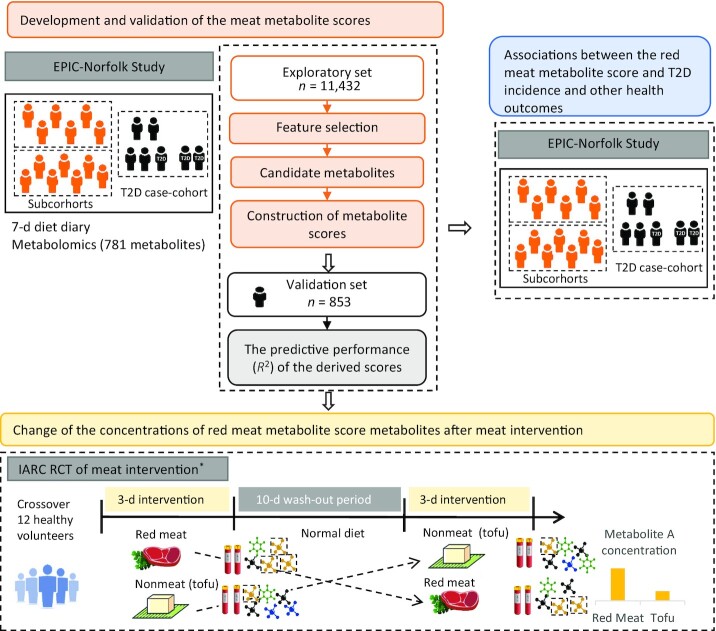
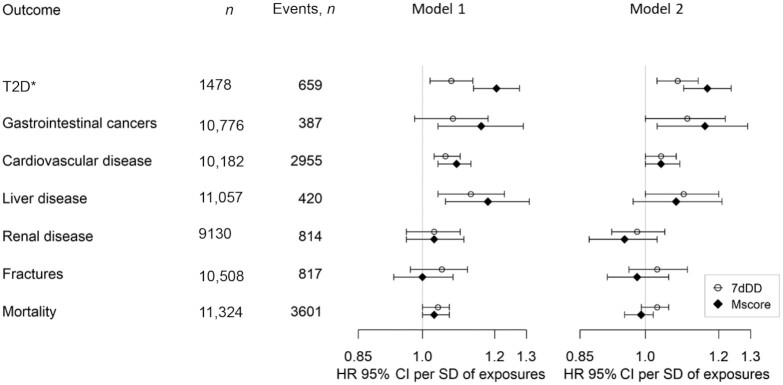
We derived scores based on 781 plasma metabolites for red meat, processed meat, and poultry consumption assessed with 7-d food records among 11,432 participants in the EPIC-Norfolk (European Prospective Investigation into Cancer and Nutrition-Norfolk) cohort. The scores were then tested for internal validity in an independent subset (n = 853) of the same cohort. In focused analysis on the red meat metabolite score, we examined whether the metabolites constituting the score were also associated with meat intake in a randomized crossover dietary intervention trial of meat (n = 12, Lyon, France). In the EPIC-Norfolk study, we assessed the association of the red meat metabolite score with T2D incidence (n = 1478) and other health endpoints.
The best-performing score was for red meat, comprising 139 metabolites which accounted for 17% of the explained variance of red meat consumption in the validation set. In the intervention, 11 top-ranked metabolites in the red meat metabolite score increased significantly after red meat consumption. In the EPIC-Norfolk study, the red meat metabolite score was associated with T2D incidence (adjusted HR per SD: 1.17; 95% CI: 1.10, 1.24).
The red meat metabolite score derived and validated in this study contains metabolites directly derived from meat consumption and is associated with T2D risk. These findings suggest the potential for objective assessment of dietary components and their application for understanding diet-disease associations.The trial in Lyon, France, was registered at clinicaltrials.gov as NCT03354130.
自我报告的肉类摄入量与疾病风险有关,但在观察性和干预性研究中,对这种异质饮食暴露的不同维度进行客观评估仍然具有挑战性。
我们旨在基于血浆代谢物为不同类型的肉类消费建立和验证评分。对于最具预测性的评分,我们旨在测试所包含的代谢物是否随肉类摄入量的变化而变化,以及该评分是否与 2 型糖尿病(T2D)和其他非传染性疾病的发病率相关。
我们基于欧洲前瞻性癌症与营养研究-诺福克(European Prospective Investigation into Cancer and Nutrition-Norfolk)队列中 11432 名参与者的 7 天食物记录评估的红肉类、加工肉类和禽肉类消费,建立了基于 781 种血浆代谢物的评分。然后,在同一队列的一个独立子集(n=853)中对这些评分进行了内部有效性测试。在对红肉类代谢物评分的重点分析中,我们在法国里昂的一项肉类随机交叉饮食干预试验(n=12)中检查了构成评分的代谢物是否也与肉类摄入量相关。在欧洲前瞻性癌症与营养研究-诺福克研究中,我们评估了红肉类代谢物评分与 T2D 发病率(n=1478)和其他健康终点的关系。
表现最好的评分是红肉类,由 139 种代谢物组成,在验证集中占红肉类消费解释方差的 17%。在干预中,红肉类代谢物评分中的 11 种排名最高的代谢物在红肉类消费后显著增加。在欧洲前瞻性癌症与营养研究-诺福克研究中,红肉类代谢物评分与 T2D 发病率相关(调整后的 HR per SD:1.17;95%CI:1.10,1.24)。
本研究中建立和验证的红肉类代谢物评分包含了直接来源于肉类消费的代谢物,与 T2D 风险相关。这些发现表明,客观评估饮食成分及其应用于理解饮食与疾病关联的潜力。法国里昂的试验在 clinicaltrials.gov 上注册为 NCT03354130。