
使用原生质谱法和紫外光解离技术绘制纳米抗体的互补决定区
Mapping paratopes of nanobodies using native mass spectrometry and ultraviolet photodissociation.
作者信息
Macias Luis A, Wang Xun, Davies Bryan W, Brodbelt Jennifer S
机构信息
Department of Chemistry, University of Texas at Austin Austin TX 78712 USA
Department of Molecular Biosciences, University of Texas at Austin Austin TX 78712 USA.
出版信息
Chem Sci. 2022 May 16;13(22):6610-6618. doi: 10.1039/d2sc01536f. eCollection 2022 Jun 7.
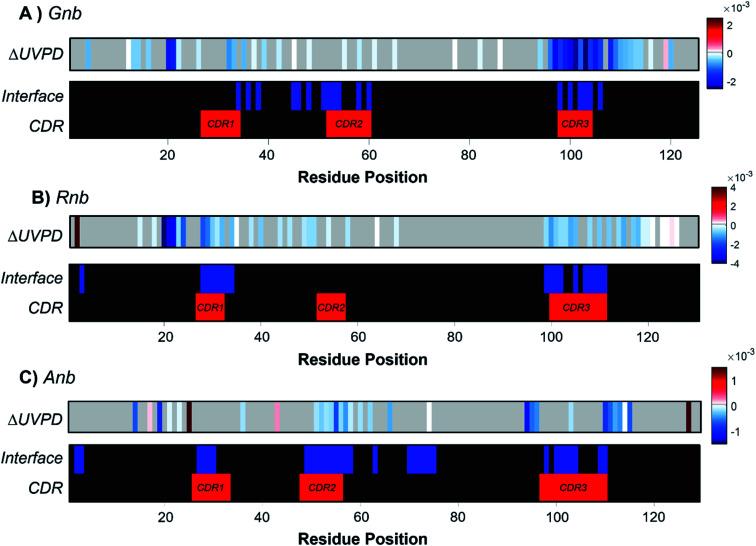
Following immense growth and maturity of the field in the past decade, native mass spectrometry has garnered widespread adoption for the structural characterization of macromolecular complexes. Routine analysis of biotherapeutics by this technique has become commonplace to assist in the development and quality control of immunoglobulin antibodies. Concurrently, 193 nm ultraviolet photodissociation (UVPD) has been developed as a structurally sensitive ion activation technique capable of interrogating protein conformational changes. Here, UVPD was applied to probe the paratopes of nanobodies, a class of single-domain antibodies with an expansive set of applications spanning affinity reagents, molecular imaging, and biotherapeutics. Comparing UVPD sequence fragments for the free nanobodies nanobody·antigen complexes empowered assignment of nanobody paratopes and intermolecular salt-bridges, elevating the capabilities of UVPD as a new strategy for characterization of nanobodies.
在过去十年中,随着该领域的巨大发展和成熟,原生质谱已被广泛应用于大分子复合物的结构表征。通过这种技术对生物治疗药物进行常规分析已成为常态,以协助免疫球蛋白抗体的开发和质量控制。同时,193nm紫外光解离(UVPD)已被开发为一种结构敏感的离子活化技术,能够探究蛋白质构象变化。在此,UVPD被应用于探测纳米抗体的抗原结合位点,纳米抗体是一类单域抗体,在亲和试剂、分子成像和生物治疗等广泛应用领域中具有重要作用。比较游离纳米抗体和纳米抗体·抗原复合物的UVPD序列片段,有助于确定纳米抗体的抗原结合位点和分子间盐桥,提升了UVPD作为一种表征纳米抗体新策略的能力。



 Zotero 插件