Department of Molecular and Structural Biochemistry, North Carolina State University, Raleigh, U.S.A.
Biochem Soc Trans. 2022 Jun 30;50(3):1151-1165. doi: 10.1042/BST20190572.
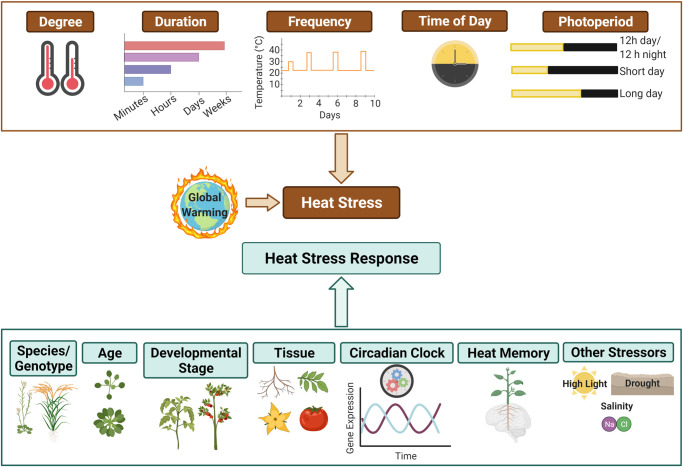
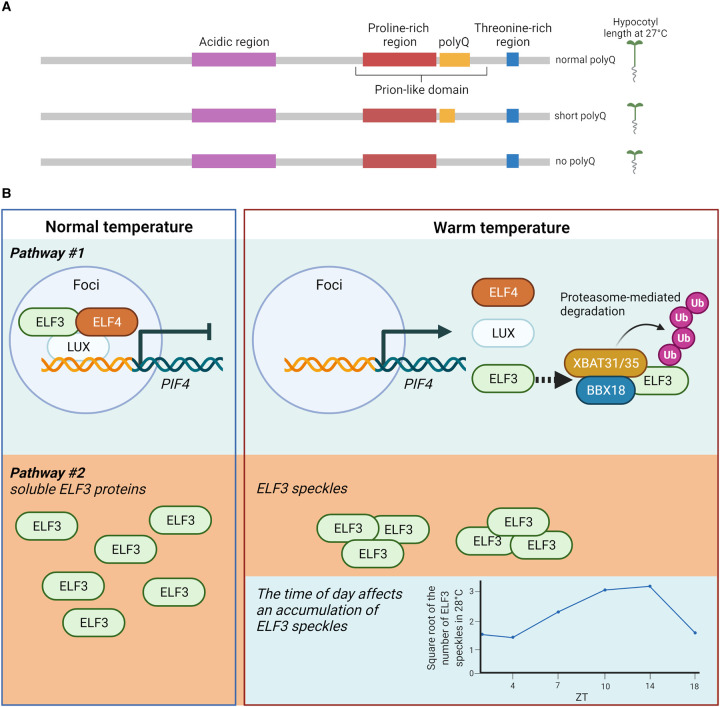
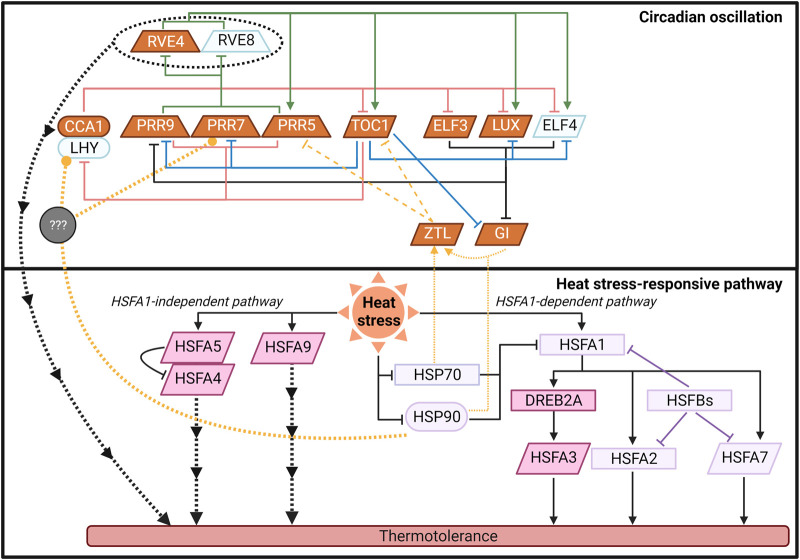
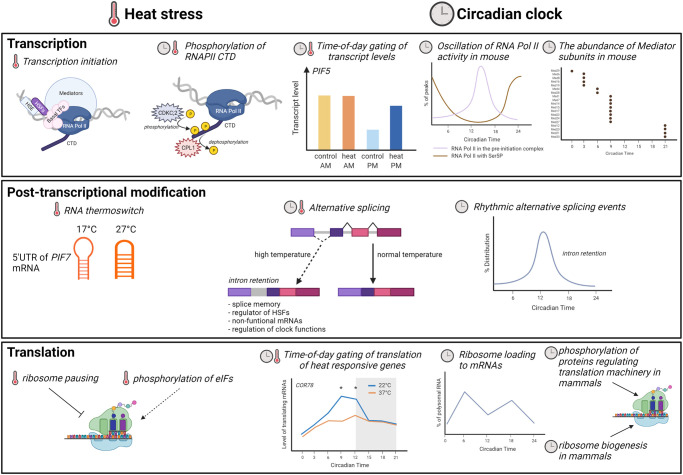
Increasing temperatures impact plant biochemistry, but the effects can be highly variable. Both external and internal factors modulate how plants respond to rising temperatures. One such factor is the time of day or season the temperature increase occurs. This timing significantly affects plant responses to higher temperatures altering the signaling networks and affecting tolerance levels. Increasing overlaps between circadian signaling and high temperature responses have been identified that could explain this sensitivity to the timing of heat stress. ELF3, a circadian clock component, functions as a thermosensor. ELF3 regulates thermoresponsive hypocotyl elongation in part through its cellular localization. The temperature sensitivity of ELF3 depends on the length of a polyglutamine region, explaining how plant temperature responses vary between species. However, the intersection between the circadian system and increased temperature stress responses is pervasive and extends beyond this overlap in thermosensing. Here, we review the network responses to increased temperatures, heat stress, and the impacts on the mechanisms of gene expression from transcription to translation, highlighting the intersections between the elevated temperature and heat stress response pathways and circadian signaling, focusing on the role of ELF3 as a thermosensor.
温度升高会影响植物的生物化学特性,但影响可能高度可变。外部和内部因素都会调节植物对升温的反应。其中一个因素是温度升高发生的时间,即一天中的时间或季节。这种时间安排会显著影响植物对更高温度的反应,改变信号网络并影响耐受水平。已经确定,昼夜节律信号和高温反应之间的重叠增加,这可以解释对热应激时间的敏感性。ELF3 是生物钟组件,作为热传感器发挥作用。ELF3 通过其细胞定位调节对热响应的下胚轴伸长。ELF3 的温度敏感性取决于聚谷氨酰胺区域的长度,这解释了植物温度反应在物种之间的差异。然而,昼夜系统和增加的温度胁迫反应之间的交叉是普遍存在的,并且超出了热感测的这种重叠。在这里,我们回顾了对温度升高、热应激以及对从转录到翻译的基因表达机制的影响的网络反应,强调了高温和热应激反应途径与昼夜节律信号之间的交叉,重点介绍了 ELF3 作为热传感器的作用。