Key Laboratory of Agro-ecological Processes in Subtropical Region, Institute of Subtropical Agriculture, the Chinese Academy of Sciences, Changsha, Hunan, China.
Hunan Provincial Key Laboratory of Animal Intestinal Function and Regulation, College of Life Sciences, Hunan Normal University, Changsha, Hunan, China.
Gut Microbes. 2022 Jan-Dec;14(1):2091369. doi: 10.1080/19490976.2022.2091369.
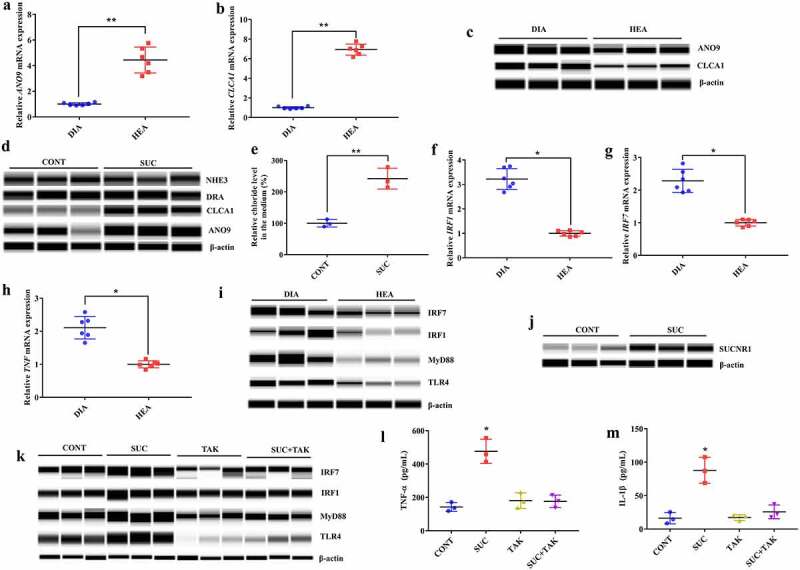
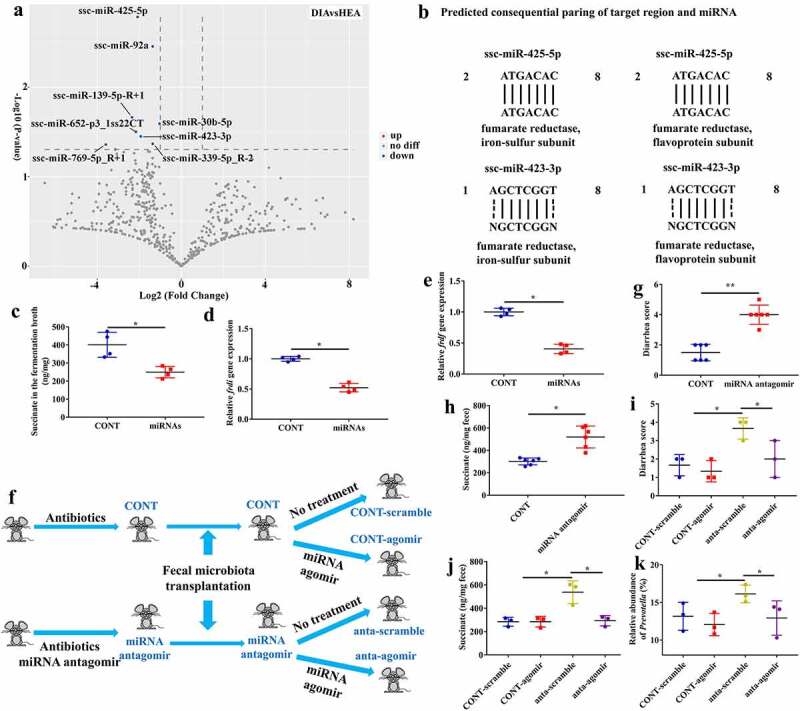
Diarrheal disease is a common health problem with complex causality. Although diarrhea is accompanied by disturbances in microbial diversity, how gut microbes are involved in the occurrence of diarrhea remains largely unknown. Here, using a pig model of post-weaning stress-induced diarrhea, we aim to elucidate and enrich the mechanistic basis of diarrhea. We found significant alterations in fecal microbiome, their metabolites, and microRNAs levels in piglets with diarrhea. Specifically, loss of ssc-miRNA-425-5p and ssc-miRNA-423-3p, which inhibit the gene expression of fumarate reductase () in genus, caused succinate accumulation in piglets, which resulted in diarrhea. Single-cell RNA sequencing indicated impaired epithelial function and increased immune response in the colon of piglet with diarrhea. Notably, the accumulated succinate increased colonic fluid secretion by regulating transepithelial Cl-secretion in the epithelial cells. Meanwhile, succinate promoted colonic inflammatory responses by activating MyD88-dependent TLR4 signaling in the macrophages. Overall, our findings expand the mechanistic basis of diarrhea and suggest that colonic accumulation of microbiota-produced succinate caused by loss of miRNAs leads to diarrhea in weanling piglets.
腹泻病是一种常见的健康问题,其病因复杂。虽然腹泻伴随着微生物多样性的紊乱,但肠道微生物如何参与腹泻的发生在很大程度上尚不清楚。在这里,我们使用仔猪断奶后应激诱导腹泻模型,旨在阐明并丰富腹泻的机制基础。我们发现腹泻仔猪的粪便微生物群、其代谢物和 microRNAs 水平发生了显著变化。具体来说,抑制属中基因表达的 ssc-miRNA-425-5p 和 ssc-miRNA-423-3p 的丢失导致了仔猪琥珀酸的积累,从而导致腹泻。单细胞 RNA 测序表明,腹泻仔猪的结肠上皮功能受损,免疫反应增强。值得注意的是,积累的琥珀酸通过调节上皮细胞中的跨上皮 Cl-分泌来增加结肠液分泌。同时,琥珀酸通过激活巨噬细胞中 MyD88 依赖性 TLR4 信号通路促进结肠炎症反应。总的来说,我们的研究结果扩展了腹泻的机制基础,并表明由 microRNAs 缺失导致的微生物群产生的琥珀酸在结肠中的积累导致了断奶仔猪的腹泻。