Department of Dental Hygiene, Kyungdong University, Gangwon-do, South Korea.
Department of Preventive and Social Dentistry, Seoul National University School of Dentistry, Seoul, South Korea.
Medicine (Baltimore). 2022 Jun 24;101(25):e29270. doi: 10.1097/MD.0000000000029270.
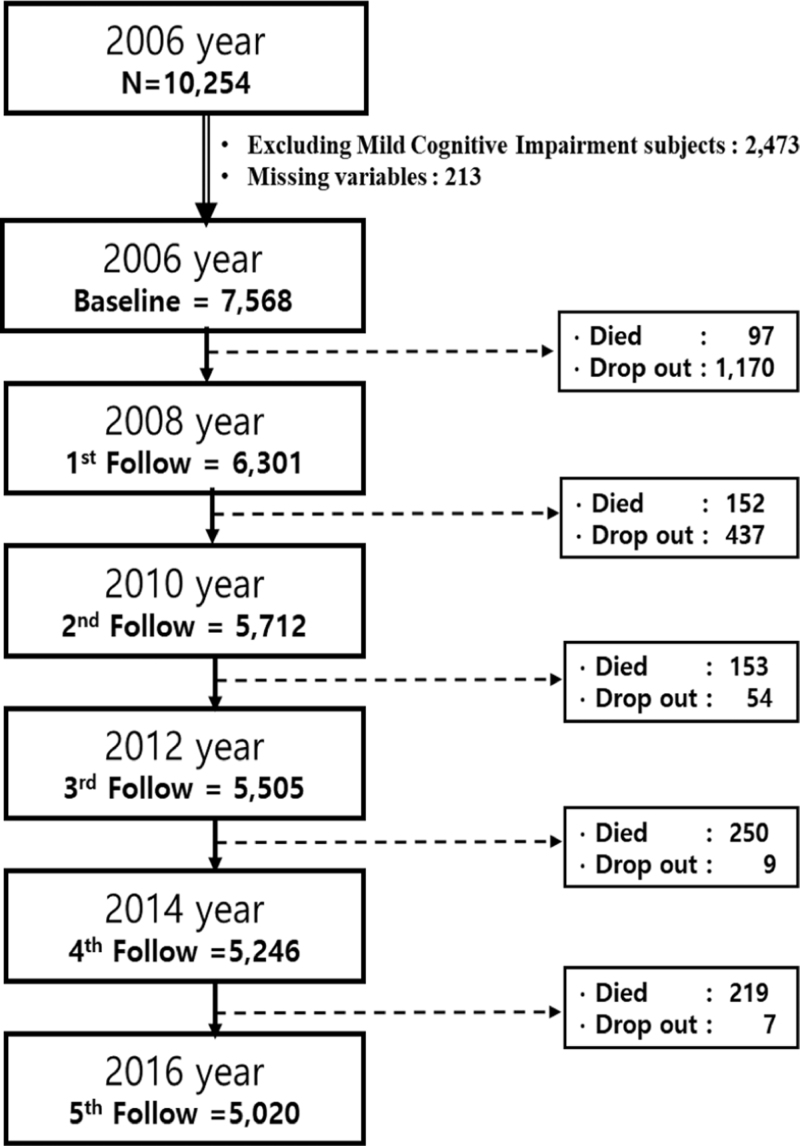
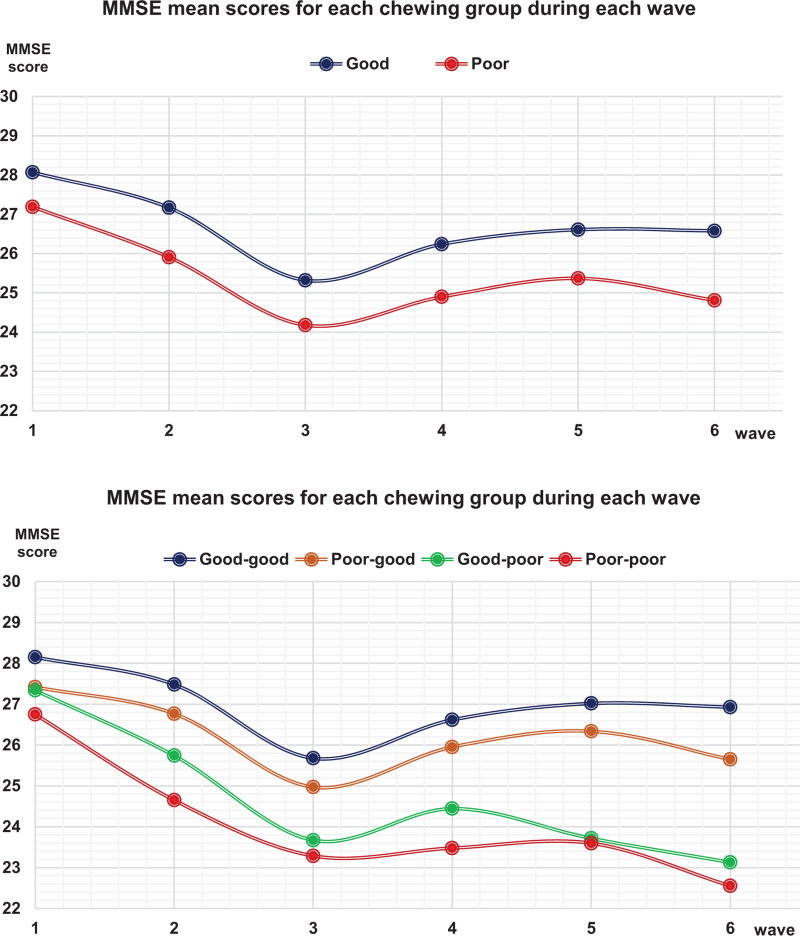
A growing body of literature suggests that oral health can influence cognitive function during aging. However, it is currently unclear whether reduced masticatory efficiency influences cognitive impairment in longitudinal studies.This study sought to investigate the effects of reduced chewing ability on the incidence of cognitive impairment using national representative data from 10 years of follow-up in Korea. Among the 10,254 people recruited in 2006 (1st wave), 7568 with normal cognitive function were selected. The participants were followed up every 2 years. The number of participants followed up until the 6th wave was 5020 in 2016. Chewing ability and scores on the Mini-Mental State Examination were recorded using self-reported questionnaires. Risk factors for dementia taken from systematic literature reviews were used as covariates. We performed logistic regression and created general estimating equation models after controlling for all covariates to assess the relationship between chewing ability and cognitive decline. Decreased chewing function was associated with mild cognitive impairment after controlling for confounding variables.The odds ratio for cognitive impairment was about 1.28 times higher than in people with poor chewing function as in those with good chewing function. We identified changes in chewing function from the 1st wave to the 6th wave; the odds ratios were 2.21 (95% confidence interval = 1.90-2.58) in the good-poor group and 2.11 (95% confidence interval = 1.74-2.55) in the poor-poor group.We identified an impairment in cognitive function in the poor (poor-poor and good-poor) chewing ability group. Therefore, we have confirmed that reduced mastication efficiency may contribute to a deterioration in cognitive function. People with deteriorated chewing ability must be given additional attention to aid in the prevention of cognitive decline.
越来越多的文献表明,口腔健康会影响衰老过程中的认知功能。然而,在纵向研究中,咀嚼效率降低是否会影响认知障碍目前还不清楚。本研究旨在使用韩国 10 年随访的全国代表性数据,调查咀嚼能力降低对认知障碍发生率的影响。在 2006 年(第 1 波)招募的 10254 人中,选择了 7568 名认知功能正常的人。参与者每 2 年随访一次。截至 2016 年第 6 波,有 5020 名参与者进行了随访。咀嚼能力和简易精神状态检查分数使用自我报告问卷记录。将从系统文献综述中获得的痴呆风险因素作为协变量。在控制所有协变量后,我们进行逻辑回归和创建一般估计方程模型,以评估咀嚼能力与认知下降之间的关系。在控制混杂因素后,咀嚼功能下降与轻度认知障碍有关。认知障碍的比值比约为咀嚼功能差的人比咀嚼功能好的人高 1.28 倍。我们从第 1 波到第 6 波识别出咀嚼功能的变化;在良好-不良组中,比值比为 2.21(95%置信区间为 1.90-2.58),在不良-不良组中,比值比为 2.11(95%置信区间为 1.74-2.55)。我们在咀嚼能力差的人群(不良-不良和良好-不良)中发现了认知功能障碍。因此,我们已经证实,咀嚼效率降低可能导致认知功能恶化。咀嚼能力恶化的人必须给予额外关注,以帮助预防认知能力下降。