Department of Epidemiology and Prevention, Center for Clinical Sciences, National Center for Global Health and Medicine, 1-21-1 Toyama, Shinjuku-ku, Tokyo 162-8655, Japan.
Department of Social and Preventive Epidemiology, School of Public Health, University of Tokyo, 7-3-1 Hongo, Bunkyo-ku, Tokyo 113-0033, Japan.
Nutrients. 2023 May 26;15(11):2485. doi: 10.3390/nu15112485.
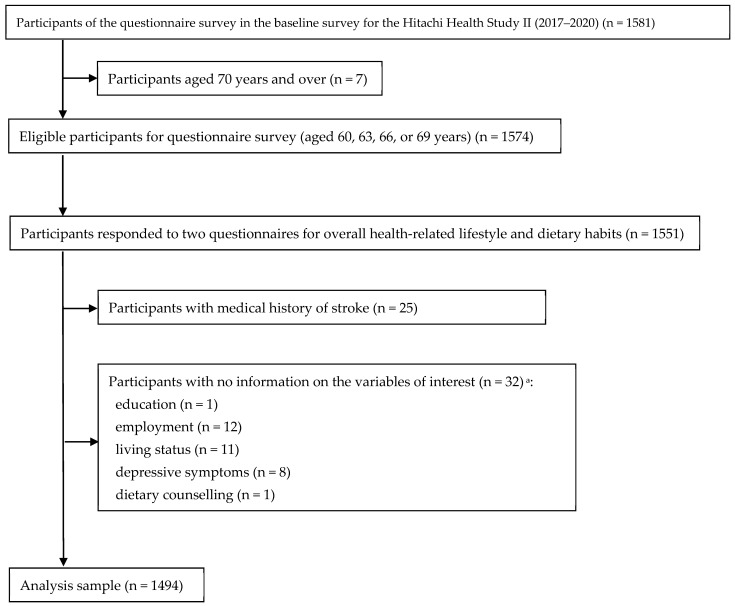
We aimed to examine the cross-sectional association between dietary hardness and cognitive dysfunction among Japanese men in their 60s. Participants were 1494 men aged 60-69 years from the baseline survey of Hitachi Health Study II (2017-2020). Dietary hardness was defined as an estimate of masticatory muscle activity involved in consuming solid foods. Habitual intake of these foods was assessed using a brief-type, self-administered diet history questionnaire. Cognitive dysfunction was defined as a score ≤ 13 points on the test battery for screening for Alzheimer's disease (MSP-1100). The mean (SD) age of participants was 63.5 (3.5) years. The prevalence of cognitive dysfunction was 7.5%. The ORs (95% CIs) for cognitive dysfunction in the second and third tertiles were: 0.77 (0.47, 1.26) and 0.87 (0.54, 1.41), respectively, after adjustment for socio-demographic factors ( for trend = 0.73). After further adjustment for protective nutrient intake against cognitive dysfunction, the corresponding figures were 0.72 (0.43, 1.21) and 0.79 (0.43, 1.46), respectively ( for trend = 0.57). Dietary hardness was not associated with the prevalence of cognitive dysfunction among Japanese men in their 60s. Future prospective studies are necessary to investigate the association between dietary hardness estimated by a validated questionnaire and cognitive dysfunctions.
我们旨在研究 60 多岁的日本男性中饮食硬度与认知功能障碍之间的横断面关联。参与者为日立健康研究 II 基线调查(2017-2020 年)中的 1494 名 60-69 岁男性。饮食硬度定义为参与食用固体食物的咀嚼肌活动的估计值。这些食物的习惯性摄入使用简短的自我管理饮食历史问卷进行评估。认知功能障碍定义为阿尔茨海默病筛查测试电池(MSP-1100)的得分≤13 分。参与者的平均(SD)年龄为 63.5(3.5)岁。认知功能障碍的患病率为 7.5%。在调整社会人口因素后,第二和第三 tertile 的认知功能障碍的 OR(95%CI)分别为:0.77(0.47,1.26)和 0.87(0.54,1.41),趋势检验=0.73)。进一步调整针对认知功能障碍的保护营养素摄入后,相应的数字分别为 0.72(0.43,1.21)和 0.79(0.43,1.46)(趋势检验=0.57)。饮食硬度与 60 多岁日本男性的认知功能障碍患病率无关。未来的前瞻性研究有必要调查通过验证问卷估计的饮食硬度与认知功能障碍之间的关联。