Department of Civil and Environmental Engineering, Virginia Tech, Blacksburg, Virginia24061, United States.
Department of Civil and Environmental Engineering, West Virginia University, Morgantown, West Virginia26506, United States.
Environ Sci Technol. 2022 Nov 1;56(21):14982-14993. doi: 10.1021/acs.est.1c08673. Epub 2022 Jun 27.
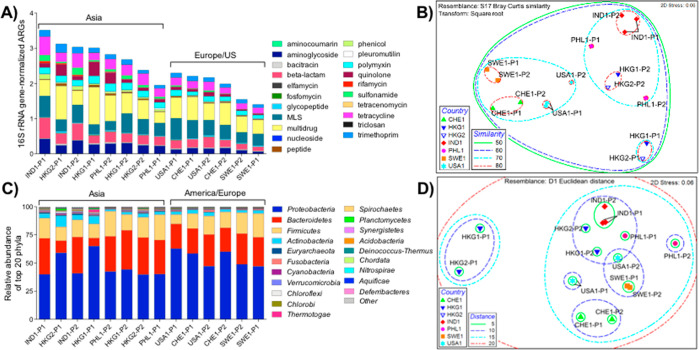
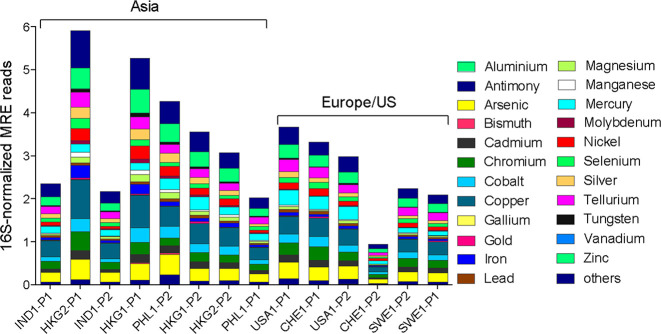
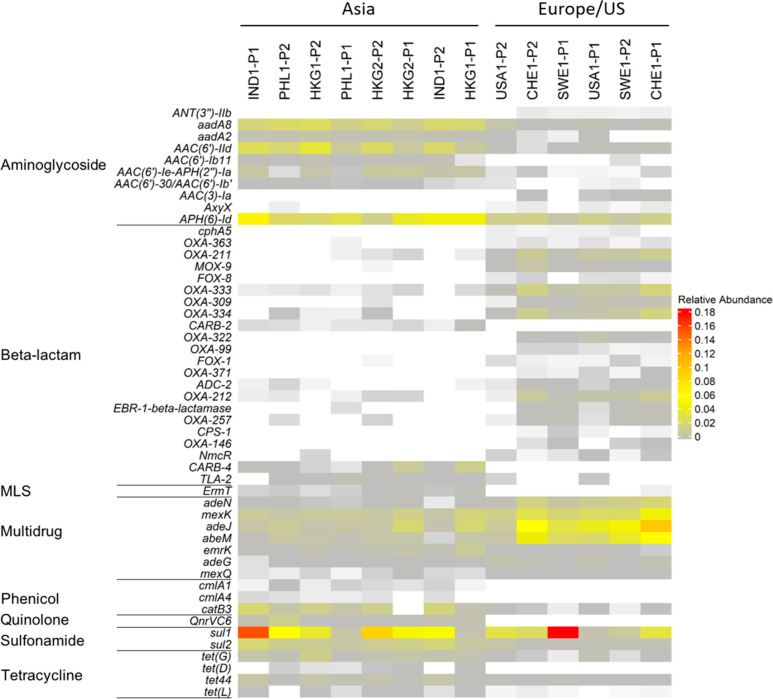
Wastewater-based surveillance (WBS) for disease monitoring is highly promising but requires consistent methodologies that incorporate predetermined objectives, targets, and metrics. Herein, we describe a comprehensive metagenomics-based approach for global surveillance of antibiotic resistance in sewage that enables assessment of 1) which antibiotic resistance genes (ARGs) are shared across regions/communities; 2) which ARGs are discriminatory; and 3) factors associated with overall trends in ARGs, such as antibiotic concentrations. Across an internationally sourced transect of sewage samples collected using a centralized, standardized protocol, ARG relative abundances (16S rRNA gene-normalized) were highest in Hong Kong and India and lowest in Sweden and Switzerland, reflecting national policy, measured antibiotic concentrations, and metal resistance genes. Asian versus European/US resistomes were distinct, with macrolide-lincosamide-streptogramin, phenicol, quinolone, and tetracycline versus multidrug resistance ARGs being discriminatory, respectively. Regional trends in measured antibiotic concentrations differed from trends expected from public sales data. This could reflect unaccounted uses, captured only by the WBS approach. If properly benchmarked, antibiotic WBS might complement public sales and consumption statistics in the future. The WBS approach defined herein demonstrates multisite comparability and sensitivity to local/regional factors.
污水监测(WBS)在疾病监测方面具有广阔的应用前景,但需要采用一致的方法,将预定的目标、指标和度量标准纳入其中。在此,我们描述了一种全面的基于宏基因组学的污水抗生素耐药性全球监测方法,该方法能够评估:1)哪些抗生素耐药基因(ARGs)在不同地区/社区之间共享;2)哪些 ARGs 具有区分性;3)与 ARGs 整体趋势相关的因素,如抗生素浓度。在所收集的国际污水样本横切面上,采用集中标准化的方案,通过 16S rRNA 基因归一化的 ARG 相对丰度(relative abundances)在香港和印度最高,在瑞典和瑞士最低,这反映了国家政策、测量的抗生素浓度和金属耐药基因。亚洲与欧洲/美国的耐药组存在明显差异,分别为大环内酯类-林可酰胺类-链阳性菌素、氯霉素、喹诺酮类和四环素类耐药基因对抗生素耐药基因具有区分性。所测量的抗生素浓度的区域趋势与从公共销售数据预测的趋势不同。这可能反映了未被销售和消费数据所捕获的未知用途。如果经过适当的基准测试,抗生素污水监测在未来可能会补充公共销售和消费统计数据。本文中定义的污水监测方法展示了多站点的可比性和对本地/区域因素的敏感性。