Department of Physical Sciences, Peter MacCallum Cancer Centre, 305 Grattan St, Melbourne, VIC, 3000, Australia.
Sir Peter MacCallum Department of Oncology, The University of Melbourne, Melbourne, VIC, 3000, Australia.
Radiat Oncol. 2022 Jun 27;17(1):112. doi: 10.1186/s13014-022-02041-2.
Delivered organs at risk (OARs) dose may vary from planned dose due to interfraction and intrafraction motion during kidney SABR treatment. Cases of bowel stricture requiring surgery post SABR treatment were reported in our institution. This study aims to provide strategies to reduce dose deposited to OARs during SABR treatment and mitigate risk of gastrointestinal toxicity.
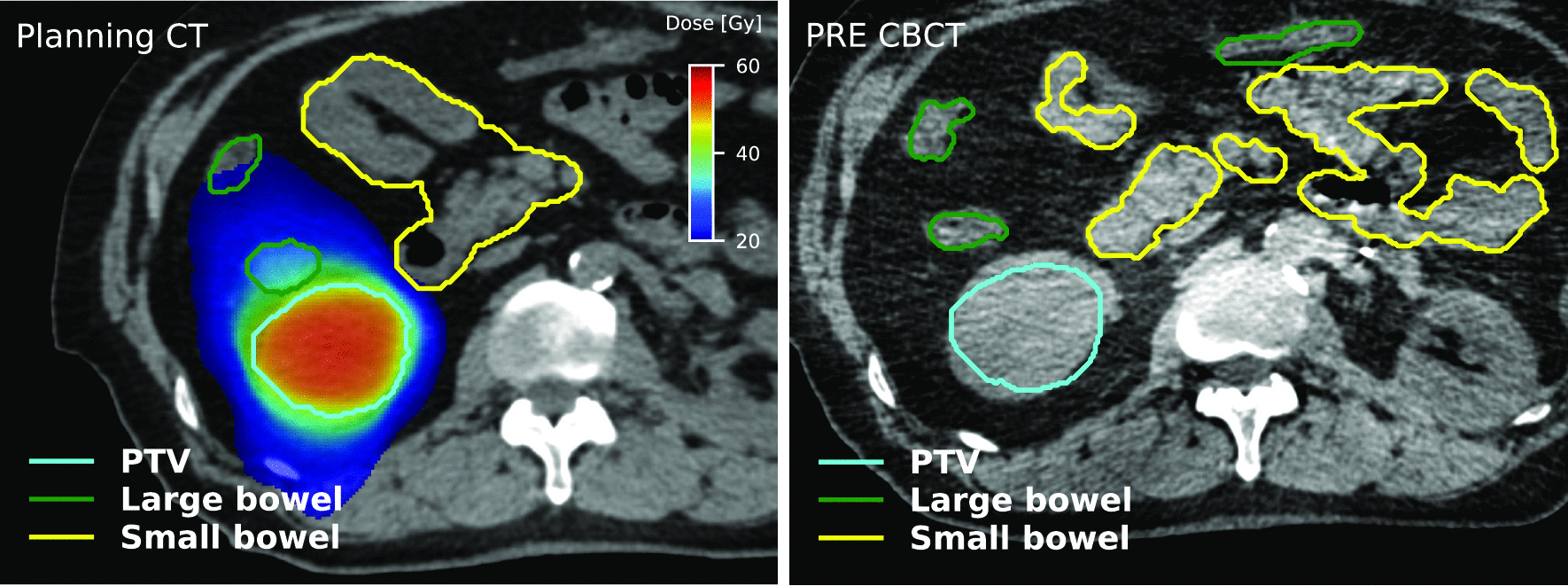
Small bowel (SB), large bowel (LB) and stomach (STO) were delineated on the last cone beam CT (CBCT) acquired before any dose had been delivered (PRE CBCT) and on the first CBCT acquired after any dose had been delivered (MID CBCT). OAR interfraction and intrafraction motion were estimated from the shortest distance between OAR and the internal target volume (ITV). Adaptive radiation therapy (ART) was used if dose limits were exceeded by projecting the planned dose on the anatomy of the day.
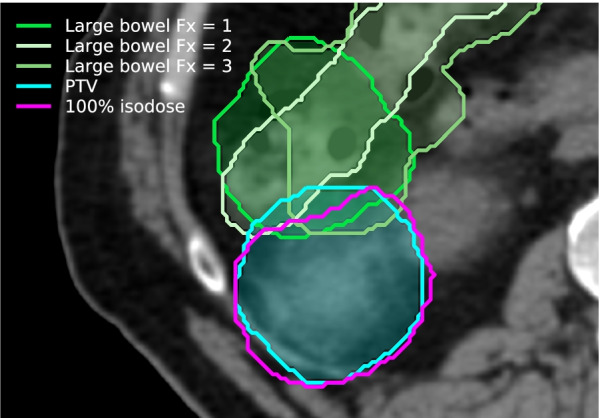
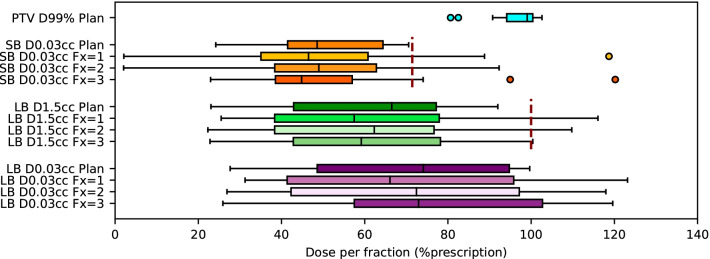
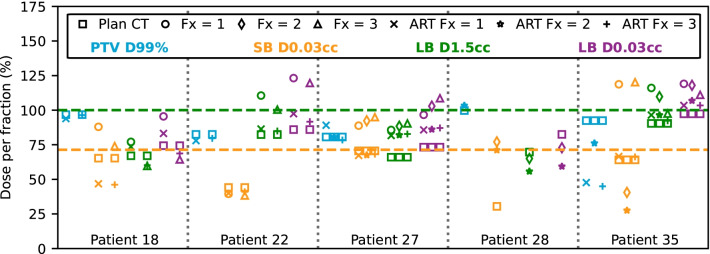
In 36 patients, OARs were segmented on 76 PRE CBCTs and 30 MID CBCTs. Interfraction motion was larger than intrafraction motion in STO (p-value = 0.04) but was similar in SB (p-value = 0.8) and LB (p-value = 0.2). LB was inside the planned 100% isodose in all PRE CBCTs and MID CBCTs in the three patients that suffered from bowel stricture. SB D0.03cc was exceeded in 8 fractions (4 patients). LB D1.5cc was exceeded in 4 fractions (2 patients). Doses to OARs were lowered and limits were all met with ART on the anatomy of the day.
Interfraction motion was responsible for OARs overdosage. Dose limits were respected by using ART with the anatomy of the day.
在肾脏 SABR 治疗过程中,由于分次内和分次间的运动,传递器官(OARs)的剂量可能会偏离计划剂量。在我们的机构中,有报道称 SABR 治疗后出现肠道狭窄需要手术的病例。本研究旨在提供策略,以减少 SABR 治疗过程中 OARs 所接受的剂量,并降低胃肠道毒性的风险。
在开始给予任何剂量之前(预 CBCT)和给予任何剂量之后的第一次 CBCT(中 CBCT)上勾画小肠(SB)、大肠(LB)和胃(STO)。通过 OAR 与内部靶区(ITV)之间的最短距离来估计分次内和分次间的运动。如果超出剂量限制,则通过将计划剂量投影到当天的解剖结构上进行自适应放射治疗(ART)。
在 36 名患者中,对 76 次预 CBCT 和 30 次中 CBCT 进行了 OAR 分段。在 STO 中,分次间运动大于分次内运动(p 值=0.04),但在 SB(p 值=0.8)和 LB(p 值=0.2)中相似。在三个发生肠道狭窄的患者中,所有预 CBCT 和中 CBCT 中 LB 均位于计划 100%等剂量线内。4 名患者的 SB D0.03cc 超过了 8 个分数。2 名患者的 LB D1.5cc 超过了 4 个分数。通过使用当天的解剖结构进行 ART,降低了 OAR 剂量,所有限制均得到满足。
分次间运动是导致 OAR 剂量过大的原因。通过使用当天的解剖结构进行 ART,剂量限制得到了遵守。