Department of Public Health and Preventive Medicine, Wuxi School of Medicine Jiangnan University, 1800 Lihu Road, Binhu District, Wuxi, 214122, Jiangsu Province, China.
Institutes of Biology and Medical Sciences, Soochow University, Suzhou, 215000, Jiangsu, China.
Sci Rep. 2022 Jun 28;12(1):10903. doi: 10.1038/s41598-022-15212-8.
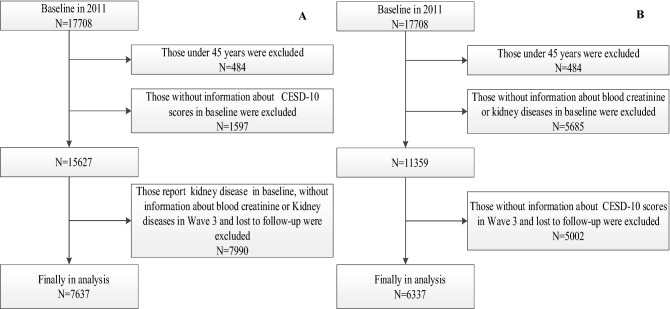
Previous studies had reported the mutual relation between depression and chronic kidney diseases (CKD). This study aimed to investigate potential bidirectional relationships between depression and CKD. Participants more than 45 years from the China Health and Retirement Longitudinal Study (CHARLS) were included in present study. In study I, we tended to assess the association between baseline depression with the risk of subsequent CKD. In study II, we aimed to examine whether the onset of CKD could predict the development of depression. Multivariate logistic regression models were used to calculate odds ratios (ORs) and 95% confidence intervals (95% CIs) in study I and study II, respectively. In study I, 301 (6.16%) respondents experienced CKD in participants without depression, and 233 (8.48%) respondents experienced CKD in participants with depression. Participants with depression had higher risk of developing CKD with the corresponding ORs (95% CIs) was 1.38(1.08-1.76). In study II, 1333 (22.29%) subjects in the non-CKD group and 97 (27.17%) in CKD group developed depressive symptoms. Individuals with CKD had higher risk of developing depression than those without CKD, with the multivariate ORs (95% CIs) was 1.48(1.23-1.78). Significant bidirectional relationships remained in both sensitivity and subgroup analyses. Findings demonstrate bidirectional relationships between depression and CKD. Individuals with depression were associated with increasing risk of CKD; in addition, CKD patients had higher risk of developing depression.
先前的研究报告了抑郁和慢性肾脏病(CKD)之间的相互关系。本研究旨在探讨抑郁和 CKD 之间潜在的双向关系。本研究纳入了来自中国健康与养老追踪调查(CHARLS)的年龄在 45 岁以上的参与者。在研究 I 中,我们倾向于评估基线抑郁与随后发生 CKD 的风险之间的关联。在研究 II 中,我们旨在检验 CKD 的发病是否可以预测抑郁的发生。在研究 I 和研究 II 中,分别使用多变量逻辑回归模型来计算比值比(ORs)和 95%置信区间(95% CIs)。在研究 I 中,在无抑郁的参与者中,有 301(6.16%)名参与者患有 CKD,在有抑郁的参与者中,有 233(8.48%)名参与者患有 CKD。患有抑郁的参与者发生 CKD 的风险更高,相应的 ORs(95% CIs)为 1.38(1.08-1.76)。在研究 II 中,在非 CKD 组中,有 1333(22.29%)名受试者和 CKD 组中有 97(27.17%)名受试者出现抑郁症状。与无 CKD 者相比,CKD 者发生抑郁的风险更高,多变量 ORs(95% CIs)为 1.48(1.23-1.78)。敏感性和亚组分析均显示出抑郁和 CKD 之间存在双向关系。这些发现表明抑郁和 CKD 之间存在双向关系。患有抑郁的个体与 CKD 风险增加相关;此外,CKD 患者发生抑郁的风险更高。