Department of Nursing, Okinawa Prefectural College of Nursing, Yogi 1-24-1, Naha City, Okinawa, 902-8513, Japan.
BMC Health Serv Res. 2022 Jun 28;22(1):836. doi: 10.1186/s12913-022-08205-w.
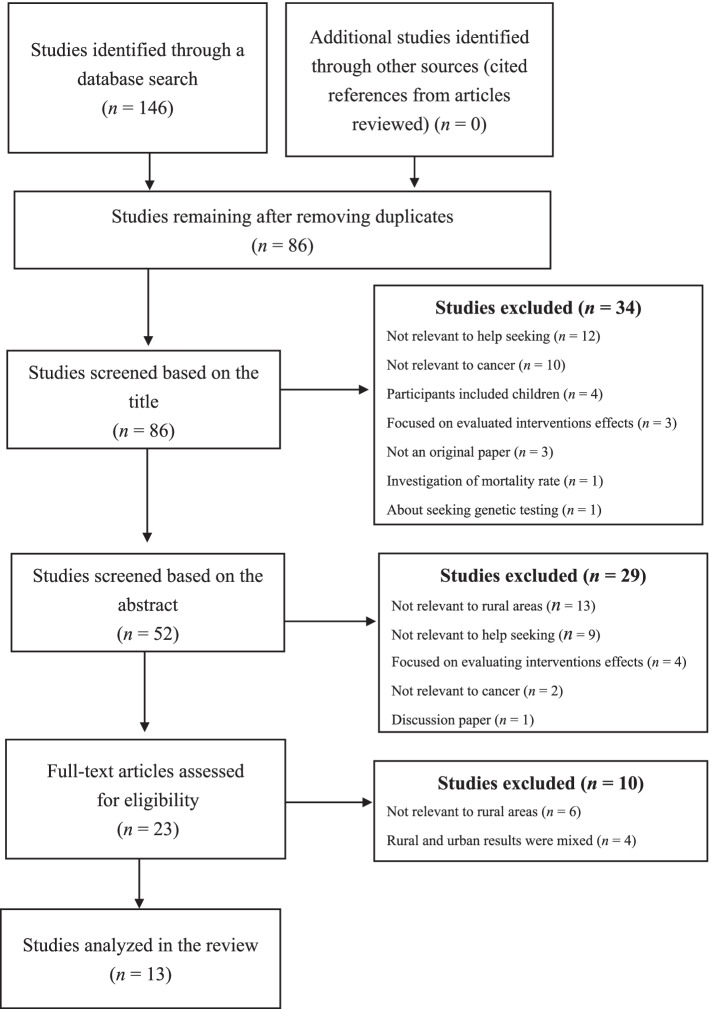
Despite the importance of timely diagnosis and access to treatment, previous studies have not adequately explored help-seeking behavior in cancer treatment among rural and remote residents. The barriers preventing help-seeking behavior also remain unclear. To address this research gap, this study conducted a scoping review to suggest a framework for eliminating barriers and facilitating help-seeking for cancer treatment among rural and remote residents. To conduct the scoping review, three English medical databases (PubMed, MEDLINE, and CINAHL) were examined for the keywords "rural," "remote," "cancer," and "help-seeking." The research objectives and study designs, participants, and excerpts describing help-seeking of the selected papers were recorded in a data charting form. Descriptions of help-seeking behavior were organized and summarized according to their meaning and integrated into factors using thematic analysis. All extracted factors related to help-seeking were sorted into four main themes according to the Ecological Model of Health Behavior, the theoretical lens for this scoping review: (1) Intrapersonal; (2) Interpersonal; (3) Groups, culture, and organizations; and (4) Policy/environment. Factors were categorized as barriers and facilitators of help-seeking. A total of 13 papers were analyzed. Intrapersonal factors such as self-reliance, symptom appraisal, and fatalism, were identified as barriers to help-seeking, whereas presentation of abnormal and serious symptoms facilitated help-seeking. Interpersonal factors such as lack of understanding of family members, influence of surrounding people, role obligations, and lack of trust in experts hindered help-seeking, whereas understanding from surrounding people such as family and friends, promoted help-seeking. Groups, cultural, and organizational factors such as prejudice, social stigma, shame, lack of anonymity, and social norms acted as barriers to help-seeking. Policy-related barriers to help-seeking included lack of medical services and physical distance from medical institutions, leading to a time burden. The study discussed the identified factors from a rural context. Future studies should consider the identified barriers and facilitators according to the four main themes in rural areas when formulating interventions to promote help-seeking. Our findings can offer a theoretical foundation to develop actionable policies, preventive strategies, and relevant interventional tools that may facilitate oncological service utilization in rural areas.
尽管及时诊断和获得治疗至关重要,但先前的研究并未充分探讨农村和偏远地区居民在癌症治疗中的寻求帮助行为。阻碍寻求帮助行为的因素也不清楚。为了解决这一研究空白,本研究进行了范围界定审查,旨在为农村和偏远地区居民消除癌症治疗中的障碍和促进寻求帮助行为提出一个框架。为了进行范围界定审查,我们检查了三个英文医学数据库(PubMed、MEDLINE 和 CINAHL),使用了“农村”、“偏远”、“癌症”和“寻求帮助”等关键词。研究目标和研究设计、参与者以及所选论文中描述寻求帮助的摘录都记录在数据图表形式中。根据意义对寻求帮助行为的描述进行组织和总结,并使用主题分析将其纳入因素中。所有提取的与寻求帮助相关的因素都根据健康行为的生态模型(本次范围界定审查的理论视角)分为四个主要主题进行分类:(1)个体内部;(2)人际间;(3)群体、文化和组织;和(4)政策/环境。因素被归类为寻求帮助的障碍和促进因素。共分析了 13 篇论文。个体内部因素,如自力更生、症状评估和宿命论,被认为是寻求帮助的障碍,而异常和严重症状的出现则促进了寻求帮助。人际间因素,如家庭成员的不理解、周围人的影响、角色义务和对专家的不信任,阻碍了寻求帮助,而来自周围人的理解,如家人和朋友,则促进了寻求帮助。群体、文化和组织因素,如偏见、社会耻辱感、羞耻感、缺乏匿名性和社会规范,是寻求帮助的障碍。与政策相关的寻求帮助障碍包括医疗服务缺乏和与医疗机构的物理距离,导致时间负担。本研究从农村背景讨论了确定的因素。未来的研究应根据农村地区的四个主要主题考虑确定的障碍和促进因素,在制定促进寻求帮助的干预措施时。我们的研究结果可以为制定可行的政策、预防策略和相关干预工具提供理论基础,这些政策、策略和干预工具可能有助于促进农村地区的肿瘤服务利用。