Bécares Laia, Shaw Richard J, Katikireddi Srinivasa Vittal, Irizar Patricia, Amele Sarah, Kapadia Dharmi, Nazroo James, Taylor Harry
Department of Social Work and Social Care, University of Sussex, Falmer, UK.
MRC/CSO Social and Public Health Sciences Unit, University of Glasgow, Glasgow, UK.
SSM Popul Health. 2022 Sep;19:101150. doi: 10.1016/j.ssmph.2022.101150. Epub 2022 Jun 24.
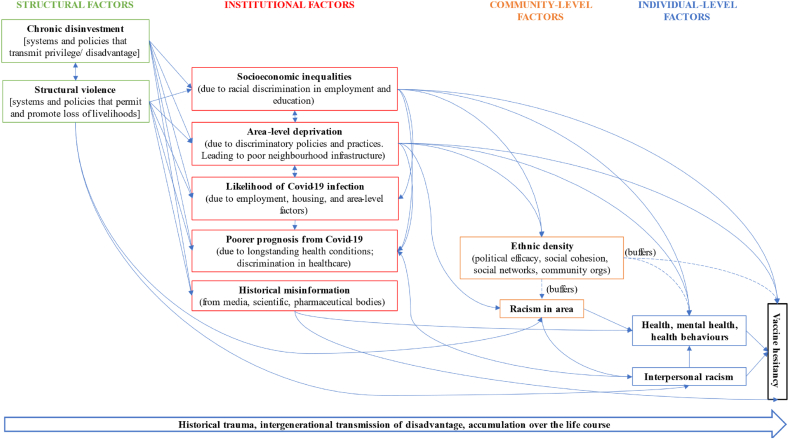
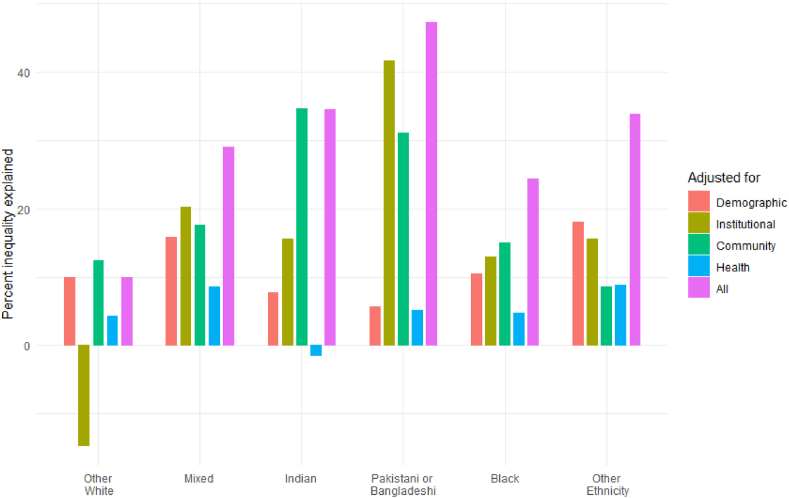
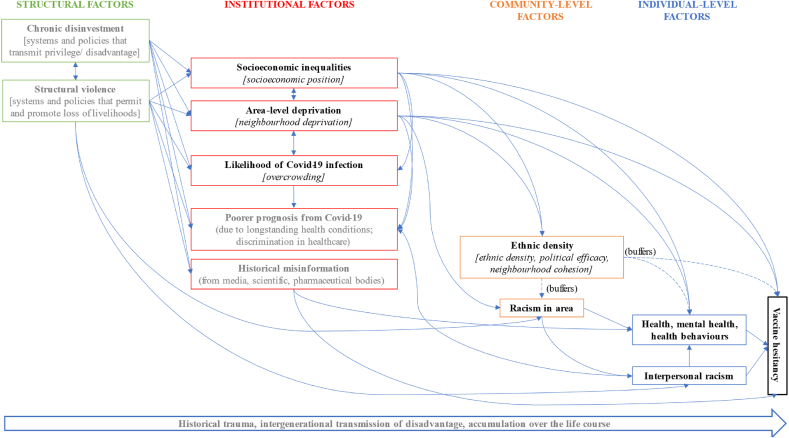
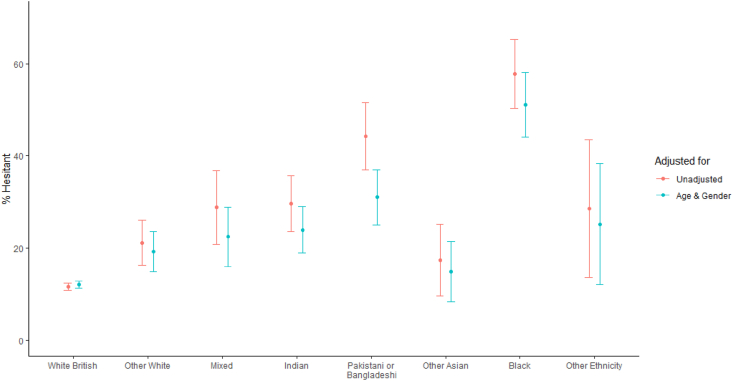
Ethnic inequities in COVID-19 vaccine hesitancy have been reported in the United Kingdom (UK), and elsewhere. Explanations have mainly focused on differences in the level of concern about side effects, and in lack of trust in the development and efficacy of vaccines. Here we propose that racism is the fundamental cause of ethnic inequities in vaccine hesitancy. We introduce a theoretical framework detailing the mechanisms by which racism at the structural, institutional, and interpersonal level leads to higher vaccine hesitancy among minoritised ethnic groups. We then use data from Wave 6 of the UK Household Longitudinal Study COVID-19 Survey (November to December 2020) to empirically examine these pathways, operationalised into institutional, community, and individual-level factors. We use the Karlson-Holm-Breen method to formally compare the relationship between ethnicity and vaccine hesitancy once age and gender, sociodemographic variables, and institutional, community, and individual-level factors are accounted for. Based on the Average Partial Effects we calculate the percentage of ethnic inequities explained by each set of factors. Findings show that institutional-level factors (socioeconomic position, area-level deprivation, overcrowding) explained the largest part (42%) of the inequity in vaccine hesistancy for Pakistani or Bangladeshi people, and community-level factors (ethnic density, community cohesion, political efficacy, racism in the area) were the most important factors for Indian and Black groups, explaining 35% and 15% of the inequity, respectively. Our findings suggest that if policy intervened on institutional and community-level factors - shaped by structural and institutional racism - considerable success in reducing ethnic inequities might be achieved.
英国及其他地区均报告了新冠疫苗犹豫方面的种族不平等现象。对此的解释主要集中在对副作用的担忧程度差异,以及对疫苗研发和效果缺乏信任。在此,我们提出种族主义是疫苗犹豫方面种族不平等的根本原因。我们引入了一个理论框架,详细阐述了结构、制度和人际层面的种族主义导致少数族裔群体疫苗犹豫程度更高的机制。然后,我们使用英国家庭纵向研究新冠调查第6波(2020年11月至12月)的数据,对这些途径进行实证检验,并将其细化为制度、社区和个人层面的因素。在考虑年龄、性别、社会人口统计学变量以及制度、社区和个人层面的因素后,我们使用卡尔森 - 霍尔姆 - 布林方法正式比较种族与疫苗犹豫之间的关系。基于平均偏效应,我们计算了每组因素所解释的种族不平等的百分比。研究结果表明,制度层面的因素(社会经济地位、地区贫困程度、居住拥挤程度)解释了巴基斯坦或孟加拉人群体疫苗犹豫不平等现象的最大部分(42%),而社区层面的因素(种族密度、社区凝聚力、政治效能感、该地区的种族主义)是印度和黑人群体最重要的因素,分别解释了35%和15%的不平等现象。我们的研究结果表明,如果政策干预由结构性和制度性种族主义塑造的制度和社区层面的因素,那么在减少种族不平等方面可能会取得相当大的成功。