Thøgersen Rasmus Vester, Bianchini Federico, Fjellvåg Helmer, Vajeeston Ponniah
Centre for Materials Science and Nanotechnology, Department of Chemistry, University of Oslo P.O. Box 1033 Blindern N-0315 Oslo Norway
RSC Adv. 2022 Jun 13;12(27):17410-17421. doi: 10.1039/d2ra01834a. eCollection 2022 Jun 7.
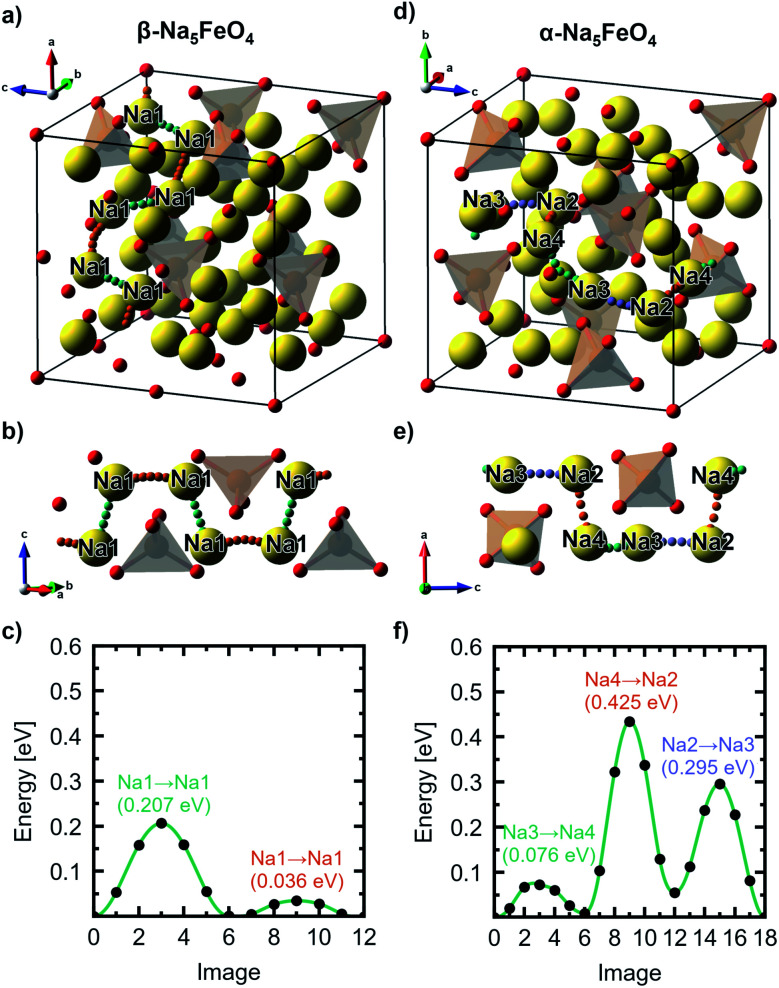
The rapid electrification of our society and the transition towards a larger share of intermittent renewable energy sources in our electricity grids will dramatically increase the demand for cheap energy storage. Sodium ion batteries (SIBs) show a lot of promise to provide the required stationary storage at the grid level at low cost owing to the natural abundance and geographical availability of sodium. In addition, alkali-rich cathode materials exhibiting anionic redox contributions have garnered much attention over the past decade as a strategy to increase the specific capacity. In this work, we investigate for the first time the sodium-rich compound NaFeO as a potential low-cost, environment-friendly cathode for sodium ion batteries from first principles using density functional theory. We investigate three low-energy polymorphs related to the antifluorite structure, verify their dynamical and mechanical stabilities, and show that they exhibit promising ion diffusive properties. As alkali-rich cathode materials are prone to oxygen loss during cycling, we investigate cycling stability with respect to phase transformations and oxygen loss and identify in particular one promising cycling interval that can reversibly shuttle 1.5 Na per formula unit between NaFeO and NaFeO with a gravimetric energy density exceeding 360 W h kg. Investigations into possible redox mechanisms reveal that the charge compensation occurs simultaneously on Fe- and O-atoms in FeO-tetrahedra, which suggests that NaFeO, if realised experimentally as a cathode material, would join the family of combined cationic/anionic redox compounds.
我们社会的快速电气化以及电网向更大比例的间歇性可再生能源的转型,将极大地增加对廉价储能的需求。钠离子电池(SIBs)由于钠的天然丰度和地理可获取性,有望以低成本在电网层面提供所需的固定储能。此外,在过去十年中,表现出阴离子氧化还原贡献的富碱阴极材料作为提高比容量的一种策略受到了广泛关注。在这项工作中,我们首次使用密度泛函理论从第一性原理出发,研究富钠化合物NaFeO作为钠离子电池潜在的低成本、环境友好型阴极。我们研究了与反萤石结构相关的三种低能量多晶型物,验证了它们的动力学和机械稳定性,并表明它们具有良好的离子扩散性能。由于富碱阴极材料在循环过程中容易发生氧损失,我们研究了相变和氧损失方面的循环稳定性,特别确定了一个有前景的循环区间,该区间每公式单位可在NaFeO和NaFeO之间可逆地穿梭1.5个Na,重量能量密度超过360 W h kg。对可能的氧化还原机制的研究表明,电荷补偿在FeO四面体中的Fe和O原子上同时发生,这表明如果NaFeO作为阴极材料通过实验实现,它将加入阳离子/阴离子复合氧化还原化合物家族。