Department of Structural Biology, Genentech, South San Francisco, CA, USA.
Pharmaceutical Development, Genentech, South San Francisco, CA, USA.
Nature. 2022 Sep;609(7926):400-407. doi: 10.1038/s41586-022-04838-3. Epub 2022 Jun 29.
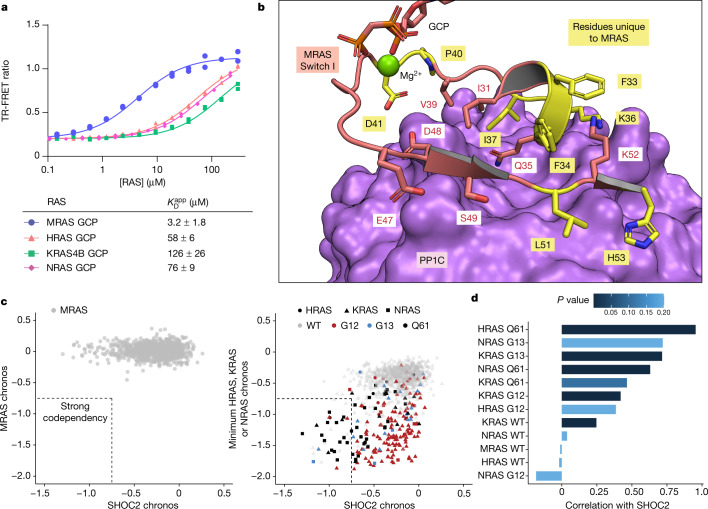
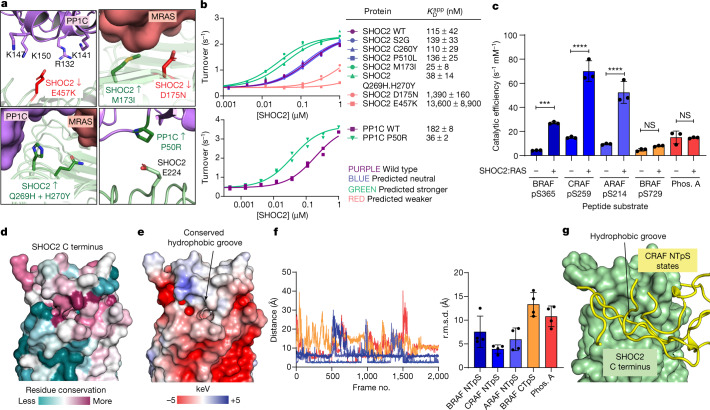
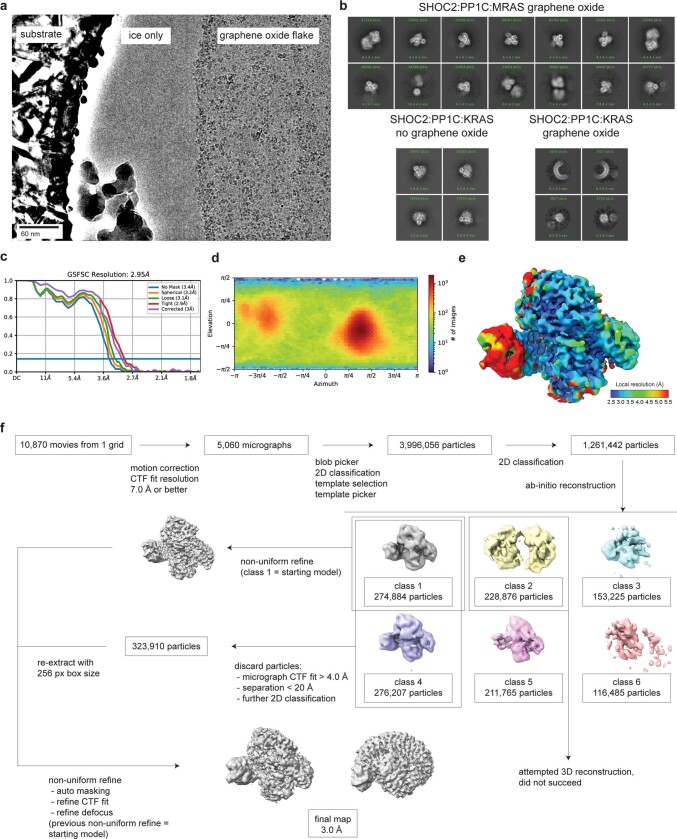
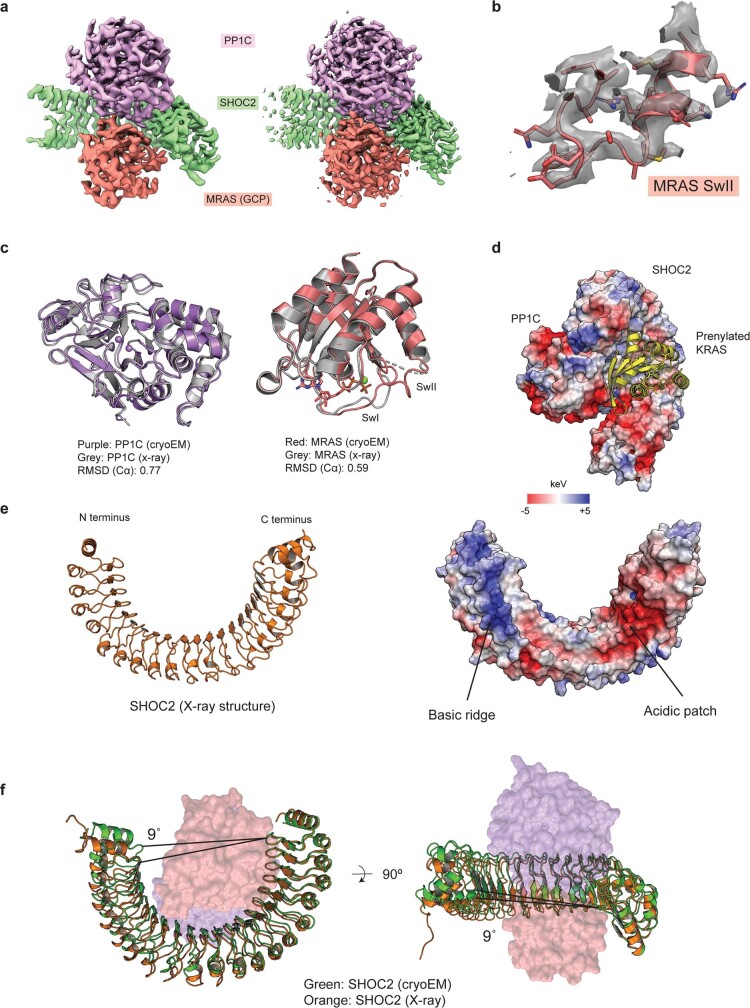
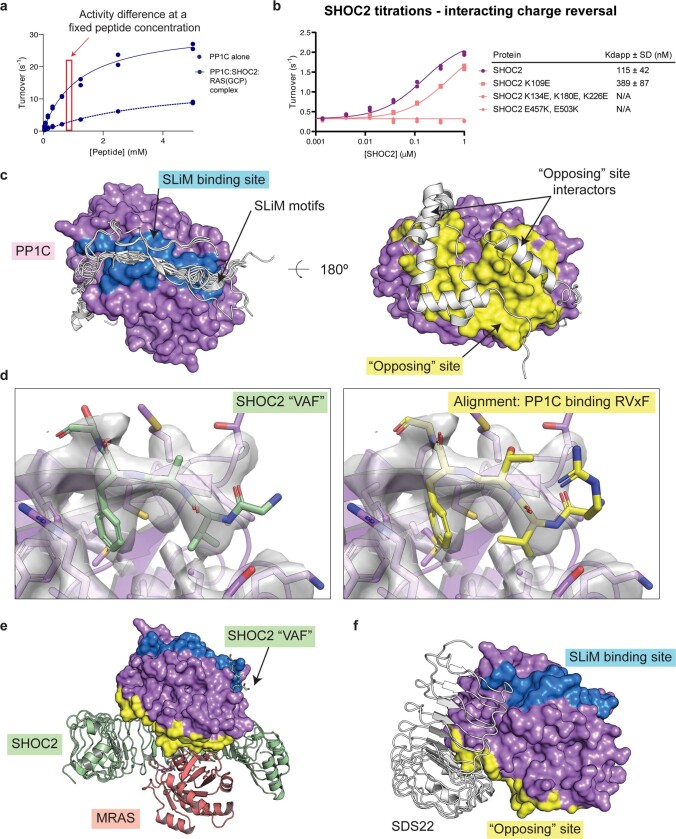
The RAS-RAF pathway is one of the most commonly dysregulated in human cancers. Despite decades of study, understanding of the molecular mechanisms underlying dimerization and activation of the kinase RAF remains limited. Recent structures of inactive RAF monomer and active RAF dimer bound to 14-3-3 have revealed the mechanisms by which 14-3-3 stabilizes both RAF conformations via specific phosphoserine residues. Prior to RAF dimerization, the protein phosphatase 1 catalytic subunit (PP1C) must dephosphorylate the N-terminal phosphoserine (NTpS) of RAF to relieve inhibition by 14-3-3, although PP1C in isolation lacks intrinsic substrate selectivity. SHOC2 is as an essential scaffolding protein that engages both PP1C and RAS to dephosphorylate RAF NTpS, but the structure of SHOC2 and the architecture of the presumptive SHOC2-PP1C-RAS complex remain unknown. Here we present a cryo-electron microscopy structure of the SHOC2-PP1C-MRAS complex to an overall resolution of 3 Å, revealing a tripartite molecular architecture in which a crescent-shaped SHOC2 acts as a cradle and brings together PP1C and MRAS. Our work demonstrates the GTP dependence of multiple RAS isoforms for complex formation, delineates the RAS-isoform preference for complex assembly, and uncovers how the SHOC2 scaffold and RAS collectively drive specificity of PP1C for RAF NTpS. Our data indicate that disease-relevant mutations affect complex assembly, reveal the simultaneous requirement of two RAS molecules for RAF activation, and establish rational avenues for discovery of new classes of inhibitors to target this pathway.
RAS-RAF 通路是人类癌症中最常失调的通路之一。尽管经过了几十年的研究,但对 RAF 激酶二聚化和激活的分子机制的理解仍然有限。最近,无活性 RAF 单体和与 14-3-3 结合的活性 RAF 二聚体的结构揭示了 14-3-3 通过特定的磷酸丝氨酸残基稳定 RAF 两种构象的机制。在 RAF 二聚化之前,蛋白磷酸酶 1 催化亚基(PP1C)必须去磷酸化 RAF 的 N 端磷酸丝氨酸(NTpS),以解除 14-3-3 的抑制,尽管单独的 PP1C 缺乏内在的底物选择性。SHOC2 是一种必不可少的支架蛋白,它与 PP1C 和 RAS 结合,使 RAF NTpS 去磷酸化,但 SHOC2 的结构和假定的 SHOC2-PP1C-RAS 复合物的结构仍然未知。在这里,我们提出了 SHOC2-PP1C-MRAS 复合物的冷冻电子显微镜结构,整体分辨率为 3Å,揭示了一个新月形的 SHOC2 作为摇篮的三部分分子结构,将 PP1C 和 MRAS 聚集在一起。我们的工作证明了多种 RAS 同工型对复合物形成的 GTP 依赖性,描绘了 RAS 同工型对复合物组装的偏好,并揭示了 SHOC2 支架和 RAS 如何共同驱动 PP1C 对 RAF NTpS 的特异性。我们的数据表明,疾病相关的突变会影响复合物的组装,揭示了两个 RAS 分子对 RAF 激活的同时需求,并为发现针对该途径的新类抑制剂提供了合理的途径。