Plant Microbiosis Lab, Department of Microbiology, Friedrich Schiller University Jena, Jena, Germany.
Mass Spectrometry Platform, Friedrich Schiller University Jena, Jena, Germany.
ISME J. 2022 Sep;16(9):2280-2289. doi: 10.1038/s41396-022-01271-2. Epub 2022 Jun 29.
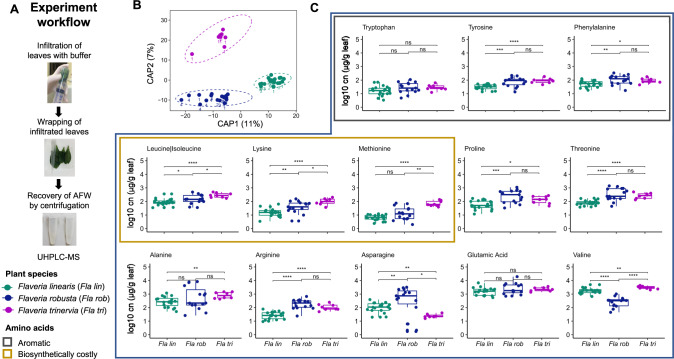
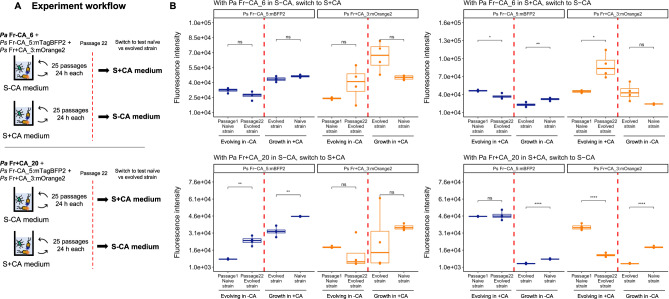
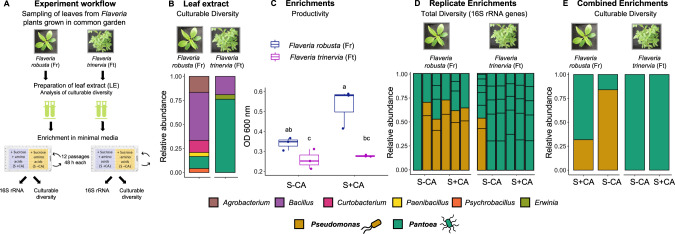
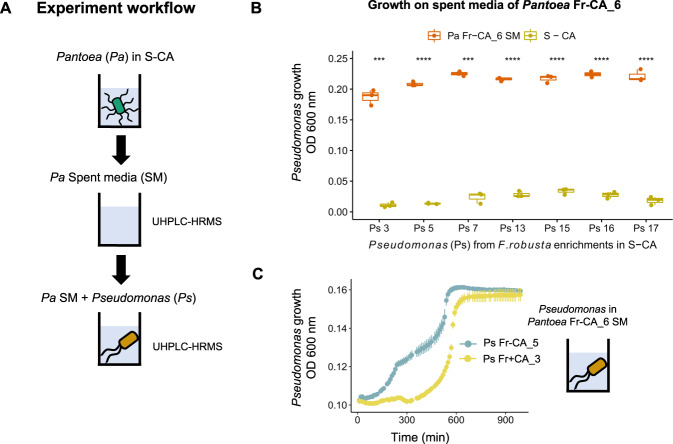
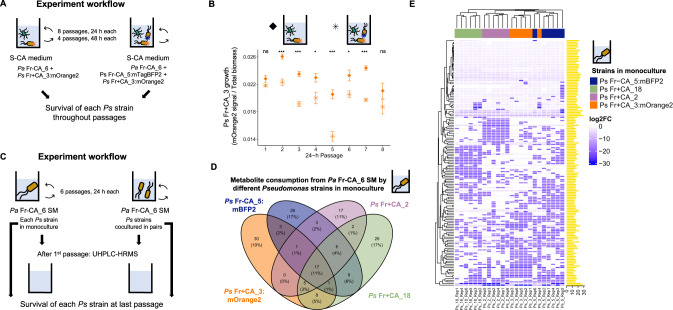
Leaf microbiomes play crucial roles in plant health, making it important to understand the origins and functional relevance of their diversity. High strain-level leaf bacterial genetic diversity is known to be relevant for interactions with hosts, but little is known about its relevance for interactions with the multitude of diverse co-colonizing microorganisms. In leaves, nutrients like amino acids are major regulators of microbial growth and activity. Using metabolomics of leaf apoplast fluid, we found that different species of the plant genus Flaveria considerably differ in the concentrations of high-cost amino acids. We investigated how these differences affect bacterial community diversity and assembly by enriching leaf bacteria in vitro with only sucrose or sucrose + amino acids as possible carbon sources. Enrichments from F. robusta were dominated by Pantoea sp. and Pseudomonas sp., regardless of carbon source. The latter was unable to grow on sucrose alone but persisted in the sucrose-only enrichment thanks to exchange of diverse metabolites from Pantoea sp. Individual Pseudomonas strains in the enrichments had high genetic similarity but still displayed clear niche partitioning, enabling distinct strains to cross-feed in parallel. Pantoea strains were also closely related, but individuals enriched from F. trinervia fed Pseudomonas more poorly than those from F. robusta. This can be explained in part by the plant environment, since some cross-feeding interactions were selected for, when experimentally evolved in a poor (sucrose-only) environment but selected against in a rich (sucrose + amino acids) one. Together, our work shows that leaf bacterial diversity is functionally relevant in cross-feeding interactions and strongly suggests that the leaf resource environment can shape these interactions and thereby indirectly drive bacterial diversity.
叶片微生物组在植物健康中起着至关重要的作用,因此了解其多样性的起源和功能相关性非常重要。已知高菌株水平的叶片细菌遗传多样性与宿主相互作用有关,但对于其与众多不同共定殖微生物的相互作用的相关性知之甚少。在叶片中,像氨基酸这样的营养物质是微生物生长和活性的主要调节剂。通过叶片质外体流体的代谢组学研究,我们发现植物属 Flaveria 的不同物种在高成本氨基酸的浓度上有很大差异。我们通过仅用蔗糖或蔗糖+氨基酸作为可能的碳源在体外富集叶片细菌,研究了这些差异如何影响细菌群落多样性和组装。从 F. robusta 中富集的细菌主要由 Pantoea sp. 和 Pseudomonas sp. 组成,而与碳源无关。后者不能单独在蔗糖上生长,但由于 Pantoea sp. 交换了各种代谢物,在蔗糖单独富集中得以存活。富集物中的单个 Pseudomonas 菌株具有很高的遗传相似性,但仍表现出明显的生态位分化,使不同的菌株能够并行交叉喂养。Pantoea 菌株也密切相关,但从 F. trinervia 中富集的个体比从 F. robusta 中富集的个体对 Pseudomonas 的喂养效果较差。这在一定程度上可以用植物环境来解释,因为一些交叉喂养相互作用在贫瘠(仅蔗糖)环境中经过实验进化时被选择,但在丰富(蔗糖+氨基酸)环境中被选择。总的来说,我们的工作表明,叶片细菌多样性在交叉喂养相互作用中具有功能相关性,并强烈表明叶片资源环境可以塑造这些相互作用,从而间接驱动细菌多样性。