Department of Endocrinology, Genetics and Metabolism, Beijing Children's Hospital, Capital Medical University, National Center for Children's Health, Beijing, China.
Department of Pain Medicine, Peking University Third Hospital, Beijing, China.
Front Endocrinol (Lausanne). 2022 Jun 13;13:880418. doi: 10.3389/fendo.2022.880418. eCollection 2022.
To ascertain the associations of serum bone turnover markers (BTMs) levels with body mass index (BMI) in Chinese children and adolescents, and whether the influence of BMI, age, pubertal stage on BTMs varied by gender.
A total of 500 students (180 controls and 320 children and adolescents with overweight/obesity) aged 9-14 years were randomly selected from the Chinese National Survey on Students Constitution and Health Cohort. Serum levels of BTMs, including bone formation marker bone alkaline phosphatase (BAP), collagen type 1 C-terminal propeptide (CICP), and bone resorption markers C-terminal telopeptide of type-I collagen (CTX) were determined by commercial enzyme-linked immunosorbent assay kits. The associations among BMI, age, gender, pubertal stage, and BTMs were analyzed.
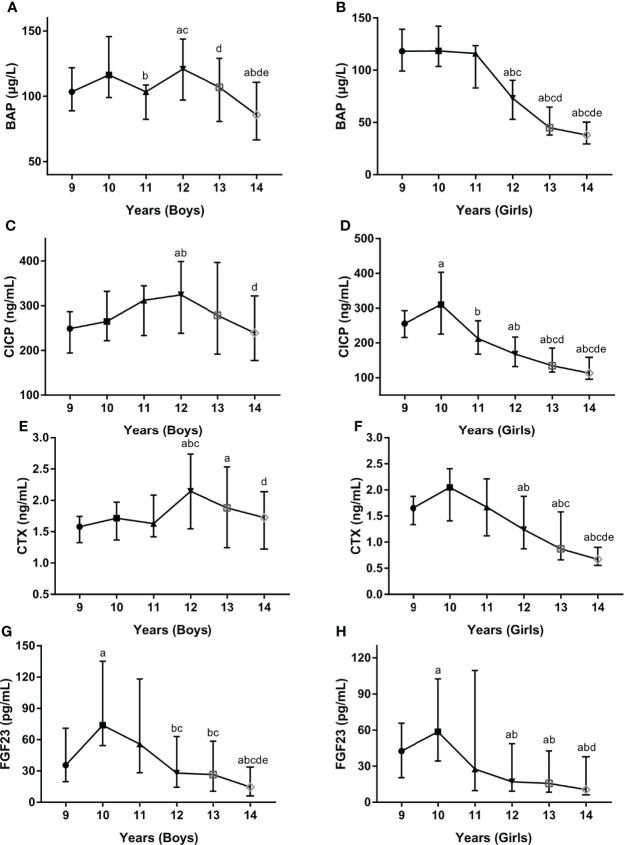
Serum levels of CICP and CTX in overweight/obese children and adolescents were lower than those in controls (<0.05). Moreover, after subgroup analysis stratified by gender, the decreased serum CICP and CTX levels in overweight/obese children and adolescents were observed only in boys (<0.05). After adjustment of age and pubertal stage, there was a negative correlation between serum BAP and BMI in both boys and girls (<0.05). However, the correlations between serum CICP, CTX levels, and BMI were significant in boys but not in girls. Serum BAP and CICP levels were independently correlated with BMI, age, gender, and pubertal stage, while CTX levels were independently correlated with BMI, age, and gender (<0.05). BAP, CICP, and CTX levels showed a clear age, gender, and pubertal stage dependence with significantly higher values in boys (<0.05).
Our findings support the associations between serum BTMs levels and BMI in Chinese children and adolescents, and suggest age, gender, and pubertal stage differences in this relationship that warrant future studies.
确定血清骨转换标志物(BTM)水平与中国儿童和青少年体重指数(BMI)之间的关联,并探讨 BMI、年龄、青春期阶段对 BTM 的影响是否因性别而异。
从中国全国学生体质与健康监测队列中随机抽取 500 名 9-14 岁的学生(180 名对照组和 320 名超重/肥胖儿童和青少年)。采用商业酶联免疫吸附试验试剂盒检测 BTMs 水平,包括骨形成标志物骨碱性磷酸酶(BAP)、I 型胶原 C 端肽(CTX)和骨吸收标志物 I 型胶原 C 端肽(CICP)。分析 BMI、年龄、性别、青春期阶段与 BTMs 之间的关系。
超重/肥胖儿童和青少年的血清 CICP 和 CTX 水平低于对照组(<0.05)。此外,按性别进行亚组分析后,仅在男孩中观察到超重/肥胖儿童和青少年的血清 CICP 和 CTX 水平降低(<0.05)。调整年龄和青春期阶段后,男女儿童和青少年的血清 BAP 与 BMI 呈负相关(<0.05)。然而,血清 CICP 和 CTX 水平与 BMI 的相关性仅在男孩中显著,而在女孩中不显著。血清 BAP 和 CICP 水平与 BMI、年龄、性别和青春期阶段独立相关,而 CTX 水平与 BMI、年龄和性别独立相关(<0.05)。BAP、CICP 和 CTX 水平具有明显的年龄、性别和青春期阶段依赖性,男孩中的值明显更高(<0.05)。
本研究结果支持中国儿童和青少年的血清 BTMs 水平与 BMI 之间的关联,并提示这种关系存在年龄、性别和青春期阶段的差异,需要进一步研究。