Social, Genetic and Developmental Psychiatry Centre, Institute of Psychiatry, Psychology and Neuroscience, King's College London, London, UK.
UK National Institute for Health Research (NIHR) Biomedical Research Centre for Mental Health, South London and Maudsley Hospital, London, UK.
Sci Rep. 2021 Jun 14;11(1):12478. doi: 10.1038/s41598-021-90644-2.
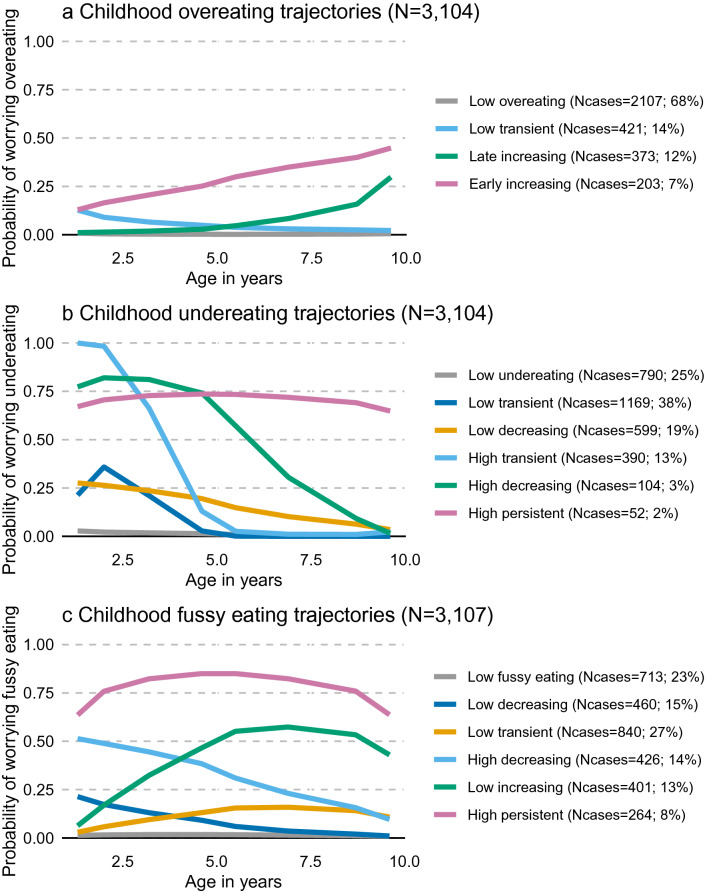
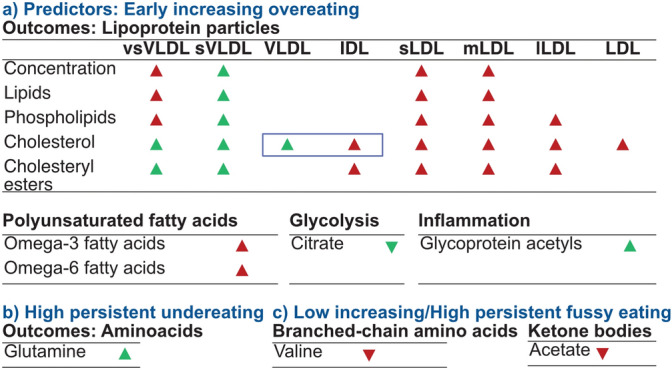
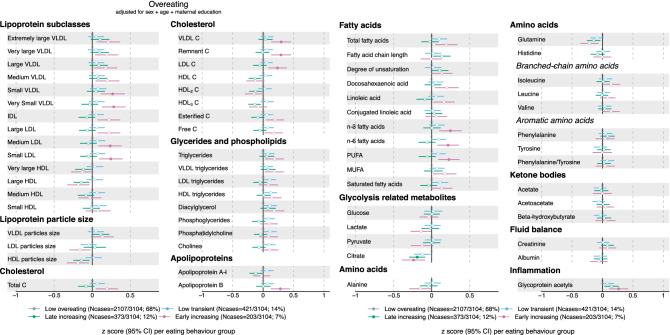
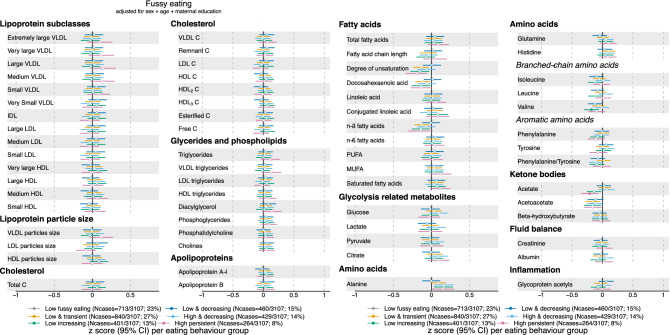
Childhood eating behaviour contributes to the rise of obesity and related noncommunicable disease worldwide. However, we lack a deep understanding of biochemical alterations that can arise from aberrant eating behaviour. In this study, we prospectively associate longitudinal trajectories of childhood overeating, undereating, and fussy eating with metabolic markers at age 16 years to explore adolescent metabolic alterations related to specific eating patterns in the first 10 years of life. Data are from the Avon Longitudinal Study of Parents and Children (n = 3104). We measure 158 metabolic markers with a high-throughput (H) NMR metabolomics platform. Increasing childhood overeating is prospectively associated with an adverse cardiometabolic profile (i.e., hyperlipidemia, hypercholesterolemia, hyperlipoproteinemia) in adolescence; whereas undereating and fussy eating are associated with lower concentrations of the amino acids glutamine and valine, suggesting a potential lack of micronutrients. Here, we show associations between early behavioural indicators of eating and metabolic markers.
儿童时期的饮食习惯是导致全球肥胖和相关非传染性疾病上升的原因之一。然而,我们对异常饮食习惯可能引起的生化变化还缺乏深入的了解。在这项研究中,我们前瞻性地将儿童期过度进食、进食不足和挑食的纵向轨迹与 16 岁时的代谢标志物相关联,以探讨与生命最初 10 年特定饮食模式相关的青少年代谢变化。数据来自雅芳纵向父母和儿童研究(n=3104)。我们使用高通量(H)NMR 代谢组学平台测量了 158 种代谢标志物。儿童时期过度进食与青少年时期不良的心血管代谢特征(即高血脂、高胆固醇血症、高脂蛋白血症)呈前瞻性相关;而进食不足和挑食与谷氨酰胺和缬氨酸等氨基酸浓度较低有关,这表明可能缺乏微量营养素。在这里,我们展示了早期行为指标与代谢标志物之间的关联。