Chui Celine Sze Ling, Fan Min, Wan Eric Yuk Fai, Leung Miriam Tim Yin, Cheung Edmund, Yan Vincent Ka Chun, Gao Le, Ghebremichael-Weldeselassie Yonas, Man Kenneth K C, Lau Kui Kai, Lam Ivan Chun Hang, Lai Francisco Tsz Tsun, Li Xue, Wong Carlos King Ho, Chan Esther W, Cheung Ching-Lung, Sing Chor-Wing, Lee Cheuk Kwong, Hung Ivan Fan Ngai, Lau Chak Sing, Chan Joseph Yat Sun, Lee Michael Kang-Yin, Mok Vincent Chung Tong, Siu Chung-Wah, Chan Lot Sze Tao, Cheung Terence, Chan Frank Ling Fung, Leung Anskar Yu-Hung, Cowling Benjamin John, Leung Gabriel Matthew, Wong Ian Chi Kei
School of Nursing, Li Ka Shing Faculty of Medicine, The University of Hong Kong, Hong Kong SAR, China.
School of Public Health, Li Ka Shing Faculty of Medicine, The University of Hong Kong, Hong Kong SAR, China.
EClinicalMedicine. 2022 Jun 25;50:101504. doi: 10.1016/j.eclinm.2022.101504. eCollection 2022 Aug.
This study aims to evaluate the association between thromboembolic events and hemorrhagic stroke following BNT162b2 and CoronaVac vaccination.
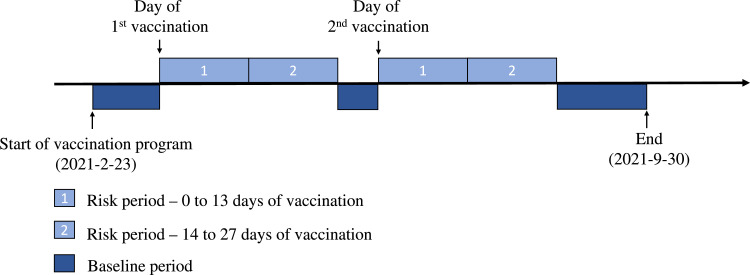
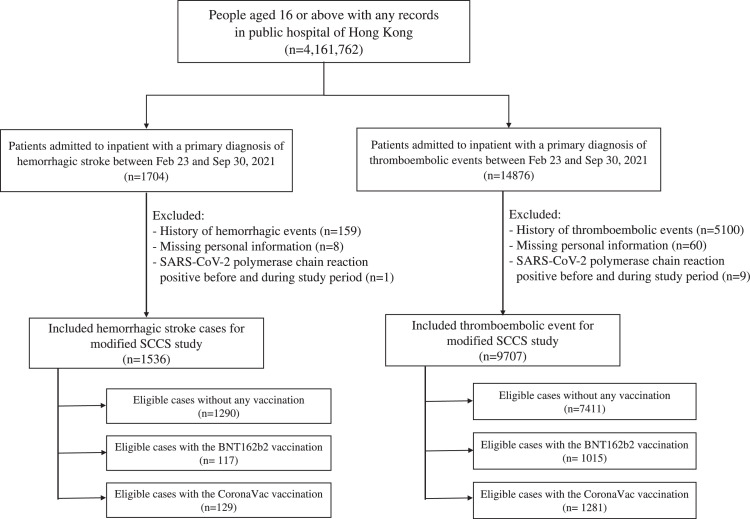
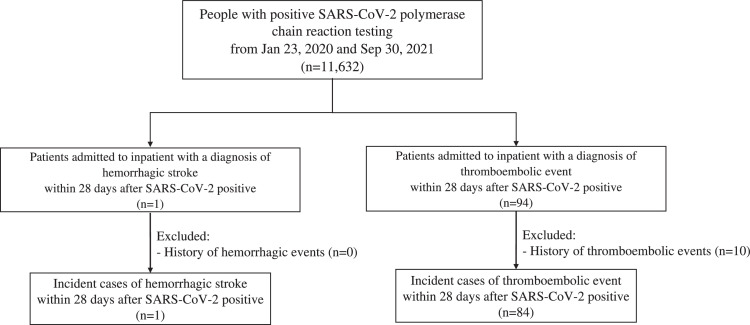
Patients with incident thromboembolic events or hemorrhagic stroke within 28 days of covid-19 vaccination or SARS-CoV-2 positive test during 23 February to 30 September 2021 were included. The incidence per 100,000 covid-19 vaccine doses administered and SARS-CoV-2 test positive cases were estimated. A modified self-controlled case series (SCCS) analysis using the data from the Hong Kong territory-wide electronic health and vaccination records. Seasonal effect was adjusted by month.
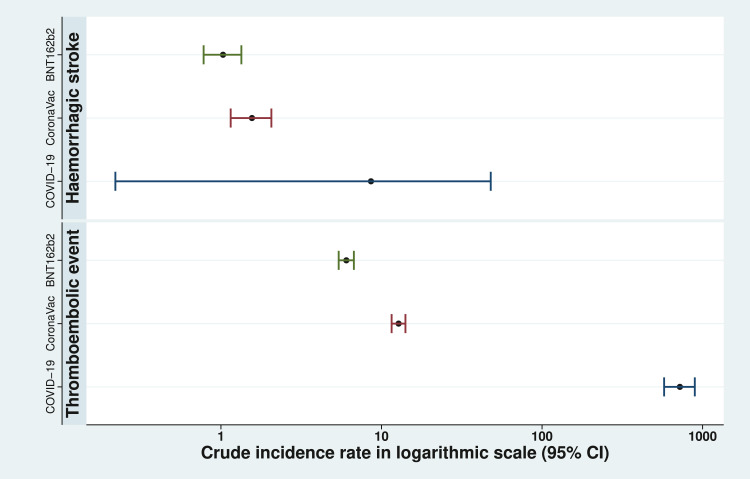
A total of 5,526,547 doses of BNT162b2 and 3,146,741 doses of CoronaVac were administered. A total of 334 and 402 thromboembolic events, and 57 and 49 hemorrhagic stroke cases occurred within 28 days after BNT162b2 and CoronaVac vaccination, respectively. The crude incidence of thromboembolic events and hemorrhagic stroke per 100,000 doses administered for both covid-19 vaccines were smaller than that per 100,000 SARS-CoV-2 test positive cases. The modified SCCS detected an increased risk of hemorrhagic stroke in BNT162b2 14-27 days after first dose with adjusted IRR of 2.53 (95% CI 1.48-4.34), and 0-13 days after second dose with adjusted IRR 2.69 (95% CI 1.54-4.69). No statistically significant risk was observed for thromboembolic events for both vaccines.
We detected a possible safety signal for hemorrhagic stroke following BNT162b2 vaccination. The incidence of thromboembolic event or hemorrhagic stroke following vaccination is lower than that among SARS-CoV-2 test positive cases; therefore, vaccination against covid-19 remains an important public health intervention.
This study was funded by a research grant from the Food and Health Bureau, The Government of the Hong Kong Special Administrative Region (reference COVID19F01).
本研究旨在评估接种BNT162b2和科兴新冠疫苗后血栓栓塞事件与出血性中风之间的关联。
纳入在2021年2月23日至9月30日期间接种新冠疫苗或SARS-CoV-2检测呈阳性后28天内发生血栓栓塞事件或出血性中风的患者。估计每10万剂新冠疫苗接种量和SARS-CoV-2检测阳性病例中的发病率。使用香港全港电子健康和疫苗接种记录数据进行改良的自我对照病例系列(SCCS)分析。季节性影响按月进行调整。
共接种了5,526,547剂BNT162b2和3,146,741剂科兴新冠疫苗。在接种BNT162b2和科兴新冠疫苗后28天内,分别发生了334例和402例血栓栓塞事件,以及57例和49例出血性中风病例。两种新冠疫苗每10万剂接种量的血栓栓塞事件和出血性中风的粗发病率均低于每10万例SARS-CoV-2检测阳性病例。改良的SCCS检测到在首次接种BNT162b2后14至27天出血性中风风险增加,调整后的发病率比值比(IRR)为2.53(95%置信区间1.48 - 4.34),在第二次接种后0至13天调整后的IRR为2.69(95%置信区间1.54 - 4.69)。两种疫苗的血栓栓塞事件均未观察到具有统计学意义的风险。
我们检测到接种BNT162b2后出血性中风可能存在安全信号。接种疫苗后血栓栓塞事件或出血性中风的发病率低于SARS-CoV-2检测阳性病例中的发病率;因此,新冠疫苗接种仍然是一项重要的公共卫生干预措施。
本研究由香港特别行政区政府食物及卫生局的一项研究资助(参考编号COVID19F01)。