Yano Yoshihiko, Yamamoto Atsushi, Minami Akihiro, Momose Kenji, Mimura Takuya, Kim Soo Ki, Hayashi Hiroki, Kado Takuo, Hirano Hirotaka, Hirohata Seiya, Yoon Seitetsu, Nishi Katsuhisa, Tei Hiroshi, Tanaka Hidenori, Oouchi Sachiko, Matsuura Takanori, Yasutomi Eiichiro, Hatazawa Yuri, Shiomi Yuuki, Ueda Yoshihide, Kodama Yuzo
Division of gastroenterology, Department of internal medicine Kobe University Graduate School of Medicine Kobe Japan.
Department of Gastroenterology Konan Medical Center Kobe Japan.
JGH Open. 2022 May 25;6(6):427-433. doi: 10.1002/jgh3.12772. eCollection 2022 Jun.
Molecular-targeted therapies such as sorafenib and lenvatinib have long been used as first-line treatment for advanced hepatocellular carcinoma (aHCC). However, adverse events or limited therapeutic effects may necessitate the change to another therapeutic option, known as post-progression therapy. To investigate the significance of post-progression therapy, we analyzed the outcomes of aHCC patients following first-line molecular-targeted therapy in a real-world study.
This retrospective, multicenter study involved patients with aHCC who received sorafenib or lenvatinib as first-line therapy between January 2011 and September 2021.
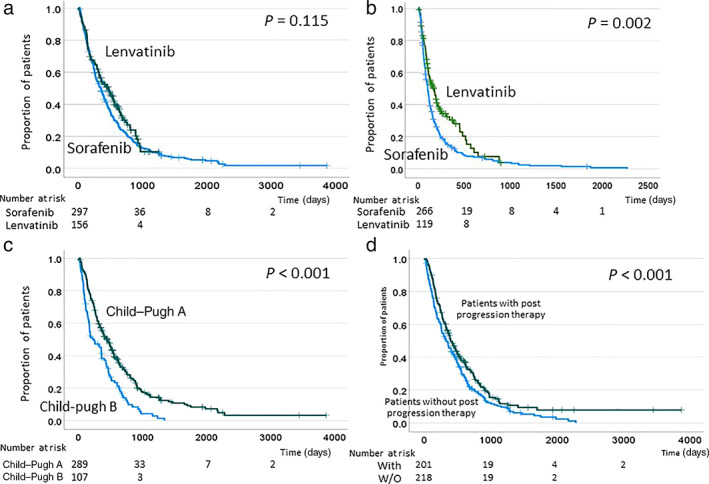
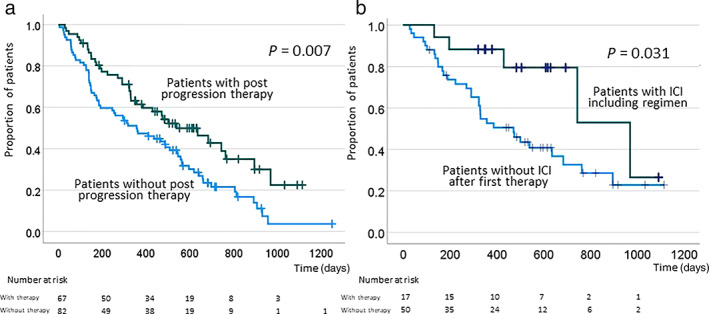
In total, 513 patients were analyzed: 309 treated with sorafenib and 204 with lenvatinib. The overall response and disease control rates were 15 and 50%, respectively, in the sorafenib group and 30 and 75%, respectively, in the lenvatinib group ( < 0.001). Kaplan-Meier analysis revealed no significant differences in progression-free survival and overall survival (OS) between the two treatments. Multivariate analysis revealed that fibrosis-4 index, disease control rate, post-progression therapy, and use of an immune checkpoint inhibitor (ICI) were significantly associated with OS. OS was significantly longer in patients who received post-progression therapy than in those who did not (log-rank < 0.001). Most patients who received an ICI as post-progression therapy had previously received lenvatinib. Among lenvatinib-treated patients, OS was significantly longer in patients who received an ICI than in patients received another or no post-progression therapy ( = 0.004).
The introduction of newer drugs for post-progression therapy is expected to prolong survival. ICI-based regimens appear to be effective after lenvatinib.
索拉非尼和仑伐替尼等分子靶向疗法长期以来一直被用作晚期肝细胞癌(aHCC)的一线治疗方法。然而,不良事件或有限的治疗效果可能需要更换为另一种治疗方案,即进展后治疗。为了研究进展后治疗的意义,我们在一项真实世界研究中分析了aHCC患者一线分子靶向治疗后的结局。
这项回顾性多中心研究纳入了在2011年1月至2021年9月期间接受索拉非尼或仑伐替尼作为一线治疗的aHCC患者。
总共分析了513例患者:309例接受索拉非尼治疗,204例接受仑伐替尼治疗。索拉非尼组的总体缓解率和疾病控制率分别为15%和50%,仑伐替尼组分别为30%和75%(<0.001)。Kaplan-Meier分析显示,两种治疗方法在无进展生存期和总生存期(OS)方面无显著差异。多变量分析显示,Fibrosis-4指数、疾病控制率、进展后治疗以及免疫检查点抑制剂(ICI)的使用与OS显著相关。接受进展后治疗患者的OS显著长于未接受进展后治疗的患者(对数秩检验<0.001)。大多数接受ICI作为进展后治疗的患者此前接受过仑伐替尼治疗。在接受仑伐替尼治疗的患者中,接受ICI治疗的患者的OS显著长于接受其他进展后治疗或未接受进展后治疗的患者(=0.004)。
引入用于进展后治疗的新药有望延长生存期。基于ICI的治疗方案在仑伐替尼治疗后似乎有效。