Park Yu-Seon, Lee Bo-Ah, Choi Seong-Ho, Kim Young-Taek
Department of Periodontology, National Health Insurance Service Ilsan Hospital, Goyang, Korea.
Department of Periodontology, Research Institute of Periodontal Regeneration, College of Dentistry, Yonsei University, Seoul, Korea.
J Periodontal Implant Sci. 2022 Jun;52(3):230-241. doi: 10.5051/jpis.2105020251.
The purpose of this study was to evaluate failed implants and reimplantation survival and to identify the relative risk factors for implant re-failure.
Ninety-one dental implants were extracted between 2006 and 2020 at the National Health Insurance Service Ilsan Hospital, including 56 implants in the maxilla and 35 implants in the mandible that were removed from 77 patients. Patient information (e.g., age, sex, and systemic diseases) and surgical information (e.g., the date of surgery and location of the implants and bone grafts) were recorded. If an implant prosthesis was used, prosthesis information was also recorded.
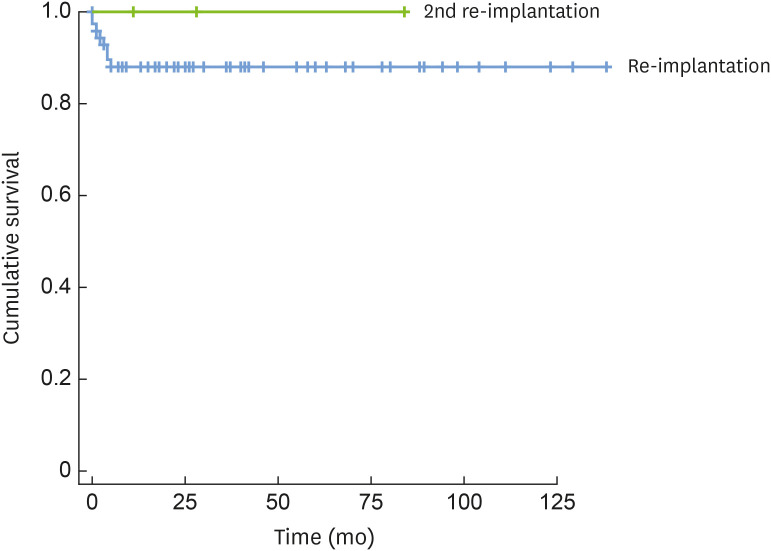
In total, 91 first-time failed dental implants in 77 patients were analyzed. Of them, 69 implants in 61 patients received reimplantation after failure. Sixteen patients (22 implants) refused reimplantation or received reimplantation at a different site. Eight of the 69 reimplants failed again. The 1-year survival rate of the 69 reimplants was 89.4%. Age at reimplantation and smoking significantly increased the risk of reimplantation failure. However, a history of taking anti-thrombotic agents showed a statistically significant negative association with reimplantation failure. Of the failed implants, 66% showed early failure and 34% showed late failure of the initial implantation. All 8 re-failed implants showed early failure. Only 3 of these 8 failed reimplants were re-tried and the second reimplants all survived.
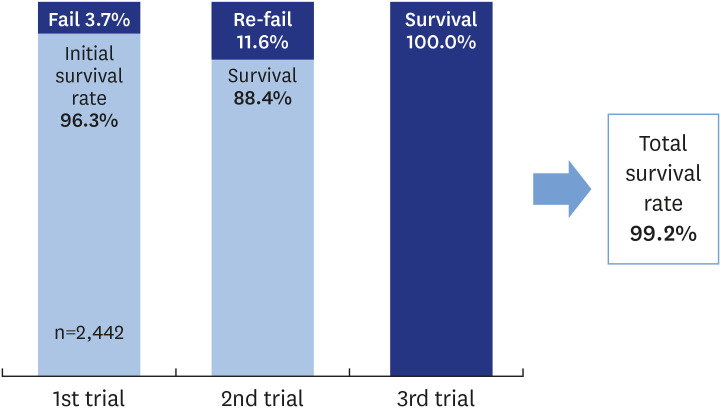
The total survival rate of implants, which included reimplants and second reimplants was 99.2%, although the survival rate of the initial implantations was 96.3%. Previous failure did not affect the success of the next trial. Reimplantation failure was more strongly affected by patient factors than by implant factors. Therefore, each patient's specific factors need to be meticulously controlled to achieve successful reimplantation.
本研究旨在评估失败种植体及再植后的存活率,并确定种植体再次失败的相关风险因素。
2006年至2020年期间,在韩国国民健康保险公团一山医院拔除了91颗牙种植体,其中包括从77例患者口中拔除的上颌56颗种植体和下颌35颗种植体。记录了患者信息(如年龄、性别和全身疾病)以及手术信息(如手术日期、种植体及骨移植的位置)。若使用了种植体修复体,也记录了修复体信息。
共分析了77例患者的91颗首次失败的牙种植体。其中,61例患者的69颗种植体在失败后接受了再植。16例患者(22颗种植体)拒绝再植或在其他部位接受了再植。69颗再植种植体中有8颗再次失败。69颗再植种植体的1年存活率为89.4%。再植时的年龄和吸烟显著增加了再植失败的风险。然而,服用抗血栓药物史与再植失败呈统计学显著负相关。在失败的种植体中,66%表现为初次种植的早期失败,34%表现为晚期失败。所有8颗再次失败的种植体均表现为早期失败。这8颗再次失败的种植体中只有3颗进行了再次尝试,第二次再植的种植体全部存活。
尽管初次种植的存活率为96.3%,但包括再植和二次再植在内的种植体总存活率为99.2%。先前的失败并不影响下一次尝试的成功率。再植失败受患者因素的影响比种植体因素更大。因此,为实现成功再植,需要精心控制每位患者的特定因素。