Institute for Systems Biology, Seattle, WA, USA.
Department of Bioengineering, University of Washington, Seattle, WA, USA.
Adv Nutr. 2022 Oct 2;13(5):1450-1461. doi: 10.1093/advances/nmac075.
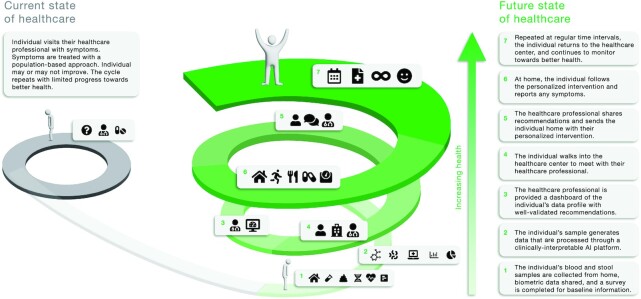
Humans often show variable responses to dietary, prebiotic, and probiotic interventions. Emerging evidence indicates that the gut microbiota is a key determinant for this population heterogeneity. Here, we provide an overview of some of the major computational and experimental tools being applied to critical questions of microbiota-mediated personalized nutrition and health. First, we discuss the latest advances in in silico modeling of the microbiota-nutrition-health axis, including the application of statistical, mechanistic, and hybrid artificial intelligence models. Second, we address high-throughput in vitro techniques for assessing interindividual heterogeneity, from ex vivo batch culturing of stool and continuous culturing in anaerobic bioreactors, to more sophisticated organ-on-a-chip models that integrate both host and microbial compartments. Third, we explore in vivo approaches for better understanding of personalized, microbiota-mediated responses to diet, prebiotics, and probiotics, from nonhuman animal models and human observational studies, to human feeding trials and crossover interventions. We highlight examples of existing, consumer-facing precision nutrition platforms that are currently leveraging the gut microbiota. Furthermore, we discuss how the integration of a broader set of the tools and techniques described in this piece can generate the data necessary to support a greater diversity of precision nutrition strategies. Finally, we present a vision of a precision nutrition and healthcare future, which leverages the gut microbiota to design effective, individual-specific interventions.
人类对饮食、益生元和益生菌干预的反应常常存在差异。新出现的证据表明,肠道微生物群是这种人群异质性的关键决定因素。在这里,我们提供了一些主要的计算和实验工具的概述,这些工具被应用于关键的微生物群介导的个性化营养和健康问题。首先,我们讨论了在微生物群-营养-健康轴的计算模型方面的最新进展,包括统计、机制和混合人工智能模型的应用。其次,我们解决了用于评估个体间异质性的高通量体外技术,从粪便的离体批量培养和厌氧生物反应器中的连续培养,到更复杂的整合宿主和微生物区室的器官芯片模型。第三,我们探讨了更好地理解个性化、微生物群介导的饮食、益生元和益生菌反应的体内方法,从非人类动物模型和人类观察性研究,到人类喂养试验和交叉干预。我们强调了一些现有的、面向消费者的精准营养平台的例子,这些平台目前正在利用肠道微生物群。此外,我们还讨论了如何整合更广泛的工具和技术,以生成支持更多样化精准营养策略所需的数据。最后,我们提出了一个利用肠道微生物群来设计有效、个体特异性干预措施的精准营养和医疗保健的未来愿景。