Student Research Committee, Kermanshah University of Medical Sciences, Kermanshah, Iran.
Student Research Committee, Tabriz University of Medical Sciences, Tabriz, Iran.
BMC Nephrol. 2022 Jul 1;23(1):233. doi: 10.1186/s12882-022-02858-9.
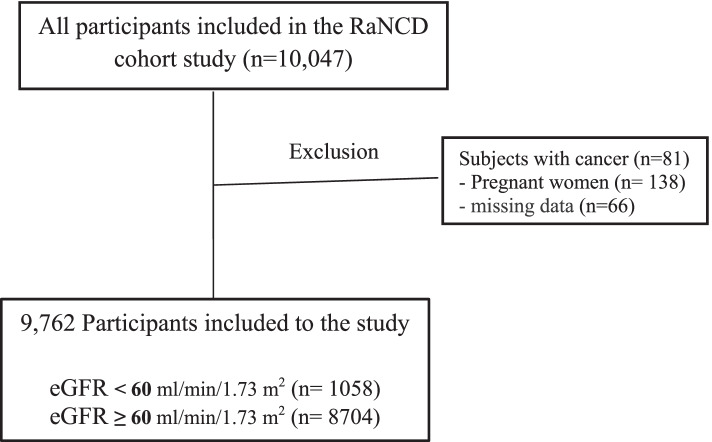
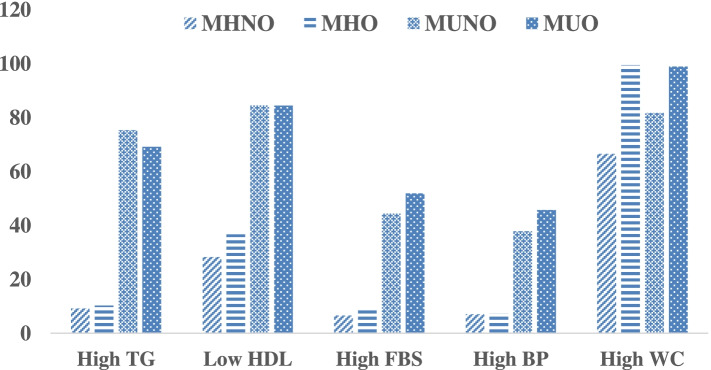
Investigating the effect of metabolic disorders on chronic kidney disease (CKD) in the presence or the absence of obesity is of great importance. This study aimed to examine the independent and joint relationships of obesity and metabolic syndrome (MetS) with CKD. METHODS : The present study was performed on 9,762 participants from the baseline phase of the Ravansar non- communicable diseases (RaNCD) study. Thereafter, the CKD was estimated by glomerular filtration rate (eGFR) using the Modification of Diet in Renal Disease (MDRD) equation. All the included participants were categorized into the following four phenotypes: metabolically healthy non-overweight/obesity (MHNO), metabolically unhealthy non-overweight/obesity (MUNO), metabolically healthy overweight/obesity (MHO), and metabolically unhealthy overweight/obesity (MUO). Finally, Logistic regression analysis was used to estimate the odds ratio (ORs).
The mean age of the included participants was 47.33 ± 8.27 years old, %48.16 (4,701) of whom were men. As well, 1,058(10.84%) participants had CKD (eGFR less than 60 ml/min/1.73m). The overweight/obesity was not significantly associated with odds of CKD. The odds of CKD in male subjects with MetS was 1.48 times higher than non-MetS ones (95% CI: 1.10, 2.01). After adjusting the confounders, the odds of CKD were 1.54 times (95% CI: 1.12, 2.11) higher in the MUNO and 2.22 times (95% CI: 1.44, 3.41) higher in the MUO compared to MHNO phenotype in male subjects. The odds of CKD in the MUNO and MUO was 1.31 times (95% CI: 1.10, 1.60) and 1.23 times (95% CI: 1.01, 1.54) higher than MHNO phenotype in female subjects, respectively.
The odds of CKD were higher in MUNO and MUO phenotypes. Therefore, lifestyle modification is recommended to control normal weight and healthy metabolism.
研究代谢紊乱对肥胖存在或不存在的慢性肾脏病(CKD)的影响非常重要。本研究旨在探讨肥胖和代谢综合征(MetS)与 CKD 的独立和联合关系。
本研究对 Ravansar 非传染性疾病(RaNCD)研究基线阶段的 9762 名参与者进行了研究。此后,使用改良肾脏病饮食法(MDRD)方程估计肾小球滤过率(eGFR)来估计 CKD。所有纳入的参与者被分为以下四种表型:代谢健康非超重/肥胖(MHNO)、代谢不健康非超重/肥胖(MUNO)、代谢健康超重/肥胖(MHO)和代谢不健康超重/肥胖(MUO)。最后,使用 Logistic 回归分析估计比值比(ORs)。
纳入参与者的平均年龄为 47.33±8.27 岁,其中 48.16%(4701 人)为男性。同样,有 1058(10.84%)名参与者患有 CKD(eGFR 低于 60ml/min/1.73m)。超重/肥胖与 CKD 的发病几率无显著相关性。男性 MetS 患者患 CKD 的几率是无 MetS 患者的 1.48 倍(95%CI:1.10,2.01)。调整混杂因素后,男性 MUNO 患者患 CKD 的几率是 MHNO 患者的 1.54 倍(95%CI:1.12,2.11),MUO 患者的几率是 MHNO 患者的 2.22 倍(95%CI:1.44,3.41)。女性 MUNO 和 MUO 患者患 CKD 的几率分别比 MHNO 患者高 1.31 倍(95%CI:1.10,1.60)和 1.23 倍(95%CI:1.01,1.54)。
MUNO 和 MUO 表型的 CKD 发病几率较高。因此,建议通过生活方式的改变来控制正常体重和健康代谢。