School of Biology, University of St Andrews, St Andrews, Fife, KY16 9TH, UK.
Environmental Toxicology Program, Institute of Organismal Biology, Uppsala University, Uppsala, Sweden.
BMC Bioinformatics. 2022 Jul 1;23(1):261. doi: 10.1186/s12859-022-04800-0.
Relationships among genetic or epigenetic features can be explored by learning probabilistic networks and unravelling the dependencies among a set of given genetic/epigenetic features. Bayesian networks (BNs) consist of nodes that represent the variables and arcs that represent the probabilistic relationships between the variables. However, practical guidance on how to make choices among the wide array of possibilities in Bayesian network analysis is limited. Our study aimed to apply a BN approach, while clearly laying out our analysis choices as an example for future researchers, in order to provide further insights into the relationships among epigenetic features and a stressful condition in chickens (Gallus gallus).
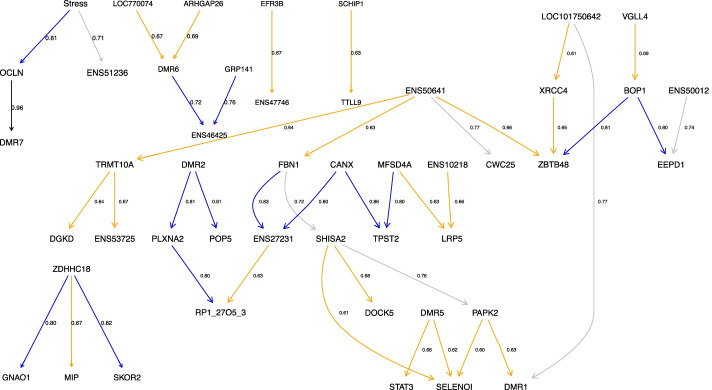
Chickens raised under control conditions (n = 22) and chickens exposed to a social isolation protocol (n = 24) were used to identify differentially methylated regions (DMRs). A total of 60 DMRs were selected by a threshold, after bioinformatic pre-processing and analysis. The treatment was included as a binary variable (control = 0; stress = 1). Thereafter, a BN approach was applied: initially, a pre-filtering test was used for identifying pairs of features that must not be included in the process of learning the structure of the network; then, the average probability values for each arc of being part of the network were calculated; and finally, the arcs that were part of the consensus network were selected. The structure of the BN consisted of 47 out of 61 features (60 DMRs and the stressful condition), displaying 43 functional relationships. The stress condition was connected to two DMRs, one of them playing a role in tight and adhesive intracellular junctions in organs such as ovary, intestine, and brain.
We clearly explain our steps in making each analysis choice, from discrete BN models to final generation of a consensus network from multiple model averaging searches. The epigenetic BN unravelled functional relationships among the DMRs, as well as epigenetic features in close association with the stressful condition the chickens were exposed to. The DMRs interacting with the stress condition could be further explored in future studies as possible biomarkers of stress in poultry species.
通过学习概率网络并揭示给定遗传/表观遗传特征之间的依赖关系,可以探索遗传或表观遗传特征之间的关系。贝叶斯网络(BN)由表示变量的节点和表示变量之间概率关系的弧组成。然而,关于如何在贝叶斯网络分析中广泛的可能性中做出选择的实际指导是有限的。我们的研究旨在应用 BN 方法,同时明确列出我们的分析选择,作为未来研究人员的示例,以提供进一步了解鸡(Gallus gallus)中表观遗传特征与应激条件之间关系的见解。
使用在对照条件下饲养的鸡(n=22)和暴露于社会隔离方案的鸡(n=24)来鉴定差异甲基化区域(DMR)。通过生物信息学预处理和分析,选择了 60 个 DMR 作为阈值。处理被包括为一个二进制变量(对照=0;应激=1)。然后,应用 BN 方法:首先,进行预过滤测试以识别特征对,这些特征对在学习网络结构的过程中必须不包括在内;然后,计算每个弧成为网络一部分的平均概率值;最后,选择成为共识网络一部分的弧。BN 的结构由 61 个特征中的 47 个组成(60 个 DMR 和应激条件),显示了 43 个功能关系。应激条件与两个 DMR 相连,其中一个 DMR 在卵巢、肠道和大脑等器官中起紧密和粘着细胞连接的作用。
我们清楚地解释了从离散 BN 模型到从多个模型平均搜索生成共识网络的每个分析选择的步骤。表观遗传 BN 揭示了 DMR 之间的功能关系,以及与鸡所经历的应激条件密切相关的表观遗传特征。与应激条件相互作用的 DMR 可以在未来的研究中进一步探索作为家禽应激的潜在生物标志物。