Department of Vector Biology, Liverpool School of Tropical Medicine, Pembroke Place, Liverpool, L3 5QA, UK.
Malar J. 2022 Jul 1;21(1):208. doi: 10.1186/s12936-022-04232-4.
The WHO cone test is one of three tests currently used to evaluate the efficacy of insecticide-treated bed nets (ITNs). It generates two test outputs, knockdown and 24-h mortality, both indicative of immediate toxicity but that reveal little about the nature of mosquito and ITN interaction or how results translate to real-world settings.
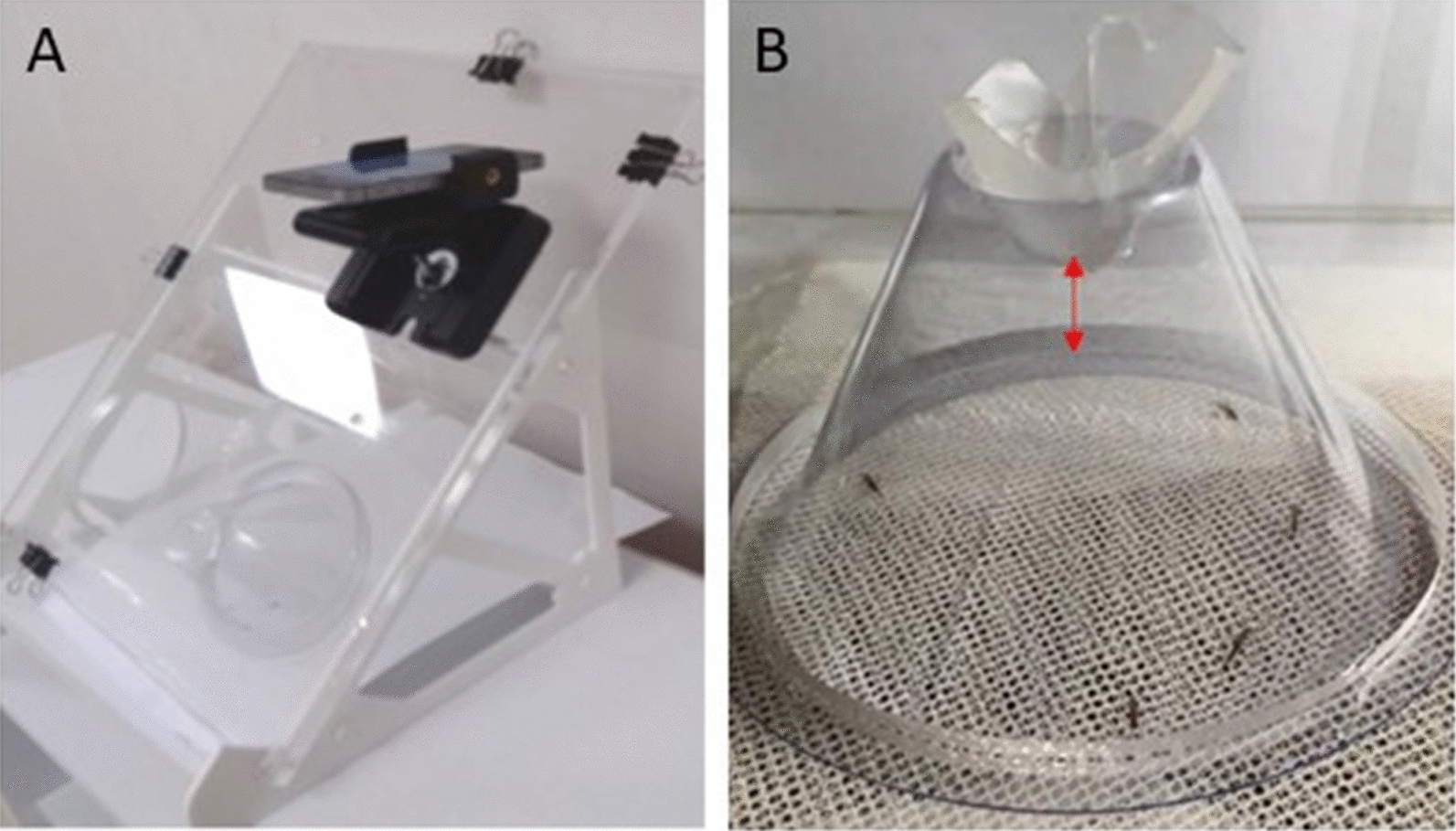
A human arm held 5 mm behind the net surface acted as a host attractant during cone tests and a smartphone was used to capture mosquito behaviour in the cone. Post-exposure blood feeding and survival for nine days were recorded; ingested blood meal size was determined by measuring excreted haematin. Four strains of Anopheles gambiae (insecticide susceptible: Kisumu and N'gousso; insecticide resistant: Banfora and VK7) were tested with and without the host attractant using untreated, Permanet 2.0 and Olyset nets. Video recordings were scan sampled every five seconds to record mosquito positions on either the net, in flight or in contact with the cone. Generalized estimating equations were used to analyse all data except survival within nine days which was analysed using Weighted Cox Regression.
Net contact was the most frequently recorded behaviour in all Anopheles spp. strains on all nets. Adding the human host as attractant triggered excitatory behaviours: in all strains, the magnitude of net contact was significantly decreased compared to tests without a host. ITN exposure altered the observed behaviour of the two susceptible strains, which exhibited a decreased response to the host during ITN tests. The resistant strains did not alter their behaviour during ITN tests. Significantly less net contact was observed during Olyset Net tests compared to Permanet 2.0. The host presence affected survival after exposure: Banfora and VK7 mosquitoes exposed to Permanet 2.0 with a host lived longer compared to tests performed without a host. However, mosquitoes that blood-fed and survived long enough to digest the blood meal did not exhibit significantly reduced longevity regardless of the presence of the host attractant.
Simple modifications to the WHO cone test and extension of post-test monitoring beyond the current 24 h enable detailed behavioural characterizations of individual ITNs to be compiled. The effects observed from testing with a host and including blood feeding suggest that more representative estimates of true of ITN efficacy are gained with these modifications than when using the current testing protocol.
世界卫生组织(WHO)锥形管测试是目前用于评估经杀虫剂处理的蚊帐(ITN)功效的三种测试方法之一。它产生两个测试结果,击倒和 24 小时死亡率,两者都表明即时毒性,但对蚊子和 ITN 相互作用的性质或测试结果如何转化为实际环境知之甚少。
在锥形管测试中,位于网面后方 5 毫米处的人类手臂充当宿主引诱物,智能手机用于捕获锥形管内的蚊子行为。记录接触后 9 天内的吸血和存活情况;通过测量排出的血红素来确定摄入的血餐量。使用未经处理的、Permanet 2.0 和 Olyset 蚊帐,对四种冈比亚按蚊(敏感型:Kisumu 和 N'gousso;抗性型:Banfora 和 VK7)进行了有和没有宿主引诱物的测试。视频记录每隔五秒扫描采样,以记录蚊子在网、飞行或与锥形管接触的位置。除了在 9 天内分析使用加权 Cox 回归的存活数据外,所有数据均使用广义估计方程进行分析。
在所有 Anopheles spp. 品系中,接触网是所有菌株在所有蚊帐上最常记录的行为。添加人类宿主作为引诱物会触发兴奋行为:在所有菌株中,与没有宿主的测试相比,网接触的程度显著降低。ITN 暴露改变了两种敏感菌株的观察到的行为,它们在 ITN 测试中对宿主的反应降低。抗性菌株在 ITN 测试中没有改变它们的行为。与 Permanet 2.0 相比,在 Olyset 蚊帐测试中观察到的网接触明显减少。宿主的存在影响暴露后的存活:暴露于含有宿主的 Permanet 2.0 的 Banfora 和 VK7 蚊子的存活时间比没有宿主的测试更长。然而,无论是否存在宿主引诱物,只要吸血并存活足够长的时间来消化血餐,蚊子的寿命都不会明显缩短。
对 WHO 锥形管测试进行简单修改,并将测试后监测延长到当前的 24 小时之外,可以对单个 ITN 进行详细的行为特征描述。从有宿主的测试和包括吸血中观察到的影响表明,与使用当前测试方案相比,通过这些修改获得的真正 ITN 功效的代表性估计值更高。