Lancet Public Health. 2022 Aug;7(8):e657-e669. doi: 10.1016/S2468-2667(22)00134-7. Epub 2022 Jun 30.
Globally, transport and unintentional injuries persist as leading preventable causes of mortality and morbidity for adolescents. We sought to report comprehensive trends in injury-related mortality and morbidity for adolescents aged 10-24 years during the past three decades.
Using the Global Burden of Disease, Injuries, and Risk Factors 2019 Study, we analysed mortality and disability-adjusted life-years (DALYs) attributed to transport and unintentional injuries for adolescents in 204 countries. Burden is reported in absolute numbers and age-standardised rates per 100 000 population by sex, age group (10-14, 15-19, and 20-24 years), and sociodemographic index (SDI) with 95% uncertainty intervals (UIs). We report percentage changes in deaths and DALYs between 1990 and 2019.
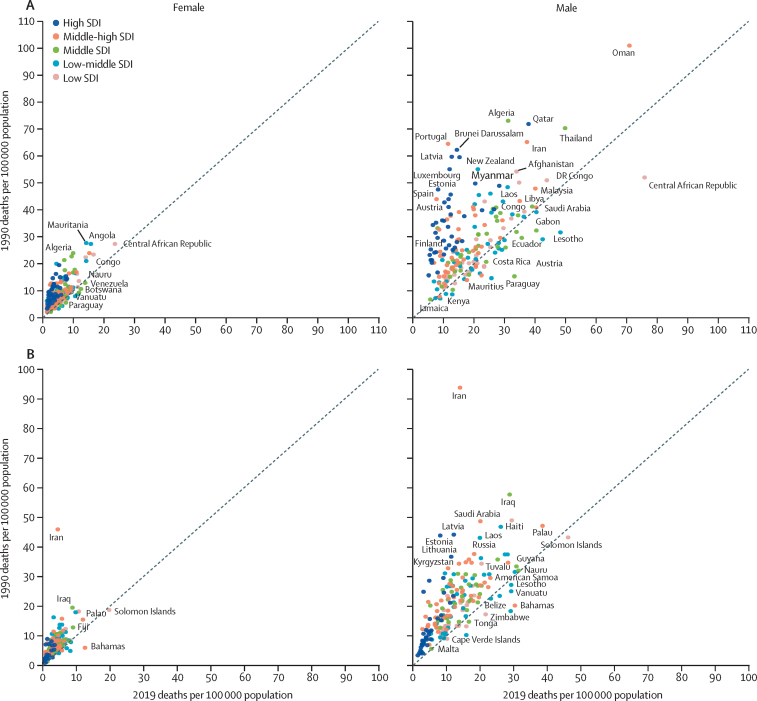
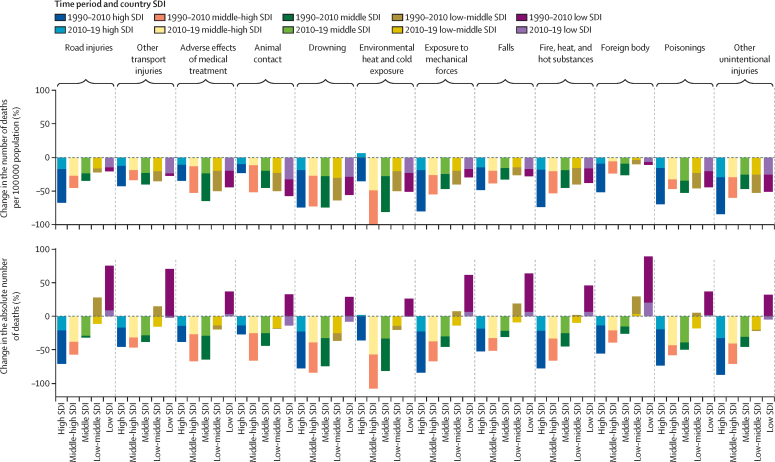
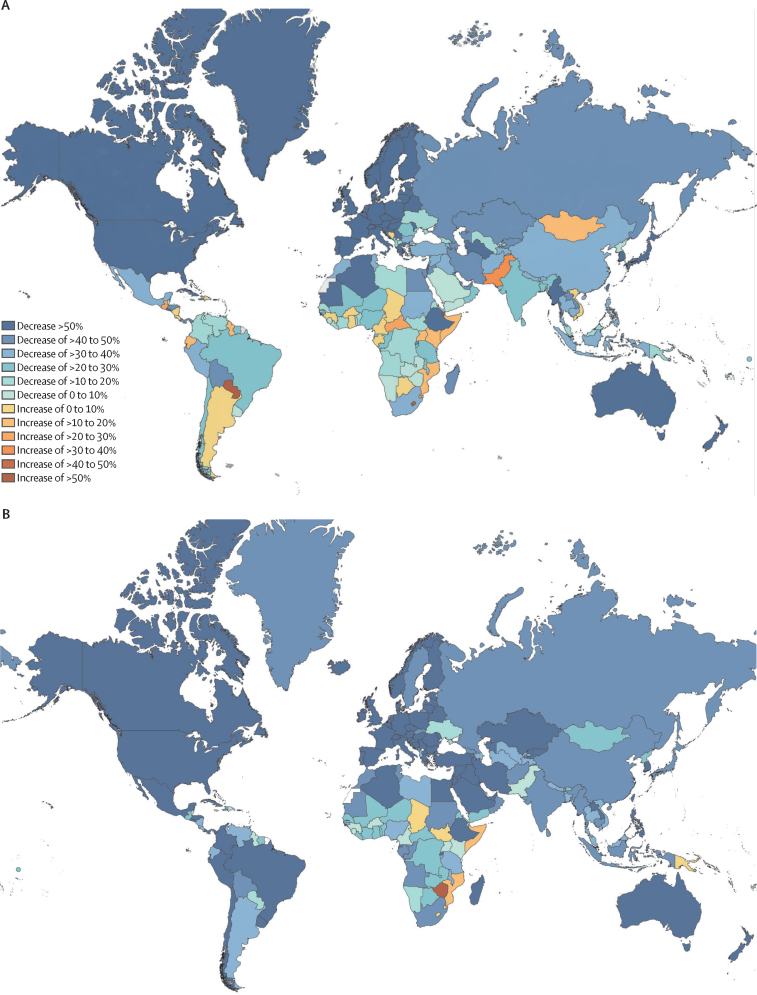
In 2019, 369 061 deaths (of which 214 337 [58%] were transport related) and 31·1 million DALYs (of which 16·2 million [52%] were transport related) among adolescents aged 10-24 years were caused by transport and unintentional injuries combined. If compared with other causes, transport and unintentional injuries combined accounted for 25% of deaths and 14% of DALYs in 2019, and showed little improvement from 1990 when such injuries accounted for 26% of adolescent deaths and 17% of adolescent DALYs. Throughout adolescence, transport and unintentional injury fatality rates increased by age group. The unintentional injury burden was higher among males than females for all injury types, except for injuries related to fire, heat, and hot substances, or to adverse effects of medical treatment. From 1990 to 2019, global mortality rates declined by 34·4% (from 17·5 to 11·5 per 100 000) for transport injuries, and by 47·7% (from 15·9 to 8·3 per 100 000) for unintentional injuries. However, in low-SDI nations the absolute number of deaths increased (by 80·5% to 42 774 for transport injuries and by 39·4% to 31 961 for unintentional injuries). In the high-SDI quintile in 2010-19, the rate per 100 000 of transport injury DALYs was reduced by 16·7%, from 838 in 2010 to 699 in 2019. This was a substantially slower pace of reduction compared with the 48·5% reduction between 1990 and 2010, from 1626 per 100 000 in 1990 to 838 per 100 000 in 2010. Between 2010 and 2019, the rate of unintentional injury DALYs per 100 000 also remained largely unchanged in high-SDI countries (555 in 2010 vs 554 in 2019; 0·2% reduction). The number and rate of adolescent deaths and DALYs owing to environmental heat and cold exposure increased for the high-SDI quintile during 2010-19.
As other causes of mortality are addressed, inadequate progress in reducing transport and unintentional injury mortality as a proportion of adolescent deaths becomes apparent. The relative shift in the burden of injury from high-SDI countries to low and low-middle-SDI countries necessitates focused action, including global donor, government, and industry investment in injury prevention. The persisting burden of DALYs related to transport and unintentional injuries indicates a need to prioritise innovative measures for the primary prevention of adolescent injury.
Bill & Melinda Gates Foundation.
在全球范围内,交通和非故意伤害仍然是导致青少年死亡和发病的主要可预防原因。我们旨在报告过去三十年中,10-24 岁青少年因交通和非故意伤害导致的相关死亡率和发病致残率的全面趋势。
我们使用 2019 年全球疾病、伤害和危险因素研究,分析了 204 个国家中 10-24 岁青少年因交通和非故意伤害导致的死亡和残疾调整生命年(DALYs)。通过性别、年龄组(10-14、15-19 和 20-24 岁)和社会人口指数(SDI),以 95%置信区间(UI)为单位,以每 100000 人绝对数量和标准化率报告负担。我们报告了 1990 年至 2019 年期间死亡人数和 DALYs 的百分比变化。
2019 年,10-24 岁青少年因交通和非故意伤害导致的死亡人数为 369061 人(其中 214337 人[58%]与交通有关),DALYs 为 3110 万人(其中 1620 万人[52%]与交通有关)。如果与其他原因相比,交通和非故意伤害在 2019 年占青少年死亡人数的 25%,占青少年 DALYs 的 14%,与 1990 年相比几乎没有改善,当时这类伤害占青少年死亡人数的 26%,占青少年 DALYs 的 17%。在整个青少年时期,交通和非故意伤害的死亡率随着年龄组的增加而增加。除了与火灾、热和热物质或医疗治疗的不良影响有关的伤害类型外,男性的非故意伤害负担高于女性。从 1990 年到 2019 年,全球交通伤害死亡率下降了 34.4%(从每 100000 人 17.5 人降至 11.5 人),非故意伤害死亡率下降了 47.7%(从每 100000 人 15.9 人降至 8.3 人)。然而,在低 SDI 国家,死亡人数绝对增加(交通伤害增加了 80.5%,达到 42774 人,非故意伤害增加了 39.4%,达到 31961 人)。在 2010-19 年的高 SDI 五分位数中,每 100000 人的交通伤害 DALYs 率下降了 16.7%,从 2010 年的 838 人降至 2019 年的 699 人。与 1990 年至 2010 年期间 48.5%的降幅相比,这一速度明显放缓,从 1990 年的每 100000 人 1626 人降至 2010 年的每 100000 人 838 人。在 2010-19 年期间,高 SDI 国家的非故意伤害 DALYs 率也基本保持不变(2010 年为 555 人,2019 年为 554 人,减少 0.2%)。高 SDI 五分位数国家的青少年因环境热和冷暴露导致的死亡人数和 DALYs 数量在 2010-19 年期间有所增加。
随着其他死因的解决,交通和非故意伤害导致的青少年死亡人数在青少年死亡人数中的比例减少的进展不明显。伤害负担从高 SDI 国家向低和中低收入 SDI 国家转移的相对变化需要采取有针对性的行动,包括全球捐赠者、政府和行业投资于预防伤害。与交通和非故意伤害有关的 DALYs 持续负担表明需要优先采取创新性措施,以预防青少年受伤。
比尔和梅琳达·盖茨基金会。