Center of Severe Acute Pancreatitis (CSAP), Department of Critical Care Medicine, Jinling Hospital, Medical School of Nanjing University, No. 305 Zhongshan East Road, Jiangsu, Nanjing, 210002, People's Republic of China.
Department of General Surgery, Jinling Hospital, Medical School of Nanjing University, Nanjing, 210002, People's Republic of China.
BMC Gastroenterol. 2022 Jul 2;22(1):327. doi: 10.1186/s12876-022-02403-w.
The importance of enteral nutrition (EN) in acute pancreatitis (AP) has been emphasised. Nasogastric (NG) feeding has been the preferred route for EN delivery in most AP patients intolerant to oral intake. However, gastric feeding intolerance (GFI) was frequently reported, especially in patients with more severe diseases. This study aimed to investigate the incidence and risk factors for GFI in moderately-severe to severe AP.
This is a single-centre, retrospective study. All the data were extracted from an electronic database from April 2020 to May 2021. Data were prospectively collected during hospitalisation. Patients diagnosed with moderately-severe to severe AP and admitted within seven days from the onset of abdominal pain were assessed for eligibility. Patients who showed signs of intolerance to gastric feeding and required switching to nasojejunal (NJ) feeding were deemed GFI. Multivariable logistic regression was performed to assess potential risk factors of GFI.
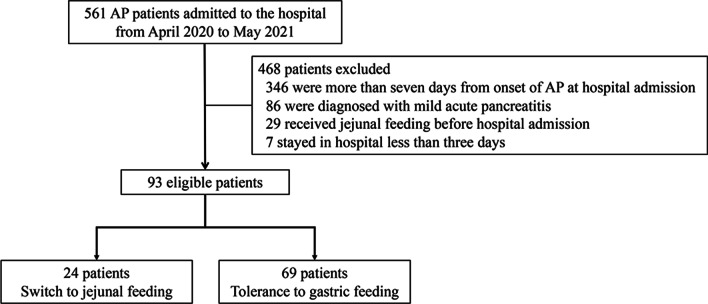
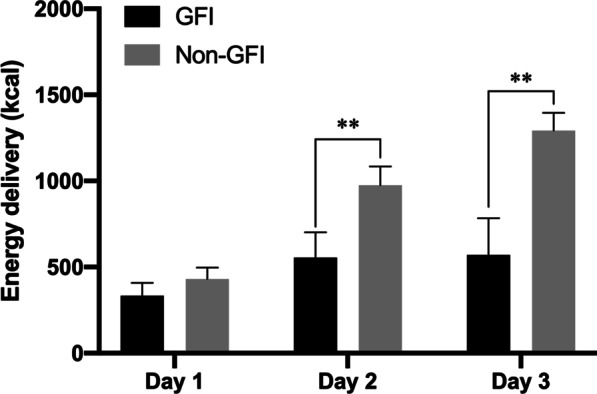
A total of 93 patients were analysed, of whom 24 were deemed GFI (25.8%), and the rest tolerated NG feeding well (n = 69). In patients with GFI, the median time of switching to NJ feeding was five days (interquartile range: 4-7 days) after admission. The multivariable analysis showed that respiratory failure (odds ratio = 3.135, 95% CI: 1.111-8.848, P = 0.031) was an independent risk factor for GFI.The mean daily energy delivery in the following three days after switching to NJ feeding was significantly higher than the first three days after initiation of NG feeding in patients with GFI [920.83 (493.33-1326) vs. 465 (252.25-556.67) kcal, P < 0.001].
GFI is common in moderately-severe to severe AP patients with an incidence of 25.8%, and the presence of respiratory failure may increase the risk of GFI.
肠内营养(EN)在急性胰腺炎(AP)中的重要性已经得到强调。对于大多数不能经口摄入的 AP 患者,鼻胃(NG)喂养是 EN 输送的首选途径。然而,胃喂养不耐受(GFI)经常被报道,尤其是在病情较重的患者中。本研究旨在探讨中重度至重度 AP 患者 GFI 的发生率和危险因素。
这是一项单中心回顾性研究。所有数据均从 2020 年 4 月至 2021 年 5 月的电子数据库中提取。数据在住院期间进行前瞻性收集。评估符合中重度至重度 AP 诊断并在腹痛发作后 7 天内入院的患者是否符合入选条件。出现胃喂养不耐受迹象并需要转为鼻空肠(NJ)喂养的患者被视为 GFI。采用多变量逻辑回归评估 GFI 的潜在危险因素。
共分析了 93 例患者,其中 24 例被认为是 GFI(25.8%),其余 69 例患者耐受 NG 喂养良好。在 GFI 患者中,入院后转为 NJ 喂养的中位时间为 5 天(四分位距:4-7 天)。多变量分析显示,呼吸衰竭(比值比=3.135,95%可信区间:1.111-8.848,P=0.031)是 GFI 的独立危险因素。在 GFI 患者中,转为 NJ 喂养后的前三天与开始 NG 喂养后的前三天相比,每日能量输送量明显更高[920.83(493.33-1326)比 465(252.25-556.67)千卡,P<0.001]。
中重度至重度 AP 患者中 GFI 很常见,发生率为 25.8%,呼吸衰竭的存在可能增加 GFI 的风险。