Heart Center, Shanghai Jiaotong University Affiliated Sixth People's Hospital, School of Medicine, Shanghai Jiaotong University, Xuhui District, No. 600, Yishan Road, Shanghai, People's Republic of China.
Department of Cardiology, Shanghai Institute of Cardiovascular Diseases, Zhongshan Hospital, Fudan University, Shanghai, People's Republic of China.
Eur J Med Res. 2022 Jul 2;27(1):106. doi: 10.1186/s40001-022-00733-9.
Chronic inflammatory disorders in atrial fibrillation (AF) contribute to the onset of ischemic stroke. Systemic immune inflammation index (SIII) and system inflammation response index (SIRI) are the two novel and convenient measurements that are positively associated with body inflammation. However, little is known regarding the association between SIII/SIRI with the presence of AF among the patients with ischemic stroke.
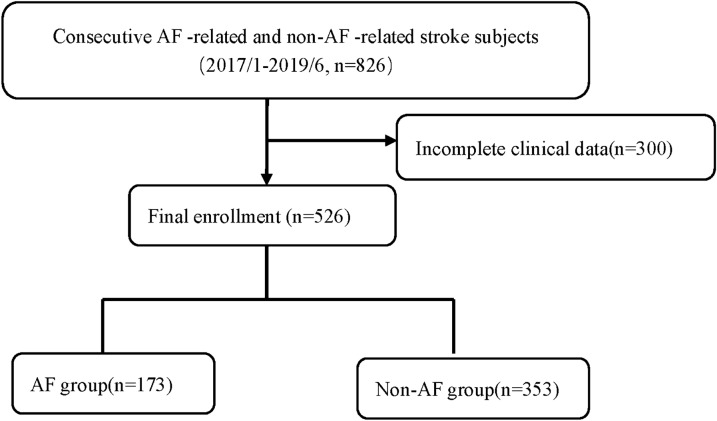
A total of 526 ischemic stroke patients (173 with AF and 353 without AF) were consecutively enrolled in our study from January 2017 to June 2019. SIII and SIRI were measured in both groups. Logistic regression analysis was used to analyse the potential association between SIII/SIRI and the presence of AF. Finally, the correlation between hospitalization expenses, changes in the National Institutes of Health Stroke Scale (NIHSS) scores and SIII/SIRI values were measured.
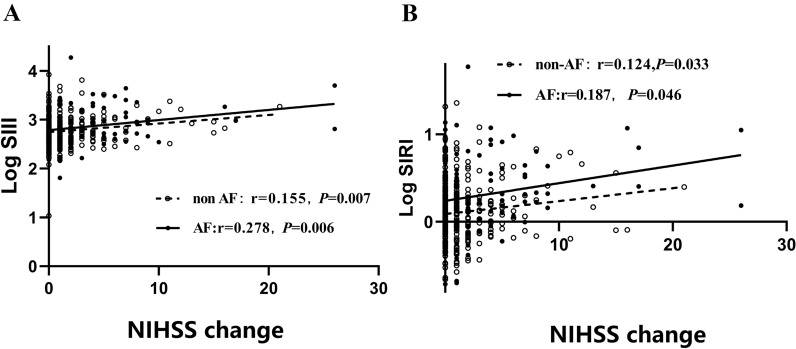
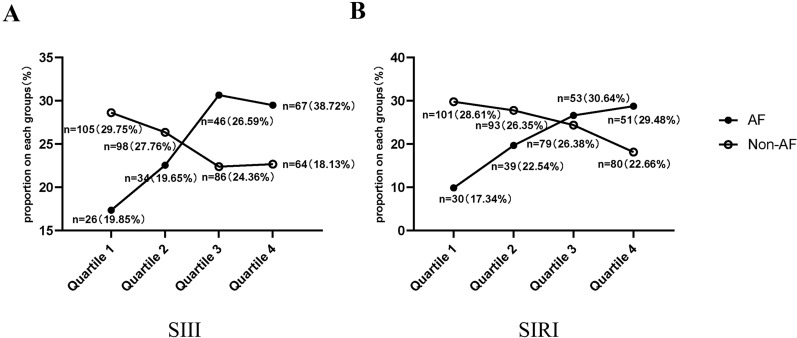
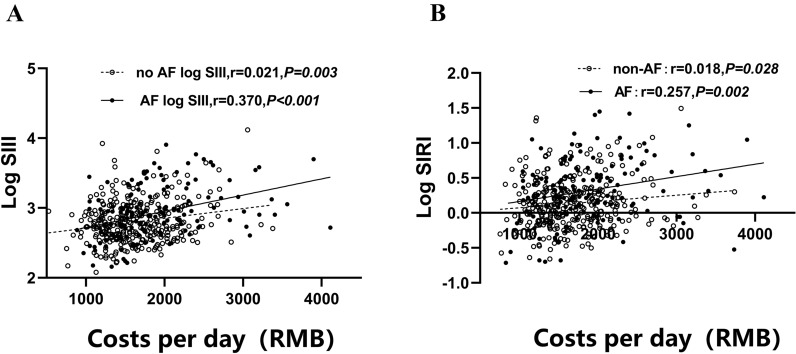
In patients with ischemic stroke, SIII and SIRI values were significantly higher in AF patients than in non-AF patients (all p < 0.001). Moreover, with increasing quartiles of SIII and SIRI in all patients, the proportion of patients with AF was higher than that of non-AF patients gradually. Logistic regression analyses demonstrated that log-transformed SIII and log-transformed SIRI were independently associated with the presence of AF in patients with ischemic stroke (log-transformed SIII: odds ratio [OR]: 1.047, 95% confidence interval CI = 0.322-1.105, p = 0.047; log-transformed SIRI: OR: 6.197, 95% CI = 2.196-17.484, p = 0.001). Finally, a positive correlation between hospitalization expenses, changes in the NIHSS scores and SIII/SIRI were found, which were more significant in patients with AF (all p < 0.05).
Our study suggests SIII and SIRI are convenient and effective measurements for predicting the presence of AF in patients with ischemic stroke. Moreover, they were correlated with increased financial burden and poor short-term prognosis in AF patients presenting with ischemic stroke.
在心房颤动(AF)中慢性炎症性疾病导致缺血性中风的发作。全身免疫炎症指数(SIII)和全身炎症反应指数(SIRI)是两个新的、方便的测量方法,与机体炎症呈正相关。然而,对于 SIII/SIRI 与缺血性中风患者 AF 存在之间的关联,人们知之甚少。
本研究共连续纳入 2017 年 1 月至 2019 年 6 月间 526 例缺血性中风患者(AF 组 173 例,无 AF 组 353 例)。两组均检测 SIII 和 SIRI。采用 Logistic 回归分析 SIII/SIRI 与 AF 存在之间的潜在关联。最后,测量住院费用、国立卫生研究院卒中量表(NIHSS)评分变化与 SIII/SIRI 值之间的相关性。
在缺血性中风患者中,AF 患者的 SIII 和 SIRI 值明显高于非 AF 患者(均 p<0.001)。此外,随着所有患者 SIII 和 SIRI 的四分位间距逐渐增加,AF 患者的比例逐渐高于非 AF 患者。Logistic 回归分析表明,经对数转换后的 SIII 和 SIRI 与缺血性中风患者 AF 的发生独立相关(经对数转换后的 SIII:比值比[OR]:1.047,95%置信区间[CI]:0.322-1.105,p=0.047;经对数转换后的 SIRI:OR:6.197,95%CI:2.196-17.484,p=0.001)。最后,发现住院费用、NIHSS 评分变化与 SIII/SIRI 之间存在正相关,在 AF 患者中更为显著(均 p<0.05)。
本研究表明 SIII 和 SIRI 是预测缺血性中风患者 AF 发生的简便有效方法,且与 AF 合并缺血性中风患者经济负担增加和短期预后不良相关。