Zhang Peng, Li Zaimin, Yang Qing, Zhou Jiali, Ma Xiujie
School of Wushu, Chengdu Sport University, Chengdu, 610041, China.
Department of Martial Arts, Shanghai University of Sport, Shanghai, 200438, China.
Sports Med Health Sci. 2021 Dec 30;4(2):85-94. doi: 10.1016/j.smhs.2021.12.004. eCollection 2022 Jun.
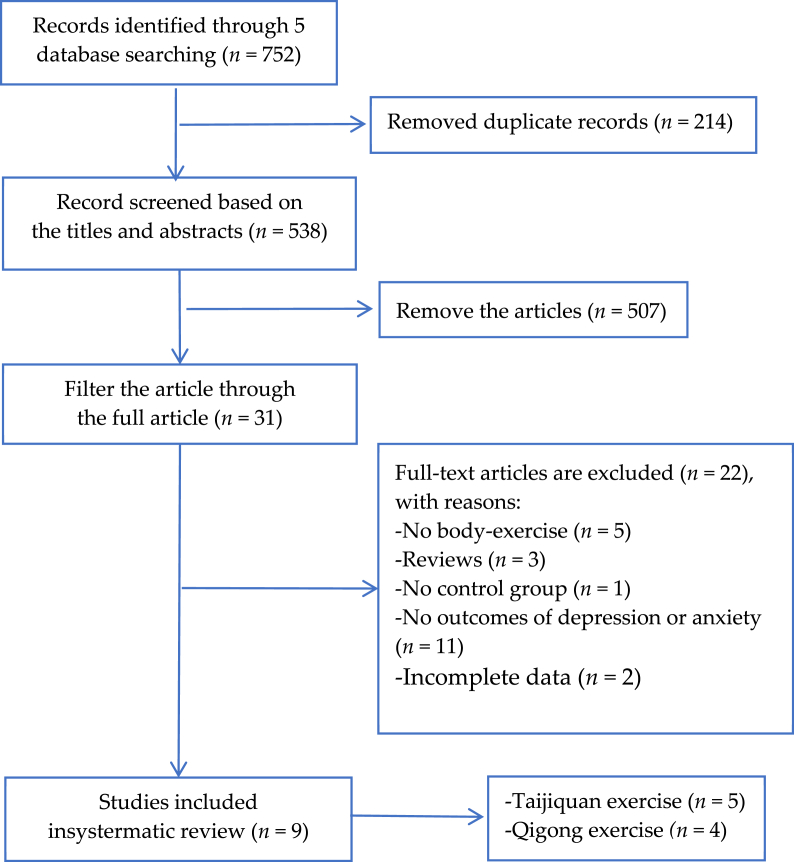
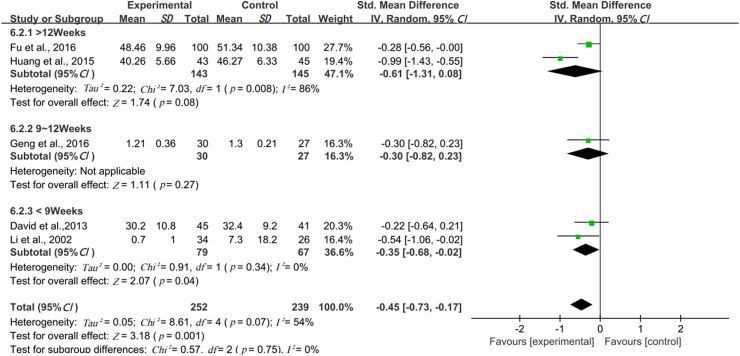
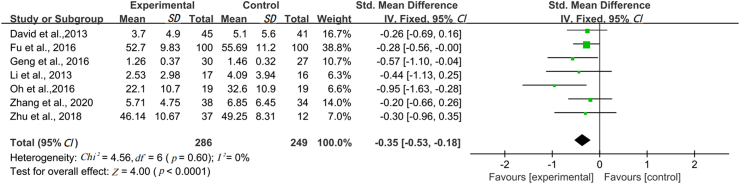
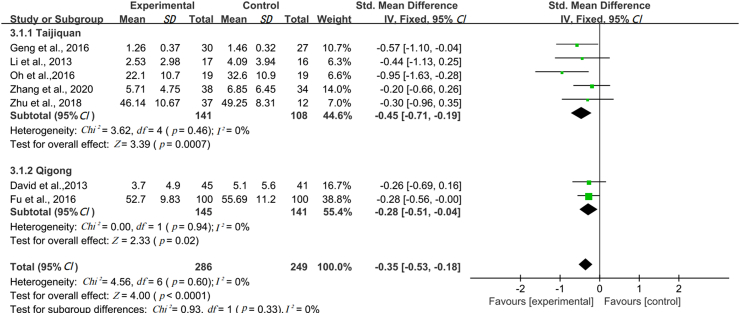
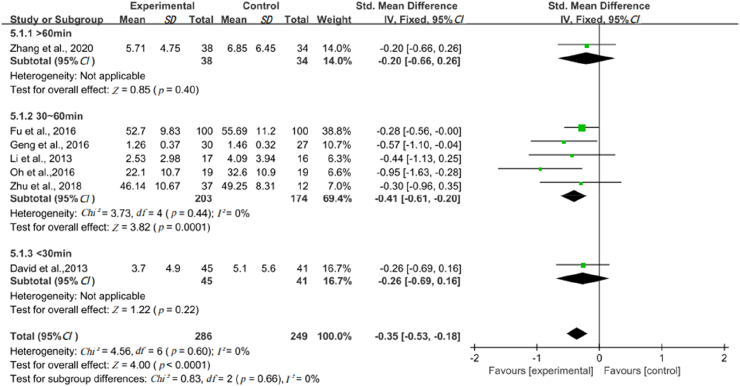
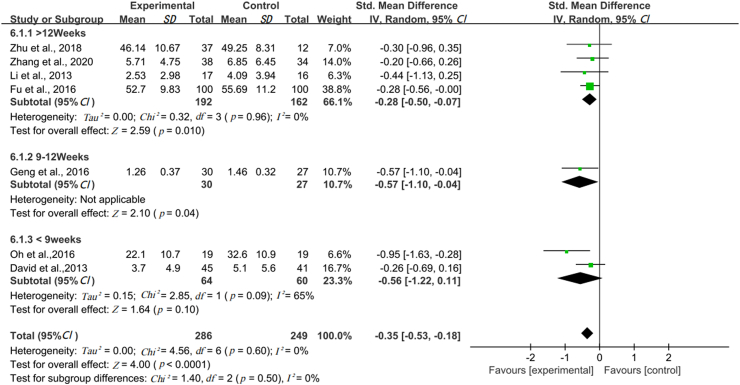
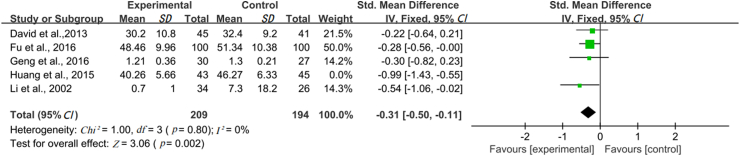
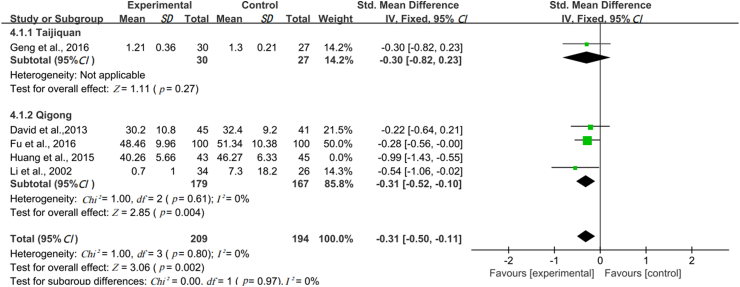
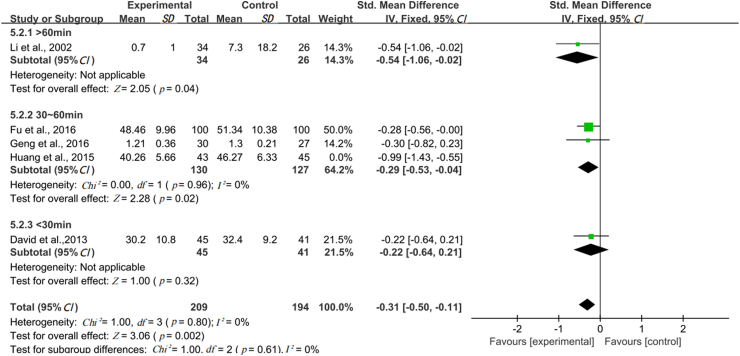
Previous studies have shown that Taijiquan and Qigong exercise can effectively reduce depression and anxiety in healthy and clinical populations. At present, only a few reviews have elaborated on the premise of different types of interventions, and there is still a lack of studies that systematically summarize the clinical evidence of patients with substance use disorders. The purpose of this meta-analysis was to assess the impact of the Taijiquan and Qigong exercise on the mood of individuals with substance use disorders (SUD); Articles were searched in Pubmed, Embase, Cochrane Library, Web of Science, and CNKI from their inception to the May 24, 2021. All randomized controlled trials (RCT) using Taijiquan and Qigong intervention were included. With the Review Manager software to determine the effect (standardized mean difference, SMD), subgroup analysis was conducted to intervention type, exercise time, and exercise duration. Nine studies totaling 823 participants were included in the study. Overall results indicated that Taijiquan and Qigong exercise had significant benefits in reducing depression ( = -0.35, 95% : -0.53 to -0.18, = 4.00, < 0.01) and anxiety ( = -0.31, 95% : -0.50 to -0.11, = 3.06, < 0.01) symptoms in SUD. When depression and anxiety were examined separately, subgroup analysis demonstrated that Taijiquan intervention ( = -0.45, 95% : -0.71 to -0.19, = 3.39, < 0.01) and Qigong intervention ( = -0.28, 95% -0.51 to -0.04, = 2.33, = 0.02),30-60 min exercise time ( = -0.41, 95% : -0.61 to -0.20, = 3.82, < 0.01) and duration of 9-12 weeks ( = -0.57, 95% : -1.10 to -0.04, = 2.10, = 0.04) more than 12 weeks ( = -0.28, 95% : -0.50 to -0.07, = 2.59, = 0.01) could effectively alleviate the symptoms of depression. Meanwhile, Qigong intervention ( = -0.31, 95% : -0.52 to -0.10, = 2.85, < 0.01), 30-60 min exercise time ( = -0.29, 95% : -0.53 to -0.04, = 2.28, = 0.02), more than 60 min exercise time ( = -0.54, 95% : -1.06 to -0.02, = 2.05, = 0.04), and duration of less than 9 weeks ( = -0.35, 95% : -0.68 to -0.02, = 2.07, = 0.04) had positive effects on alleviating anxiety symptoms with SUD. Taijiquan and Qigong exercise could reduce levels of anxiety and depression in those with SUD. Considering the small number of included studies, more reliable RCTs are needed on this topic.
以往研究表明,太极拳和气功练习可有效减轻健康人群和临床患者的抑郁与焦虑情绪。目前,仅有少数综述阐述了不同类型干预措施的前提条件,且仍缺乏系统总结物质使用障碍患者临床证据的研究。本荟萃分析的目的是评估太极拳和气功练习对物质使用障碍(SUD)个体情绪的影响;从创刊至2021年5月24日,在PubMed、Embase、Cochrane图书馆、科学网和中国知网中检索相关文章。纳入所有使用太极拳和气功干预的随机对照试验(RCT)。使用Review Manager软件确定效应(标准化均值差,SMD),并对干预类型、运动时间和运动持续时间进行亚组分析。该研究共纳入9项研究,总计823名参与者。总体结果表明,太极拳和气功练习在减轻SUD患者的抑郁( = -0.35,95% :-0.53至-0.18, = 4.00, < 0.01)和焦虑( = -0.31,95% :-0.50至-0.11, = 3.06, < 0.01)症状方面具有显著益处。分别检查抑郁和焦虑时,亚组分析表明,太极拳干预( = -0.45,95% :-0.71至-0.19, = 3.39, < 0.01)和气功干预( = -0.28,95% -0.51至-0.04, = 2.33, = 0.02)、30 - 60分钟的运动时间( = -0.41,95% :-0.61至-0.20, = 3.82, < 0.01)以及9 - 12周的持续时间( = -0.57,95% :-1.10至-0.04, = 2.10, = 0.04)比超过12周( = -0.28,95% :-0.50至-0.07, = 2.59, = 0.01)能更有效地缓解抑郁症状。同时,气功干预( = -0.31,95% :-0.52至-0.10, = 2.85, < 0.01)、30 - 60分钟的运动时间( = -0.29,95% :-0.53至-0.04, = 2.28, = 0.02)、超过60分钟的运动时间( = -0.54,95% :-1.06至-0.02, = 2.05, = 0.04)以及少于9周的持续时间( = -0.35,95% :-0.68至-0.02, = 2.07, = 0.04)对缓解SUD患者的焦虑症状有积极作用。太极拳和气功练习可降低SUD患者的焦虑和抑郁水平。鉴于纳入研究数量较少,关于该主题需要更可靠的RCT。