Naseem Usman, Razzak Imran, Khushi Matloob, Eklund Peter W, Kim Jinman
School of Computer ScienceThe University of Sydney Ultimo NSW 2006 Australia.
School of Information TechnologyDeakin University Geelong VIC 3217 Australia.
IEEE Trans Comput Soc Syst. 2021 Jan 29;8(4):1003-1015. doi: 10.1109/TCSS.2021.3051189. eCollection 2021 Aug.
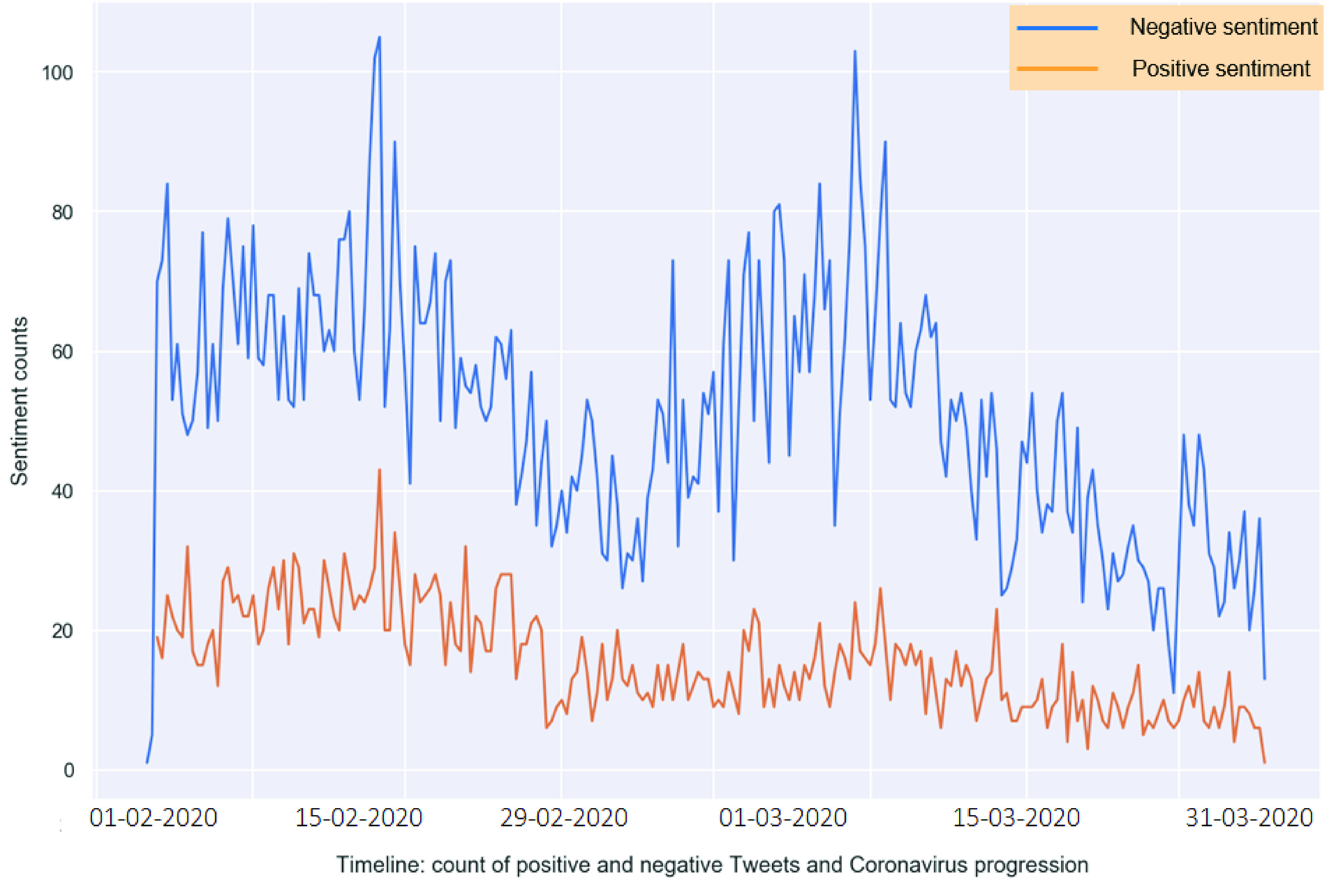
Social media (and the world at large) have been awash with news of the COVID-19 pandemic. With the passage of time, news and awareness about COVID-19 spread like the pandemic itself, with an explosion of messages, updates, videos, and posts. Mass hysteria manifest as another concern in addition to the health risk that COVID-19 presented. Predictably, public panic soon followed, mostly due to misconceptions, a lack of information, or sometimes outright misinformation about COVID-19 and its impacts. It is thus timely and important to conduct an assessment of the early information flows during the pandemic on social media, as well as a case study of evolving public opinion on social media which is of general interest. This study aims to inform policy that can be applied to social media platforms; for example, determining what degree of moderation is necessary to curtail misinformation on social media. This study also analyzes views concerning COVID-19 by focusing on people who interact and share social media on Twitter. As a platform for our experiments, we present a new large-scale sentiment data set COVIDSENTI, which consists of 90 000 COVID-19-related tweets collected in the early stages of the pandemic, from February to March 2020. The tweets have been labeled into positive, negative, and neutral sentiment classes. We analyzed the collected tweets for sentiment classification using different sets of features and classifiers. Negative opinion played an important role in conditioning public sentiment, for instance, we observed that people favored lockdown earlier in the pandemic; however, as expected, sentiment shifted by mid-March. Our study supports the view that there is a need to develop a proactive and agile public health presence to combat the spread of negative sentiment on social media following a pandemic.
社交媒体(乃至整个世界)充斥着新冠疫情的相关新闻。随着时间的推移,关于新冠疫情的新闻和认知如同疫情本身一样迅速传播,各种消息、更新、视频和帖子大量涌现。除了新冠疫情带来的健康风险外,群体癔症也成为了另一个令人担忧的问题。不出所料,公众恐慌很快随之而来,这主要是由于对新冠疫情及其影响存在误解、信息缺乏,有时甚至是完全错误的信息。因此,对疫情期间社交媒体上的早期信息流进行评估,以及对社交媒体上不断演变的公众舆论进行案例研究是及时且重要的,这也是大众普遍感兴趣的。本研究旨在为可应用于社交媒体平台的政策提供参考;例如,确定为减少社交媒体上的错误信息需要何种程度的审核。本研究还通过关注在推特上互动和分享社交媒体的人群,分析了关于新冠疫情的观点。作为我们实验的平台,我们展示了一个新的大规模情感数据集COVIDSENTI,它由2020年2月至3月疫情早期收集的9万条与新冠疫情相关的推文组成。这些推文已被标记为积极、消极和中性情感类别。我们使用不同的特征集和分类器对收集到的推文进行情感分类分析。负面观点在影响公众情绪方面发挥了重要作用,例如,我们观察到在疫情早期人们支持封锁措施;然而,正如预期的那样,到3月中旬情绪发生了转变。我们的研究支持这样一种观点,即需要建立一个积极主动且灵活的公共卫生形象,以应对疫情后社交媒体上负面情绪的传播。