• 文献检索
  • 文档翻译
  • 深度研究
  • 学术资讯
  • Suppr Zotero 插件Zotero 插件
  • 邀请有礼
  • 套餐&价格
  • 历史记录
应用&插件
Suppr Zotero 插件Zotero 插件浏览器插件Mac 客户端Windows 客户端微信小程序
定价
高级版会员购买积分包购买API积分包
服务
文献检索文档翻译深度研究API 文档MCP 服务
关于我们
关于 Suppr公司介绍联系我们用户协议隐私条款
关注我们

Suppr 超能文献

核心技术专利:CN118964589B侵权必究
粤ICP备2023148730 号-1Suppr @ 2026

文献检索

告别复杂PubMed语法,用中文像聊天一样搜索,搜遍4000万医学文献。AI智能推荐,让科研检索更轻松。

立即免费搜索

文件翻译

保留排版,准确专业,支持PDF/Word/PPT等文件格式,支持 12+语言互译。

免费翻译文档

深度研究

AI帮你快速写综述,25分钟生成高质量综述,智能提取关键信息,辅助科研写作。

立即免费体验

SperoPredictor:一种基于集成机器学习和分子对接的药物重定位框架,COVID-19 应用案例。

SperoPredictor: An Integrated Machine Learning and Molecular Docking-Based Drug Repurposing Framework With Use Case of COVID-19.

机构信息

Department of Mechatronics Engineering, Jeju National University, Jeju, South Korea.

BioSpero, Inc., Jeju, South Korea.

出版信息

Front Public Health. 2022 Jun 16;10:902123. doi: 10.3389/fpubh.2022.902123. eCollection 2022.

DOI:10.3389/fpubh.2022.902123
PMID:35784208
原文链接:https://pmc.ncbi.nlm.nih.gov/articles/PMC9244710/
Abstract

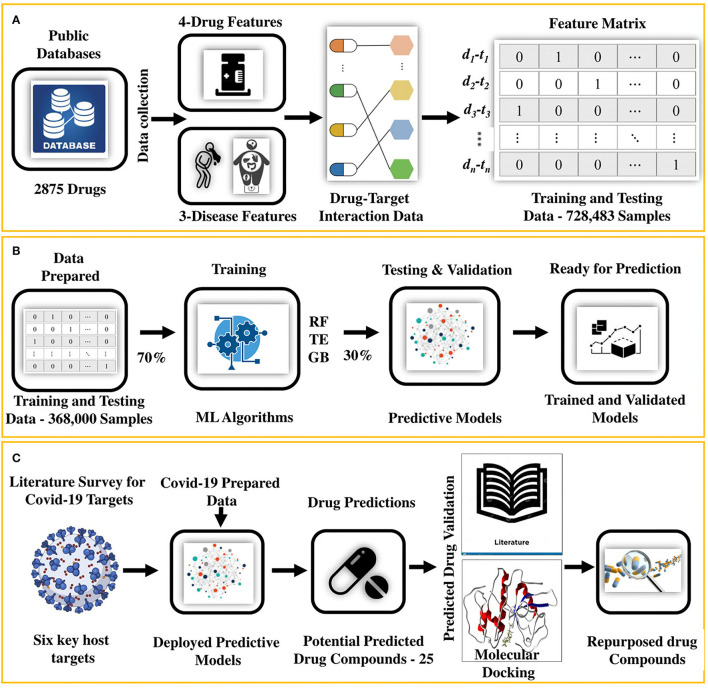
The global spread of the SARS coronavirus 2 (SARS-CoV-2), its manifestation in human hosts as a contagious disease, and its variants have induced a pandemic resulting in the deaths of over 6,000,000 people. Extensive efforts have been devoted to drug research to cure and refrain the spread of COVID-19, but only one drug has received FDA approval yet. Traditional drug discovery is inefficient, costly, and unable to react to pandemic threats. Drug repurposing represents an effective strategy for drug discovery and reduces the time and cost compared to drug discovery. In this study, a generic drug repurposing framework (SperoPredictor) has been developed which systematically integrates the various types of drugs and disease data and takes the advantage of machine learning (Random Forest, Tree Ensemble, and Gradient Boosted Trees) to repurpose potential drug candidates against any disease of interest. Drug and disease data for FDA-approved drugs ( = 2,865), containing four drug features and three disease features, were collected from chemical and biological databases and integrated with the form of drug-disease association tables. The resulting dataset was split into 70% for training, 15% for testing, and the remaining 15% for validation. The testing and validation accuracies of the models were 99.3% for Random Forest and 99.03% for Tree Ensemble. In practice, SperoPredictor identified 25 potential drug candidates against 6 human host-target proteomes identified from a systematic review of journals. Literature-based validation indicated 12 of 25 predicted drugs (48%) have been already used for COVID-19 followed by molecular docking and re-docking which indicated 4 of 13 drugs (30%) as potential candidates against COVID-19 to be pre-clinically and clinically validated. Finally, SperoPredictor results illustrated the ability of the platform to be rapidly deployed to repurpose the drugs as a rapid response to emergent situations (like COVID-19 and other pandemics).

摘要

SARS 冠状病毒 2(SARS-CoV-2)在全球范围内的传播、在人类宿主中的表现为传染病以及其变体引发了大流行,导致超过 600 万人死亡。人们投入了大量精力进行药物研究以治疗和阻止 COVID-19 的传播,但目前仅有一种药物获得了 FDA 的批准。传统的药物发现方法效率低下、成本高昂,且无法应对大流行的威胁。药物再利用代表了一种有效的药物发现策略,与药物发现相比,它可以减少时间和成本。在这项研究中,开发了一种通用的药物再利用框架(SperoPredictor),该框架系统地整合了各种类型的药物和疾病数据,并利用机器学习(随机森林、树集成和梯度提升树)来重新利用针对任何感兴趣疾病的潜在药物候选物。从化学和生物数据库中收集了 FDA 批准药物(=2865 种)的药物和疾病数据,这些药物包含四种药物特征和三种疾病特征,并将其整合为药物-疾病关联表的形式。将得到的数据集分为 70%用于训练、15%用于测试,其余 15%用于验证。随机森林模型的测试和验证准确率为 99.3%,树集成模型的测试和验证准确率为 99.03%。在实际应用中,SperoPredictor 从系统综述期刊中鉴定了 6 个人类宿主靶标蛋白质组,识别出 25 种针对这些蛋白质组的潜在药物候选物。基于文献的验证表明,25 种预测药物中有 12 种(48%)已用于 COVID-19,随后进行分子对接和重新对接,结果表明其中 13 种药物中的 4 种(30%)可能是针对 COVID-19 的候选药物,有待进行临床前和临床验证。最后,SperoPredictor 的结果表明,该平台能够迅速部署,重新利用药物,以快速应对紧急情况(如 COVID-19 和其他大流行)。
https://cdn.ncbi.nlm.nih.gov/pmc/blobs/ebe9/9244710/a92180bf622b/fpubh-10-902123-g0005.jpg
https://cdn.ncbi.nlm.nih.gov/pmc/blobs/ebe9/9244710/10ea0ac1c179/fpubh-10-902123-g0001.jpg
https://cdn.ncbi.nlm.nih.gov/pmc/blobs/ebe9/9244710/a99075e2f399/fpubh-10-902123-g0002.jpg
https://cdn.ncbi.nlm.nih.gov/pmc/blobs/ebe9/9244710/f8592957f30c/fpubh-10-902123-g0003.jpg
https://cdn.ncbi.nlm.nih.gov/pmc/blobs/ebe9/9244710/d6b9fe114b51/fpubh-10-902123-g0004.jpg
https://cdn.ncbi.nlm.nih.gov/pmc/blobs/ebe9/9244710/a92180bf622b/fpubh-10-902123-g0005.jpg
https://cdn.ncbi.nlm.nih.gov/pmc/blobs/ebe9/9244710/10ea0ac1c179/fpubh-10-902123-g0001.jpg
https://cdn.ncbi.nlm.nih.gov/pmc/blobs/ebe9/9244710/a99075e2f399/fpubh-10-902123-g0002.jpg
https://cdn.ncbi.nlm.nih.gov/pmc/blobs/ebe9/9244710/f8592957f30c/fpubh-10-902123-g0003.jpg
https://cdn.ncbi.nlm.nih.gov/pmc/blobs/ebe9/9244710/d6b9fe114b51/fpubh-10-902123-g0004.jpg
https://cdn.ncbi.nlm.nih.gov/pmc/blobs/ebe9/9244710/a92180bf622b/fpubh-10-902123-g0005.jpg

相似文献

1
SperoPredictor: An Integrated Machine Learning and Molecular Docking-Based Drug Repurposing Framework With Use Case of COVID-19.SperoPredictor:一种基于集成机器学习和分子对接的药物重定位框架,COVID-19 应用案例。
Front Public Health. 2022 Jun 16;10:902123. doi: 10.3389/fpubh.2022.902123. eCollection 2022.
2
Developing a SARS-CoV-2 main protease binding prediction random forest model for drug repurposing for COVID-19 treatment.开发一种用于 COVID-19 治疗药物再利用的 SARS-CoV-2 主蛋白酶结合预测随机森林模型。
Exp Biol Med (Maywood). 2023 Nov;248(21):1927-1936. doi: 10.1177/15353702231209413. Epub 2023 Nov 24.
3
Machine Learning Applications in Drug Repurposing.机器学习在药物再利用中的应用。
Interdiscip Sci. 2022 Mar;14(1):15-21. doi: 10.1007/s12539-021-00487-8. Epub 2022 Jan 23.
4
Repurposing potential of FDA-approved and investigational drugs for COVID-19 targeting SARS-CoV-2 spike and main protease and validation by machine learning algorithm.经 FDA 批准和正在研究的药物针对 SARS-CoV-2 刺突蛋白和主蛋白酶的再利用潜力,以及通过机器学习算法进行验证。
Chem Biol Drug Des. 2021 Apr;97(4):836-853. doi: 10.1111/cbdd.13812. Epub 2020 Dec 22.
5
MCCS: a novel recognition pattern-based method for fast track discovery of anti-SARS-CoV-2 drugs.MCCS:一种基于新型识别模式的快速发现抗 SARS-CoV-2 药物的方法。
Brief Bioinform. 2021 Mar 22;22(2):946-962. doi: 10.1093/bib/bbaa260.
6
Combined deep learning and molecular docking simulations approach identifies potentially effective FDA approved drugs for repurposing against SARS-CoV-2.联合深度学习和分子对接模拟方法鉴定出针对 SARS-CoV-2 可能具有治疗效果的已上市药物。
Comput Biol Med. 2022 Feb;141:105049. doi: 10.1016/j.compbiomed.2021.105049. Epub 2021 Nov 20.
7
Integrated docking and enhanced sampling-based selection of repurposing drugs for SARS-CoV-2 by targeting host dependent factors.通过靶向宿主依赖因素,对 SARS-CoV-2 进行基于综合对接和增强采样的再利用药物选择。
J Biomol Struct Dyn. 2022;40(20):9897-9908. doi: 10.1080/07391102.2021.1937319. Epub 2021 Jun 22.
8
Drug repurposing for COVID-19 using computational screening: Is Fostamatinib/R406 a potential candidate?使用计算筛选进行 COVID-19 的药物再利用:福他替尼/ R406 是一种潜在的候选药物吗?
Methods. 2022 Jul;203:564-574. doi: 10.1016/j.ymeth.2021.08.007. Epub 2021 Aug 27.
9
Repurposing therapeutics for COVID-19: Rapid prediction of commercially available drugs through machine learning and docking.新冠病毒治疗药物再利用:通过机器学习和对接快速预测市售药物。
PLoS One. 2020 Nov 12;15(11):e0241543. doi: 10.1371/journal.pone.0241543. eCollection 2020.
10
Computational repurposing approach for targeting the critical spike mutations in B.1.617.2 (delta), AY.1 (delta plus) and C.37 (lambda) SARS-CoV-2 variants using exhaustive structure-based virtual screening, molecular dynamic simulations and MM-PBSA methods.基于结构的虚拟筛选、分子动力学模拟和 MM-PBSA 方法对 B.1.617.2(德尔塔)、AY.1(德尔塔加)和 C.37(拉姆达)SARS-CoV-2 变异株关键刺突突变进行计算重利用的方法。
Comput Biol Med. 2022 Aug;147:105709. doi: 10.1016/j.compbiomed.2022.105709. Epub 2022 Jun 7.

引用本文的文献

1
Advancing genome-based precision medicine: a review on machine learning applications for rare genetic disorders.推进基于基因组的精准医学:关于机器学习在罕见遗传疾病中的应用综述
Brief Bioinform. 2025 Jul 2;26(4). doi: 10.1093/bib/bbaf329.
2
Revolutionizing Biomedical Research: Unveiling the Power of Microphysiological Systems with Advanced Assays, Integrated Sensor Technologies, and Real-Time Monitoring.变革生物医学研究:通过先进检测方法、集成传感器技术和实时监测揭示微生理系统的力量。
ACS Omega. 2025 Mar 10;10(10):9869-9889. doi: 10.1021/acsomega.4c11227. eCollection 2025 Mar 18.
3
Critical role of Oas1g and STAT1 pathways in neuroinflammation: insights for Alzheimer's disease therapeutics.

本文引用的文献

1
Fighting COVID-19 with Artificial Intelligence.运用人工智能抗击新冠疫情。
Methods Mol Biol. 2022;2390:103-112. doi: 10.1007/978-1-0716-1787-8_3.
2
Mental depression: Relation to different disease status, newer treatments and its association with COVID-19 pandemic (Review).精神抑郁:与不同疾病状况、新治疗方法的关系及其与 COVID-19 大流行的关联(综述)。
Mol Med Rep. 2021 Dec;24(6). doi: 10.3892/mmr.2021.12479. Epub 2021 Oct 11.
3
Efficient machine learning model for predicting drug-target interactions with case study for Covid-19.
Oas1g和STAT1通路在神经炎症中的关键作用:对阿尔茨海默病治疗的启示
J Transl Med. 2025 Feb 14;23(1):182. doi: 10.1186/s12967-025-06112-2.
4
A weighted Bayesian integration method for predicting drug combination using heterogeneous data.一种使用异质数据预测药物组合的加权贝叶斯集成方法。
J Transl Med. 2024 Sep 28;22(1):873. doi: 10.1186/s12967-024-05660-3.
5
Structural Characterization of Heat Shock Protein 90β and Molecular Interactions with Geldanamycin and Ritonavir: A Computational Study.热休克蛋白 90β 的结构特征及其与格尔德霉素和利托那韦的分子相互作用:一项计算研究。
Int J Mol Sci. 2024 Aug 12;25(16):8782. doi: 10.3390/ijms25168782.
6
Integrated ML-Based Strategy Identifies Drug Repurposing for Idiopathic Pulmonary Fibrosis.基于机器学习的综合策略识别特发性肺纤维化的药物再利用。
ACS Omega. 2024 Jun 27;9(27):29870-29883. doi: 10.1021/acsomega.4c03796. eCollection 2024 Jul 9.
7
Integrated edge information and pathway topology for drug-disease associations.用于药物-疾病关联的整合边缘信息和通路拓扑结构
iScience. 2024 May 18;27(7):110025. doi: 10.1016/j.isci.2024.110025. eCollection 2024 Jul 19.
8
Repurposing lipid-lowering drugs on asthma and lung function: evidence from a genetic association analysis.降脂药物在哮喘和肺功能方面的再利用:遗传关联分析的证据。
J Transl Med. 2024 Jul 3;22(1):615. doi: 10.1186/s12967-024-05359-5.
9
CT-based delta-radiomics nomogram to predict pathological complete response after neoadjuvant chemoradiotherapy in esophageal squamous cell carcinoma patients.基于 CT 的 delta 放射组学列线图预测食管鳞癌患者新辅助放化疗后病理完全缓解。
J Transl Med. 2024 Jun 18;22(1):579. doi: 10.1186/s12967-024-05392-4.
10
Accurate prediction of drug combination risk levels based on relational graph convolutional network and multi-head attention.基于关系图卷积网络和多头注意力的药物组合风险水平的准确预测。
J Transl Med. 2024 Jun 16;22(1):572. doi: 10.1186/s12967-024-05372-8.
用于预测药物-靶标相互作用的高效机器学习模型:以新冠病毒为例。
Comput Biol Chem. 2021 Aug;93:107536. doi: 10.1016/j.compbiolchem.2021.107536. Epub 2021 Jul 5.
4
The DisGeNET cytoscape app: Exploring and visualizing disease genomics data.DisGeNET Cytoscape应用程序:探索和可视化疾病基因组学数据。
Comput Struct Biotechnol J. 2021 May 11;19:2960-2967. doi: 10.1016/j.csbj.2021.05.015. eCollection 2021.
5
Epidemiology, prognosis and management of potassium disorders in Covid-19.新型冠状病毒肺炎患者钾紊乱的流行病学、预后及管理
Rev Med Virol. 2022 Jan;32(1):e2262. doi: 10.1002/rmv.2262. Epub 2021 Jun 2.
6
Prediction of repurposed drugs for Coronaviruses using artificial intelligence and machine learning.利用人工智能和机器学习预测冠状病毒的药物新用途
Comput Struct Biotechnol J. 2021;19:3133-3148. doi: 10.1016/j.csbj.2021.05.037. Epub 2021 May 24.
7
Repurposing Anti-Malaria Phytomedicine Artemisinin as a COVID-19 Drug.将抗疟疾植物药青蒿素重新用作治疗新冠肺炎的药物。
Front Pharmacol. 2021 Mar 19;12:649532. doi: 10.3389/fphar.2021.649532. eCollection 2021.
8
Cathepsin L plays a key role in SARS-CoV-2 infection in humans and humanized mice and is a promising target for new drug development.组织蛋白酶L在SARS-CoV-2感染人类和人源化小鼠过程中起关键作用,是新药研发的一个有前景的靶点。
Signal Transduct Target Ther. 2021 Mar 27;6(1):134. doi: 10.1038/s41392-021-00558-8.
9
Genomics-driven drug discovery based on disease-susceptibility genes.基于疾病易感性基因的基因组学驱动的药物发现。
Inflamm Regen. 2021 Mar 10;41(1):8. doi: 10.1186/s41232-021-00158-7.
10
Determination of Potential Drug Candidate Molecules of the for COVID-19 Treatment.用于治疗新冠肺炎的潜在候选药物分子的确定。
Curr Pharmacol Rep. 2021;7(2):42-48. doi: 10.1007/s40495-021-00254-9. Epub 2021 Mar 2.